
The dolphin
Why the dolphin?
The short answer
The dolphin stands for cooperation. In studies, bottlenose dolphin partners learned to coordinate a shared task within a fraction of a second, and in Shark Bay, Western Australia, male dolphins keep what researchers call "the largest nonhuman alliance network known."
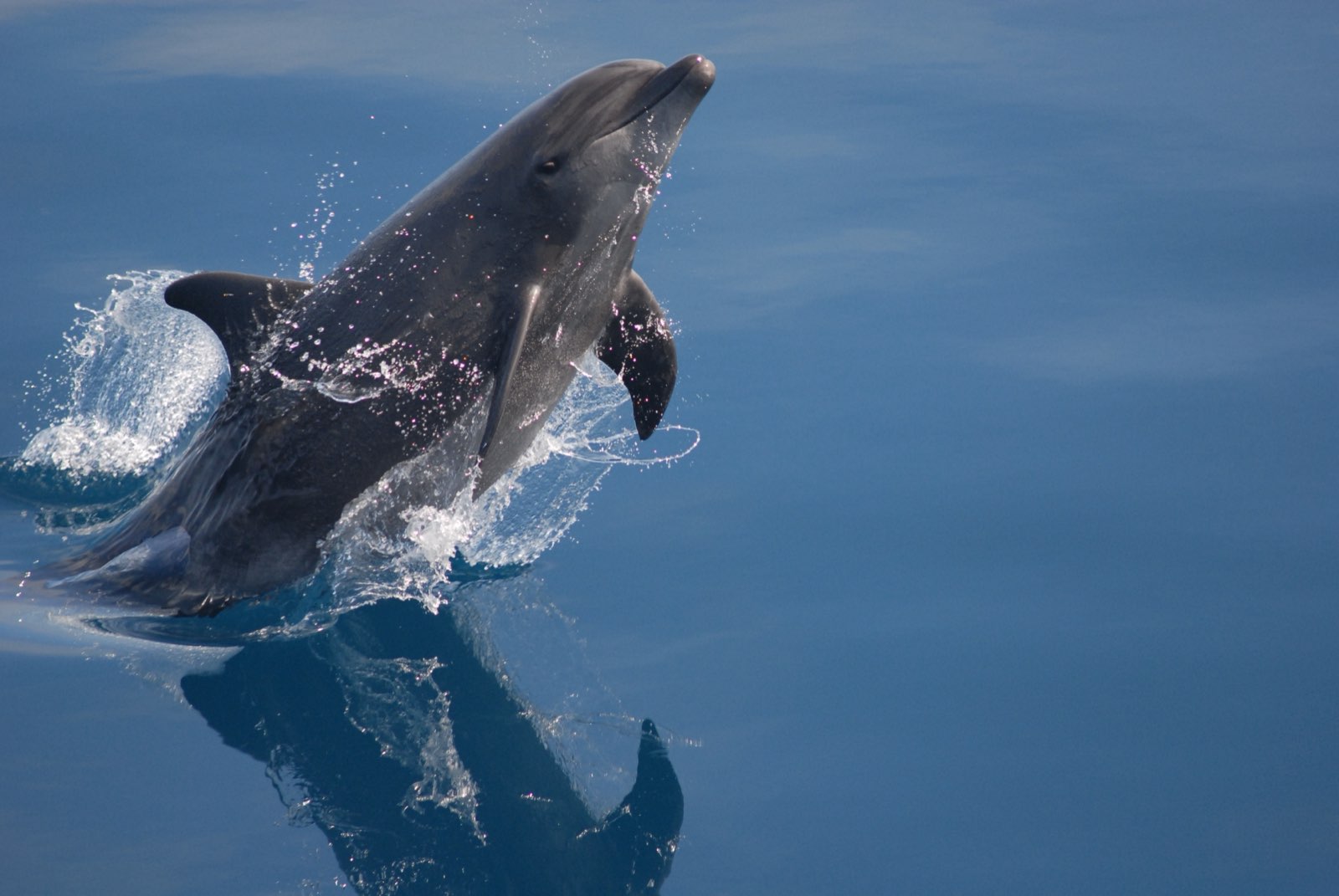
We chose the dolphin to stand for cooperation: two partners moving as one, in one direction. Red above, blue below, one animal.
This page shows what researchers have measured about dolphin cooperation, with the species, the setting and the number of animals named, and how to keep wild dolphins safe.
Setting and species
"Dolphin" covers dozens of species, and the studies below do not describe all of them. Almost everything on this page concerns two closely related animals that are both called bottlenose dolphins:
- Common bottlenose dolphin (Tursiops truncatus), the species in the two captive cooperation experiments, the Sarasota Bay study, and the Scottish and Virginia stranding studies pmc.ncbi.nlm.nih.govpmc.ncbi.nlm.nih.govpmc.ncbi.nlm.nih.govdigitalcommons.odu.edupmc.ncbi.nlm.nih.gov.
- Indo-Pacific bottlenose dolphin (Tursiops aduncus), the species in the long-running Shark Bay, Western Australia, studies of male alliances doi.orgpmc.ncbi.nlm.nih.gov.
The settings matter as much as the species. Two of the cooperation findings come from dolphins in human care, working on tasks that people designed. The alliance findings come from free-ranging dolphins in one bay. The injury and mortality findings come from animals found dead on particular coastlines and examined by pathologists. Each kind of evidence answers a different question, and none of them speaks for every dolphin everywhere.
The cooperation evidence
A button task in Florida. Kelly Jaakkola and colleagues worked with four common bottlenose dolphins, forming two pairs, at the Dolphin Research Center in Grassy Key, Florida, where the animals live in natural seawater lagoons pmc.ncbi.nlm.nih.gov. Each dolphin had to swim across the lagoon and press its own underwater button within one second of its partner. The researchers then released the partners at different times, with delays of up to 20 seconds, so that one dolphin had to arrive and wait. Over the course of the study, March 2017 to February 2018, the gap between the two presses shrank to an average of about 370 milliseconds in the final phase, and success rates in the randomized delay phase ran from 18 to 20 trials out of 20 for each dolphin pmc.ncbi.nlm.nih.gov. The authors concluded that "bottlenose dolphins can learn to understand their partner's role in a cooperative situation" pmc.ncbi.nlm.nih.gov.
A rope task in Japan. Chisato Yamamoto and colleagues adapted a rope pulling test, long used with primates, for three bottlenose dolphins at the Kagoshima City Aquarium: one juvenile male and two adult females, forming two pairs pmc.ncbi.nlm.nih.gov. Both ends of a rope had to be pulled at the same time to obtain a reward. When one dolphin was released first, by 3, 5 or 8 seconds, one pair still succeeded above chance at every delay; the other succeeded at 3 seconds but not at 8 pmc.ncbi.nlm.nih.gov. The first dolphin to arrive often waited longer when the delay was longer. The authors were careful about what this means: "it remains to be elucidated whether coordination in our dolphins represented intentional cooperation" pmc.ncbi.nlm.nih.gov.
In the wild, cooperation at scale. In Shark Bay, Western Australia, Richard Connor and colleagues analyzed association and consortship records collected from 2001 to 2006 on 121 adult male Indo-Pacific bottlenose dolphins doi.org. The males form alliances at three levels: pairs and trios, larger groups of 4 to 14 that compete with other groups, and alliances between those groups. The authors describe it as "the largest nonhuman alliance network known" doi.org. NOAA Fisheries also describes common bottlenose dolphins working together to herd schools of fish and taking turns feeding fisheries.noaa.gov.
That is the case for the symbol: in specific studies, dolphins coordinate their actions with partners, and in one wild population, males maintain cooperative relationships at a scale seen in few other animals.
Why a modern mark on an old name
The Democratic-Republican Party of the 1790s is a historical subject, and this site tells its story. The dolphin is not part of that history. It is a contemporary mark made for this party in 2026, and nothing on this site says the historical party used it, chose it, or would have recognized it.
We made the choice for one reason: cooperation across disagreement is a value worth stating plainly, and "Left. Right. Forward." is our language for it. Leave left and right at the door; move forward together.
The full evidence review, including the behavior of dolphins in competition and conflict, is in the Library.
Do not feed, touch, swim with, or harass wild dolphins
A dolphin on a website is not an invitation to approach a dolphin in the sea. In the United States, wild dolphins are protected under the Marine Mammal Protection Act.
- Do not feed or attempt to feed them. NOAA Fisheries states that feeding or attempting to feed wild dolphins is prohibited under the Marine Mammal Protection Act and its regulations, and that violations can be prosecuted civilly or criminally fisheries.noaa.govfisheries.noaa.gov.
- Do not swim with, ride, pet or touch them. NOAA's viewing guidelines say: "Do not swim with, ride, pet, touch, or attempt to interact with marine mammals or sea turtles in the wild" fisheries.noaa.gov.
- Keep your distance. NOAA advises staying at least 50 yards away, and notes that some locations require 100 yards fisheries.noaa.govfisheries.noaa.gov. Never put a boat between a mother and calf fisheries.noaa.gov.
- Do not harass them. NOAA describes harassment under the act at two levels: acts that have the potential to injure a marine mammal, and acts that have the potential to disturb its behavior, such as feeding or nursing fisheries.noaa.gov.
The reasons are documented. Dolphins that are fed lose their caution around people and boats, which raises their risk of propeller strikes and entanglement in fishing gear fisheries.noaa.govfisheries.noaa.gov. NOAA reports that young dolphins can fail to survive when their mothers stop teaching them to forage and compete with them for handouts fisheries.noaa.gov. In Sarasota Bay, a study drawing on more than 45 years of records and more than 1,100 individual dolphins found that dolphins conditioned to human interaction were more likely to be injured by it pmc.ncbi.nlm.nih.gov. And dolphins that expect food can bite fisheries.noaa.govfisheries.noaa.gov.
Evidence
How strong is each finding on this page? The answer depends on the kind of evidence.
| Finding | Species and setting | Kind of evidence | Sample |
|---|---|---|---|
| Partners coordinate button presses | Common bottlenose, captive, Florida | Experiment | 4 dolphins, 2 pairs pmc.ncbi.nlm.nih.gov |
| Partners coordinate rope pulling | Common bottlenose, captive, Japan | Experiment | 3 dolphins, 2 pairs pmc.ncbi.nlm.nih.gov |
| Three level male alliances | Indo-Pacific bottlenose, wild, Shark Bay | Long term observation | 121 adult males doi.org |
| Fed dolphins injured more often | Common bottlenose, wild, Sarasota Bay | Long term observation | More than 1,100 dolphins pmc.ncbi.nlm.nih.gov |
Sources
- Jaakkola K, Guarino E, Donegan K, King SL, "Bottlenose dolphins can understand their partner's role in a cooperative task," Proceedings of the Royal Society B 285(1887): 20180948, 2018. pmc.ncbi.nlm.nih.gov (locator: Methods a to e; Results; Table 3; Discussion). Accessed 2026-10-28. (full text reviewed)
- Yamamoto C, Kashiwagi N, Otsuka M, Sakai M, Tomonaga M, "Cooperation in bottlenose dolphins: bidirectional coordination in a rope-pulling task," PeerJ 7: e7826, 2019. pmc.ncbi.nlm.nih.gov (locator: Methods; Results; Conclusions). Accessed 2026-10-28. (full text reviewed)
- Connor RC, Krützen M, Allen SJ, Sherwin WB, King SL, "Strategic intergroup alliances increase access to a contested resource in male bottlenose dolphins," Proceedings of the National Academy of Sciences 119(36): e2121723119, 2022. doi.org (full text read at pmc.ncbi.nlm.nih.gov; locator: Abstract; Introduction; Materials and Methods; Results). Accessed 2026-10-28. (full text reviewed)
- King SL, Allen SJ, Krützen M, Connor RC, "Vocal behaviour of allied male dolphins during cooperative mate guarding," Animal Cognition 22: 991 to 1000, 2019. pmc.ncbi.nlm.nih.gov (locator: Abstract; Introduction; Methods, Behavioural data). Accessed 2026-10-28. (full text reviewed)
- Patterson IAP, Reid RJ, Wilson B, Grellier K, Ross HM, Thompson PM, "Evidence for infanticide in bottlenose dolphins: an explanation for violent interactions with harbour porpoises?" Proceedings of the Royal Society B 265(1402): 1167 to 1170, 1998. pmc.ncbi.nlm.nih.gov (locator: Abstract). Accessed 2026-10-28. (abstract only)
- Dunn DG, Barco SG, Pabst DA, McLellan WA, "Evidence for infanticide in bottlenose dolphins of the western North Atlantic," Journal of Wildlife Diseases 38(3): 505 to 510, 2002. digitalcommons.odu.edu (locator: Abstract). Accessed 2026-10-28. (abstract only)
- NOAA Fisheries, "Protect Wild Dolphins: Admire Them from a Distance," last updated October 3, 2023. fisheries.noaa.gov (locator: full page). Accessed 2026-10-28. (full text reviewed)
- NOAA Fisheries, "Frequent Questions: Feeding or Harassing Marine Mammals in the Wild," last updated January 20, 2026. fisheries.noaa.gov (locator: full page). Accessed 2026-10-28. (full text reviewed)
- Christiansen F, McHugh KA, Bejder L, Siegal EM, Lusseau D, McCabe EB, Lovewell G, Wells RS, "Food provisioning increases the risk of injury in a long-lived marine top predator," Royal Society Open Science 3(12): 160560, 2016. pmc.ncbi.nlm.nih.gov (locator: Abstract; Methods 2.1; Results). Accessed 2026-10-28. (full text reviewed)
- Gross S, Claus P, Wohlsein P, Kesselring T, Lakemeyer J, Reckendorf A, Roller M, Tiedemann R, Siebert U, "Indication of lethal interactions between a solitary bottlenose dolphin (Tursiops truncatus) and harbor porpoises (Phocoena phocoena) in the German Baltic Sea," BMC Zoology 5: 12, 2020. link.springer.com (locator: Abstract, Background, Results, Conclusion). Accessed 2026-10-28. (abstract only)
- NOAA Fisheries, "Common Bottlenose Dolphin," species page, last updated September 1, 2026. fisheries.noaa.gov (locator: diet, behavior and threats sections). Accessed 2026-10-28. (full text reviewed)
- NOAA Fisheries, "Marine Life Viewing Guidelines: Guidelines and Distances." fisheries.noaa.gov (locator: General Viewing Guidelines; dolphins and porpoises; watercraft). Accessed 2026-10-28. (full text reviewed)
Last checked against its sources on October 31, 2026. Report a correction.