
The flagship paper
The Donkey, the Elephant, and the Long Life of Political Symbols: A Visual History of American Party Identity
The short answer
Neither the Democratic donkey nor the Republican elephant was designed by a party: both grew out of nineteenth-century print culture, and Thomas Nast's Harper's Weekly cartoons of 1870 and 1874 fixed them in the public eye rather than inventing them from nothing. Before that, the record shows eagles, liberty caps, portraits, and fighting roosters, but no documented official emblem for the Jeffersonian Republicans, and no surviving 1828 image of Andrew Jackson as a donkey. The animals became quasi-official through cartoonists, ballots printed for voters who could not read, and later party branding, a history that includes Alabama's Democratic rooster carrying the words "White Supremacy" until 1966.
Historical setting
Every political symbol in this paper began as a printed object. That is the first fact to hold onto, because most popular accounts of the donkey and the elephant skip it. They tell a story about personalities: Andrew Jackson defiantly adopting the insult "jackass," Thomas Nast inventing two animals at his drawing table, the parties choosing mascots the way a school chooses a team name. The documents tell a slower and more interesting story. Symbols were made by engravers, lithographers, newspaper editors, cartoonists, ballot printers, and state election laws, each working for a different audience and each leaving a different kind of evidence.
The technologies matter. In the 1790s a political image usually meant a copperplate engraving or etching, expensive to produce and sold as a separate sheet. From the 1830s, lithography made single-sheet political cartoons cheaper and faster; publishers in New York such as Henry R. Robinson, James Baillie, and later Currier & Ives, sold them as separate sheets. After the Civil War, illustrated weeklies such as Harper's Weekly printed wood engravings to a national readership every seven days, which is why a single artist, Thomas Nast, could make an image familiar across the country within a few years. In the late nineteenth century the states took over the printing of ballots, and some of them printed party emblems at the top of each column so that voters who could not read could find their party. Finally, the twentieth century added party-owned logos and television graphics.
Each of those layers produced symbols with different meanings. A satirical print mocks; a campaign banner celebrates; a ballot emblem identifies; a logo brands. When people say "the Democrats chose the donkey," they collapse all of these into one decision that never happened. This paper separates them again.
The method is simple to state. Every image reproduced here is held by a public institution that states it has no known restrictions on publication, is dedicated to the public domain, or holds it in a collection the institution believes to be in the public domain. Every date and quotation is tied to a source a reader can open. Where a familiar story is unconfirmed, the paper explains what the surviving evidence does show. Modern party logos are trademarks and are described in words, not reproduced.
A note on names. This site uses "Democratic-Republican Party" for the coalition led by Thomas Jefferson and James Madison in the 1790s to 1820s. The U.S. Senate Historical Office notes that this opposition "became known as Democratic Republicans," while many members "preferred the one-word label, Republicans" senate.gov. The Senate's party key adds that "Republican" refers to two different parties "widely separated in time" senate.gov. That organization is not the Republican Party founded in the 1850s, and it is not the parent of either modern party in any simple sense. The symbols in this paper belong to the later parties; the early chapter explains what the earlier coalition used instead.
Before the animals: eagles, liberty caps, and a party without a logo
The visual vocabulary of the early republic was national, not partisan. Its central figures were the eagle, the figure of Liberty, the liberty cap on a pole, stars, and the portraits of leaders. These belonged to everyone, and rival factions fought over who served them best rather than drawing separate emblems.
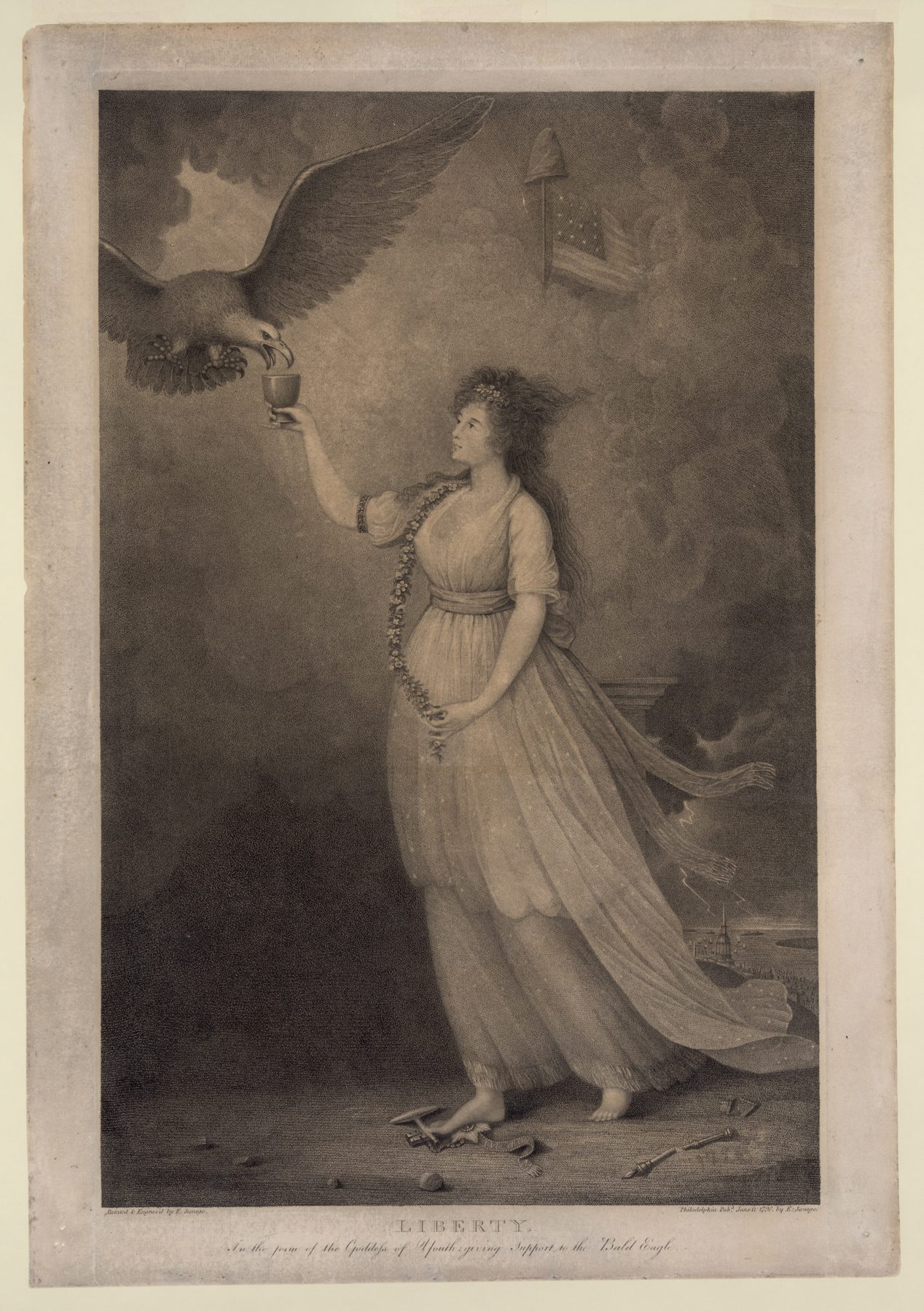 Liberty. In the form of the goddess of youth, giving support to the bald eagle. Edward Savage, painter and engraver, Philadelphia, published June 11, 1796. Library of Congress Prints and Photographs Division, LC-DIG-ppmsca-13641.
Edward Savage's 1796 print is a good place to begin, because it shows the shared language at full strength. The Library of Congress describes it as "an allegory of American liberty," in which Liberty, in the form of the goddess Hebe, offers a cup to a descending eagle while treading on chains, a scepter, a key, and "other implements of tyranny" loc.gov. Look closely at the upper right and you will also see a liberty cap raised on a pole beside the Stars and Stripes. Eagle, Liberty, cap, and flag: every element is patriotic, none is partisan. A Federalist and a Republican could both hang this on a wall and claim it.
That does not mean the 1790s were calm. They were among the most bitter decades in American politics, and some of the bitterness was drawn. An anonymous 1798 etching in Philadelphia, "Congressional Pugilists," shows Vermont Representative Matthew Lyon and Roger Griswold of Connecticut fighting on the floor of Congress Hall, Griswold "armed with a cane" and Lyon raising "a pair of fireplace tongs," according to the Library's catalog loc.gov. The Library's exhibition on the formation of parties identifies Lyon as a Jeffersonian Republican and Griswold as a Federalist loc.gov.
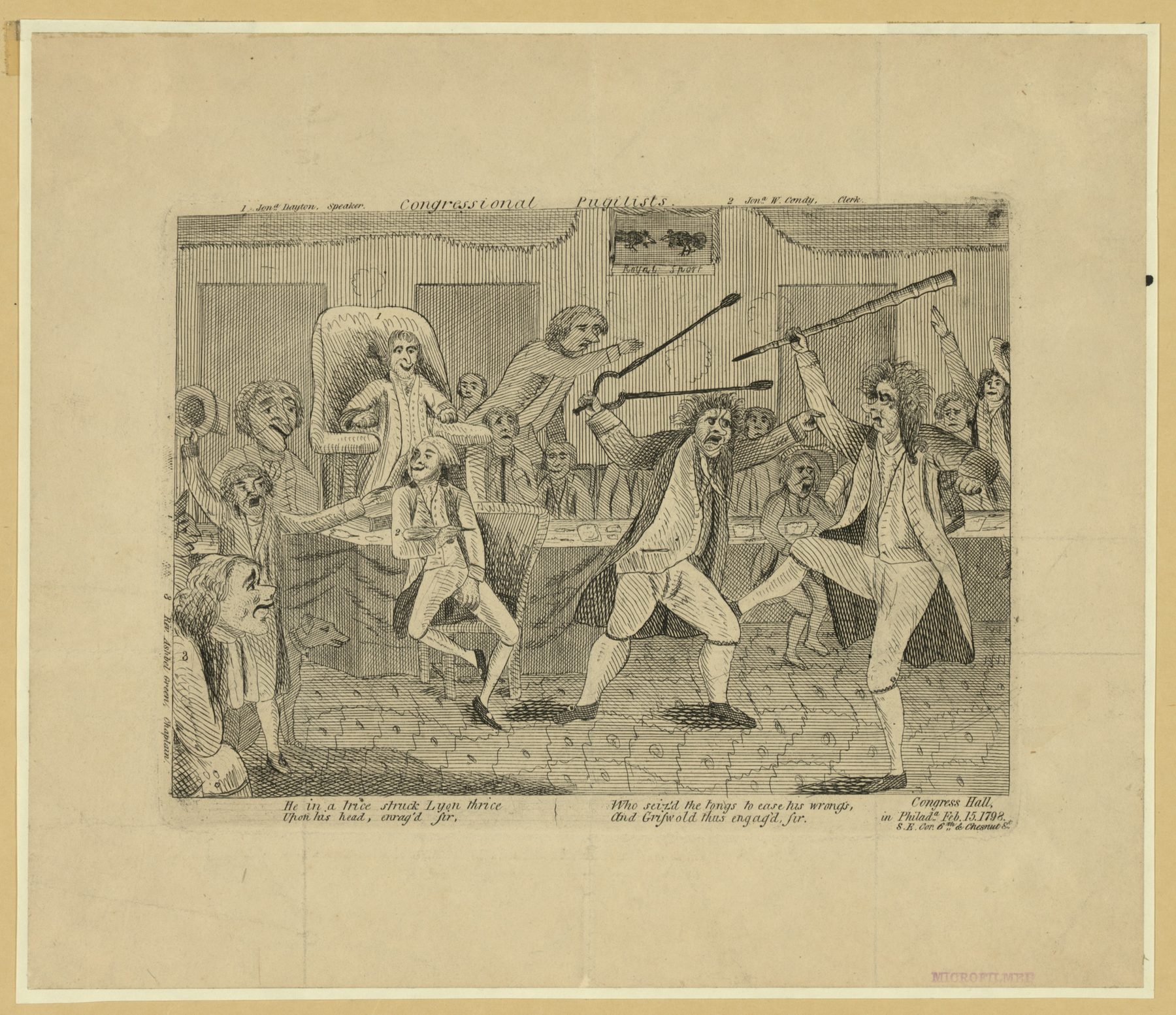 Congressional pugilists. Artist unknown, Philadelphia, 1798 (scene dated February 15, 1798). Library of Congress Prints and Photographs Division, LC-DIG-ppmsca-19356 (second state).
Notice what the print does not contain. Neither man wears a badge, carries a party flag, or stands beside an animal. Party identity is supplied by the viewer's knowledge of who these men were. That is typical of early partisan imagery, and it is the single most important thing to know about the symbols of the Jeffersonian coalition: in the sources checked for this paper, there is no documented official emblem of the Democratic-Republican Party. There was no national committee to adopt one and no ballot on which to print one. Coordination ran through letters, newspapers, congressional caucuses, and local clubs.
The clubs are a good example of how loose the structure was. The Democratic-Republican Societies that formed from 1793 were local associations, not branches of a national organization. When President Washington addressed Congress in November 1794 after the unrest in western Pennsylvania, he blamed what he called "self-created societies," and Mount Vernon's digital encyclopedia notes that the clubs declined rapidly by the end of the decade mountvernon.org. No common emblem for them is recorded in the sources checked.
What partisans did produce were objects of celebration built from the shared national vocabulary. The most remarkable survivor is a linen banner from the election of 1800 now at the Smithsonian's National Museum of American History.
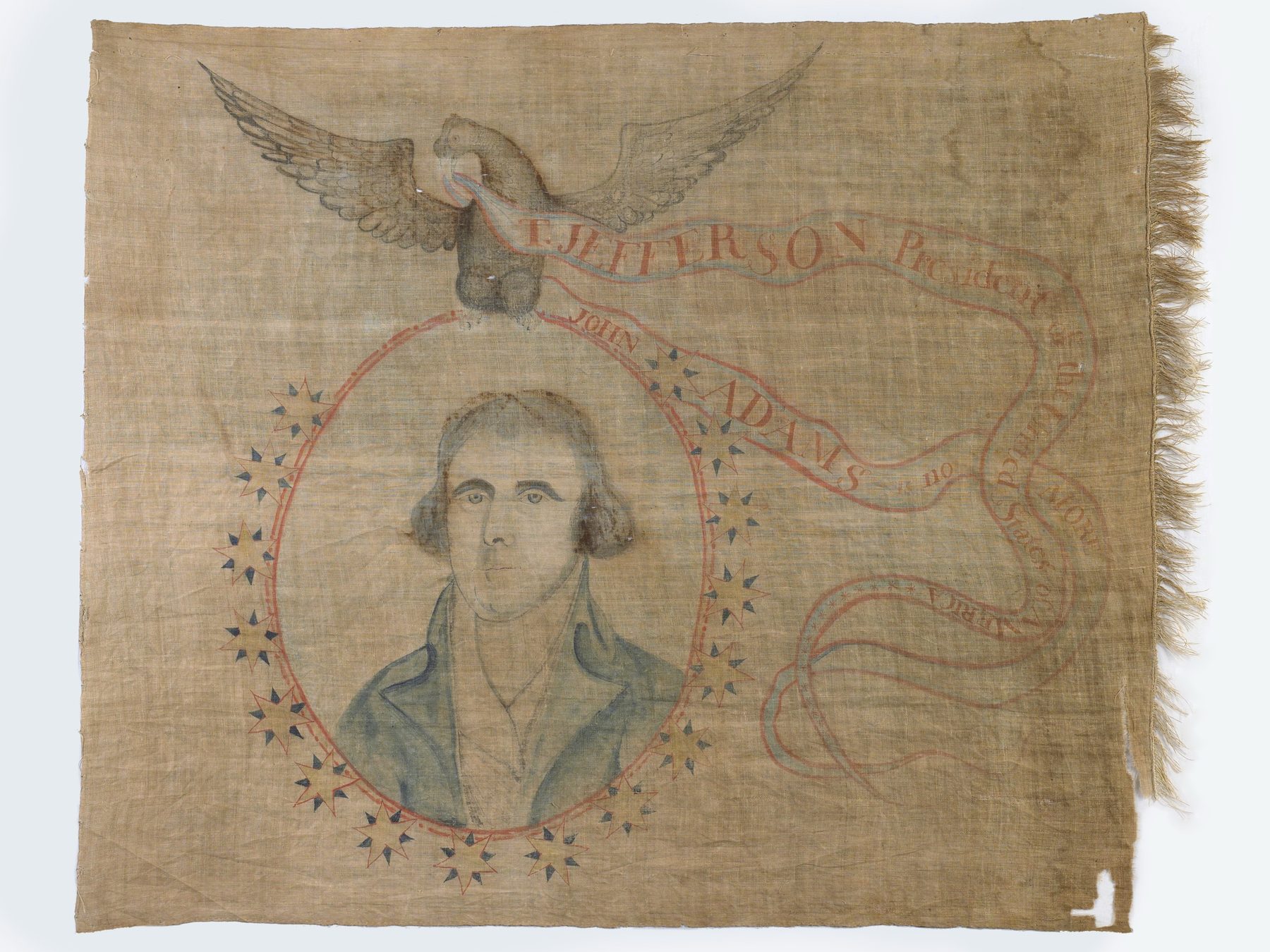 Jefferson Banner. Maker unknown, 1800. Linen, 30 by 37 inches. National Museum of American History, Smithsonian Institution, Political History Campaign Collection, ID PL.227739.1800.C01, gift of Ralph E. Becker. Smithsonian Open Access, CC0.
The museum describes it as "believed to be one of the earliest surviving textiles carrying partisan imagery," created "at the dawn of the first American party system." Its design is an eagle with a streamer in its beak that reads, in the museum's transcription, "T. Jefferson President of the United States of America / John Adams is no more" si.edu. The partisan message is entirely in the words and the portrait. The eagle is the same national eagle Savage drew four years earlier. In 1800, a party's symbol was its candidate's face and its claim on the nation's emblems.
This is worth stating plainly because the site you are reading uses the historical name. The Democratic-Republicans did not have a donkey, an elephant, or any equivalent mark that the record attests. Anyone who shows you an "official logo" of the Jeffersonian party is showing you a modern design.
Andrew Jackson and the trouble with the 1828 donkey
The most repeated sentence about the Democratic donkey goes something like this: in the 1828 campaign, Andrew Jackson's opponents called him a "jackass," and Jackson, enjoying the insult, put a donkey on his campaign posters. Versions of it appear on many reference and explainer sites; a 2016 History News Network explainer, for example, repeats that Jackson's opponents called him a jackass during the 1828 campaign and dates the donkey association from that moment historynewsnetwork.org.
The story may contain a real memory of name calling. The problem is the posters. In the course of this research no 1828 campaign item showing Jackson as, or with, a donkey was found in the Library of Congress or Smithsonian collections, and none of the explainers repeating the story cites one. That absence is not proof that no such item ever existed. It does mean the claim, as usually told, is a retelling without a documented object behind it.
What Jackson's 1828 campaign images do look like is well documented.
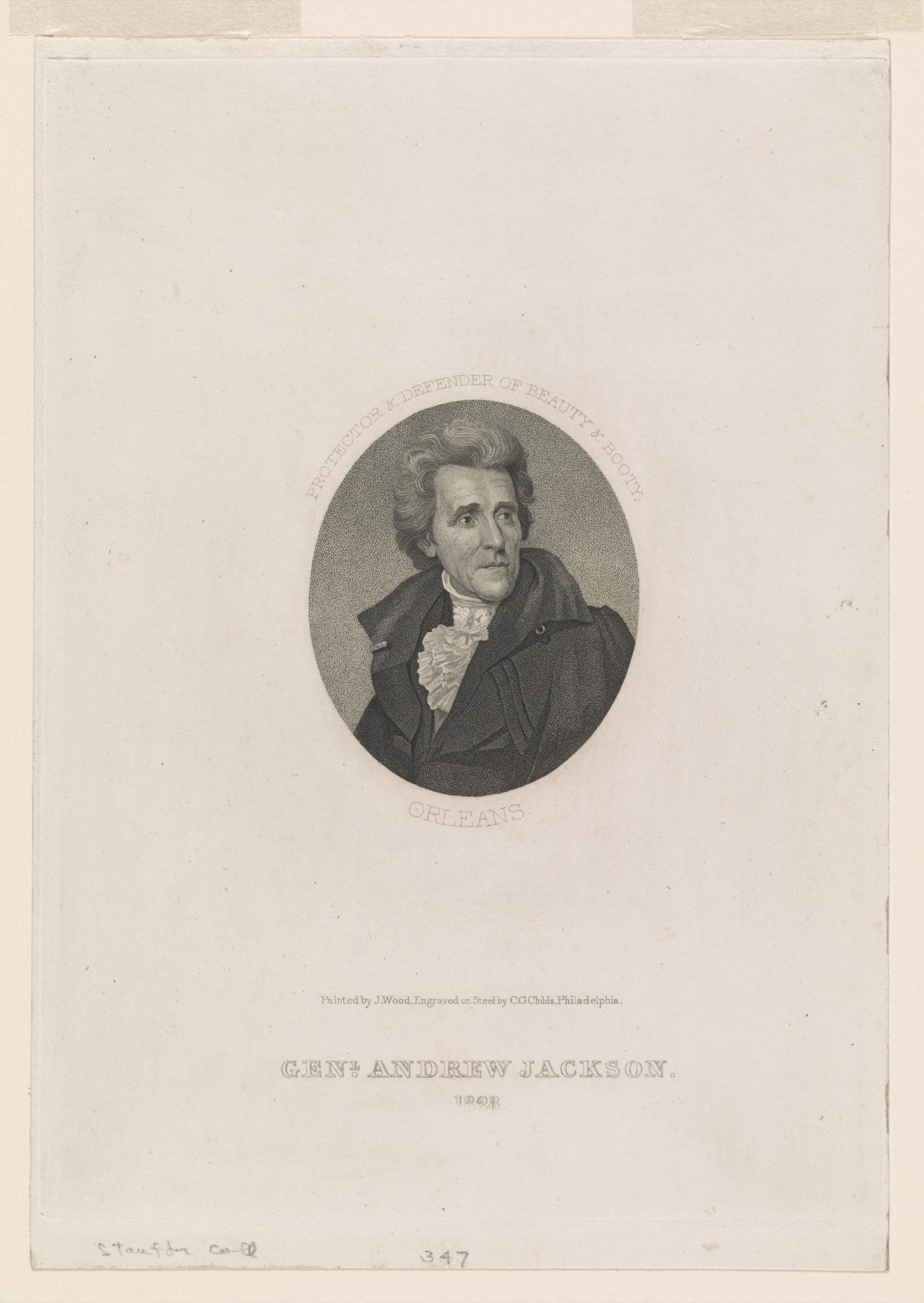 Genl. Andrew Jackson, 1828. Protector & defender of beauty & booty, Orleans. Engraved by Cephas G. Childs after a painting by Joseph Wood, Philadelphia, 1828. Library of Congress Prints and Photographs Division, LC-DIG-ds-00682.
The Library of Congress describes this as "a campaign portrait of Andrew Jackson issued during the presidential election of 1828," with lettering that refers to his War of 1812 victory at New Orleans loc.gov. It is a hero portrait in a military register. There is no animal in it.
The paper ephemera of the campaign point the same way. A small printed Ohio election ticket of 1828 in the Library's Printed Ephemera Collection, listing Jackson for president and John C. Calhoun for vice president, carries a woodcut of a broom and the words "To sweep the Augean Stable" loc.gov. Its picture is a promise to clean house, borrowed from classical myth. If Jackson's supporters had a favorite image in 1828, the surviving record suggests brooms and battle portraits, not donkeys.
The first securely dated image in this research that puts Jackson together with an ass comes nine years later, after his presidency, and it was made by an opponent.
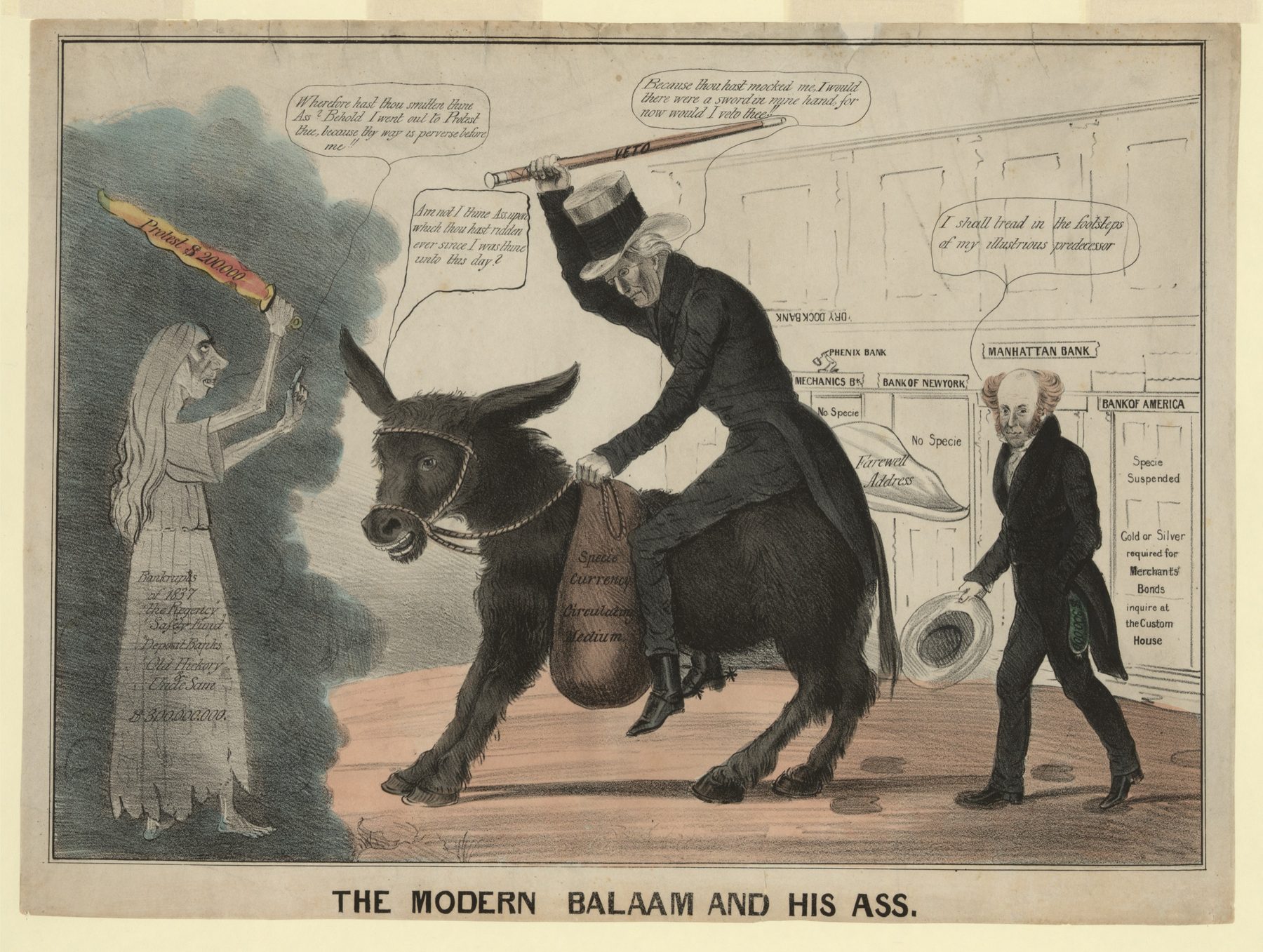 The modern Balaam and his ass. Henry R. Robinson, publisher, New York, 1837. Lithograph with watercolor. Library of Congress Prints and Photographs Division, LC-DIG-ppmsca-15775.
"The Modern Balaam and His Ass" borrows the biblical story in which the prophet Balaam beats his donkey for refusing to go forward, not knowing the animal sees an angel blocking the road. Here Jackson, riding the beast, raises a cane labeled "VETO." A pale apparition carries a flaming sword and bears inscriptions about the bankrupts of 1837. The animal carries a sack marked "Specie Currency, Circulating Medium," and Martin Van Buren follows on foot, saying in his speech balloon that he will "tread in the footsteps of my illustrious predecessor." In the background, bank buildings carry signs reading "No Specie" and "Specie Suspended." The Library dates the print to 1837 and attributes it to Henry R. Robinson loc.gov.
This print is often called the first donkey of the Democratic Party. Read it carefully and that claim weakens. The animal is not labeled. The cartoon's target is Jackson's financial policy and the Panic of 1837, and the biblical joke depends on the donkey being wiser than its rider. One can reasonably interpret the ass as the Democratic Party, or the public, or the economy, but the print does not say which. It is evidence that cartoonists found donkeys useful for mocking Jacksonians, not evidence that anyone treated the donkey as the party's emblem.
The same caution applies to the next important item, a woodcut from a New York humor magazine.
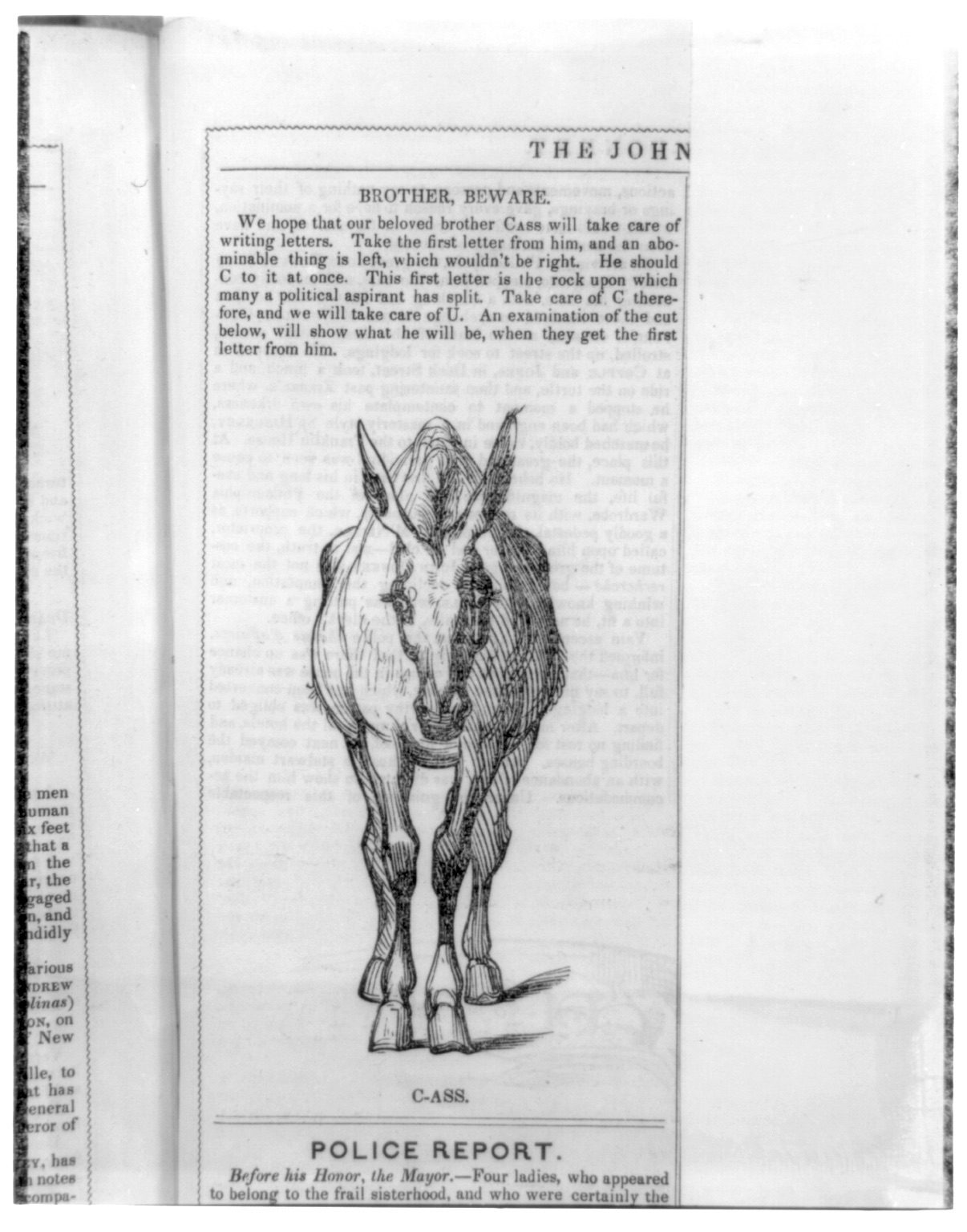 "Brother, Beware. C-Ass." Wood engraving in The John-Donkey, June 10, 1848. Artist unknown. Library of Congress Prints and Photographs Division, LC-USZ6-781.
In 1848 the Democratic presidential nominee was Lewis Cass. The Library catalogs this woodcut from The John-Donkey of June 10, 1848, as a "caricature of Lewis Cass as jackass" loc.gov. The joke is a pun: take the first letter from Cass and only "ass" remains, and the caption reads "C-ASS." Again, this is a donkey aimed at a Democrat, but its logic is the candidate's surname, not a party emblem.
So the documented story of the donkey before 1870 is this. Between the 1830s and the 1840s, opponents of the Jacksonian Democrats occasionally drew donkeys or asses to ridicule Democratic leaders. None of the items located for this paper labels the animal as the party, and none was produced by Democrats to represent themselves. The donkey had a reputation, not a role.
Roosters in the ring
If any animal had a claim to being the Democrats' own symbol in the middle of the nineteenth century, it was the rooster, and the rooster's story is better documented than the donkey's in its early decades.
The Indiana State Library traces one strand of it. In 1841 the brothers who ran the Indianapolis Democratic newspaper renamed it the Indiana State Sentinel, and the paper "displayed on the masthead the party mascot, a rooster, with the motto, 'Crow, Chapman, Crow!'" The library adds that the motto "reportedly originated in reference to Hancock County, Indiana politician Joseph Chapman, and not the Chapman brothers" library.in.gov. The word "reportedly" is the library's, and it should be kept. Later popular accounts tell a fuller story about an 1840 letter, a Whig opponent, and a joke turned into a slogan, but those details come from retellings decades later and are not confirmed here.
At the same time, the fighting cock was a general image of political combat, available to any party. A good corrective is that the two cockfight prints in the Library of Congress from the 1840s both feature Whigs as the winning rooster.
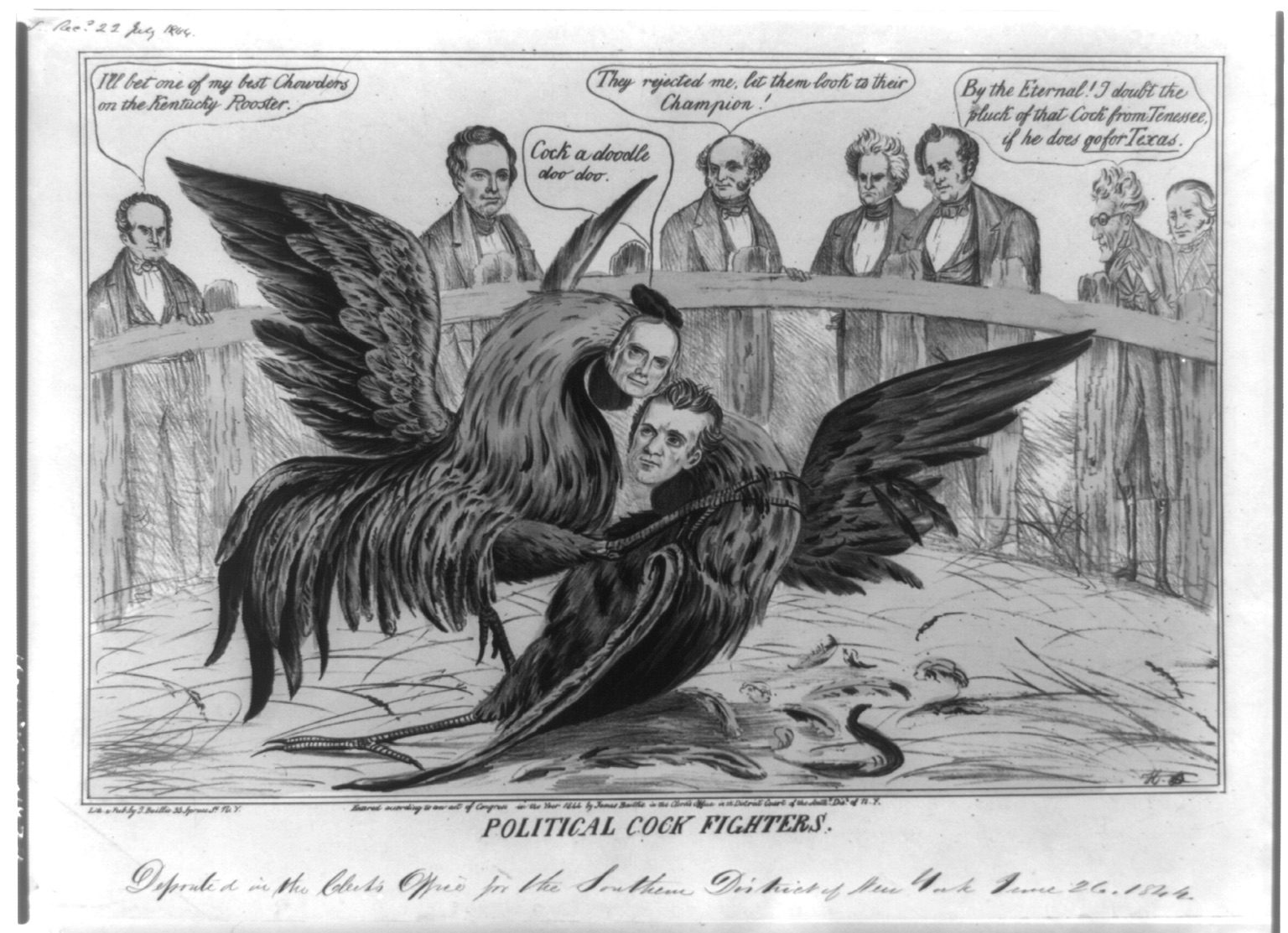 Political cock fighters. James S. Baillie, publisher, drawn by H. Bucholzer, New York, 1844. Lithograph with watercolor. Library of Congress Prints and Photographs Division, LC-USZ62-1972.
In James Baillie's "Political Cock Fighters" of 1844, the Library notes, "Whig candidate Henry Clay prevails" over Democrat James K. Polk, whose bird "is obviously waning, having lost many of its feathers" loc.gov. (Polk won the actual election.) In Abel and Durang's "Cock of the Walk" of 1848, Whig Zachary Taylor stands as the victorious cock over the Democrat Lewis Cass loc.gov. The rooster in these prints is the image of a contest, not a party's property.
By 1860 the association had shifted in a way the prints make visible. Currier & Ives' "The Great Match at Baltimore" shows the Democratic Party's internal fight as a cockfight: Stephen A. Douglas, the "Illinois Bantam," stands crowing on the body of the incumbent Democratic president James Buchanan, the "Old Cock" of the White House loc.gov.
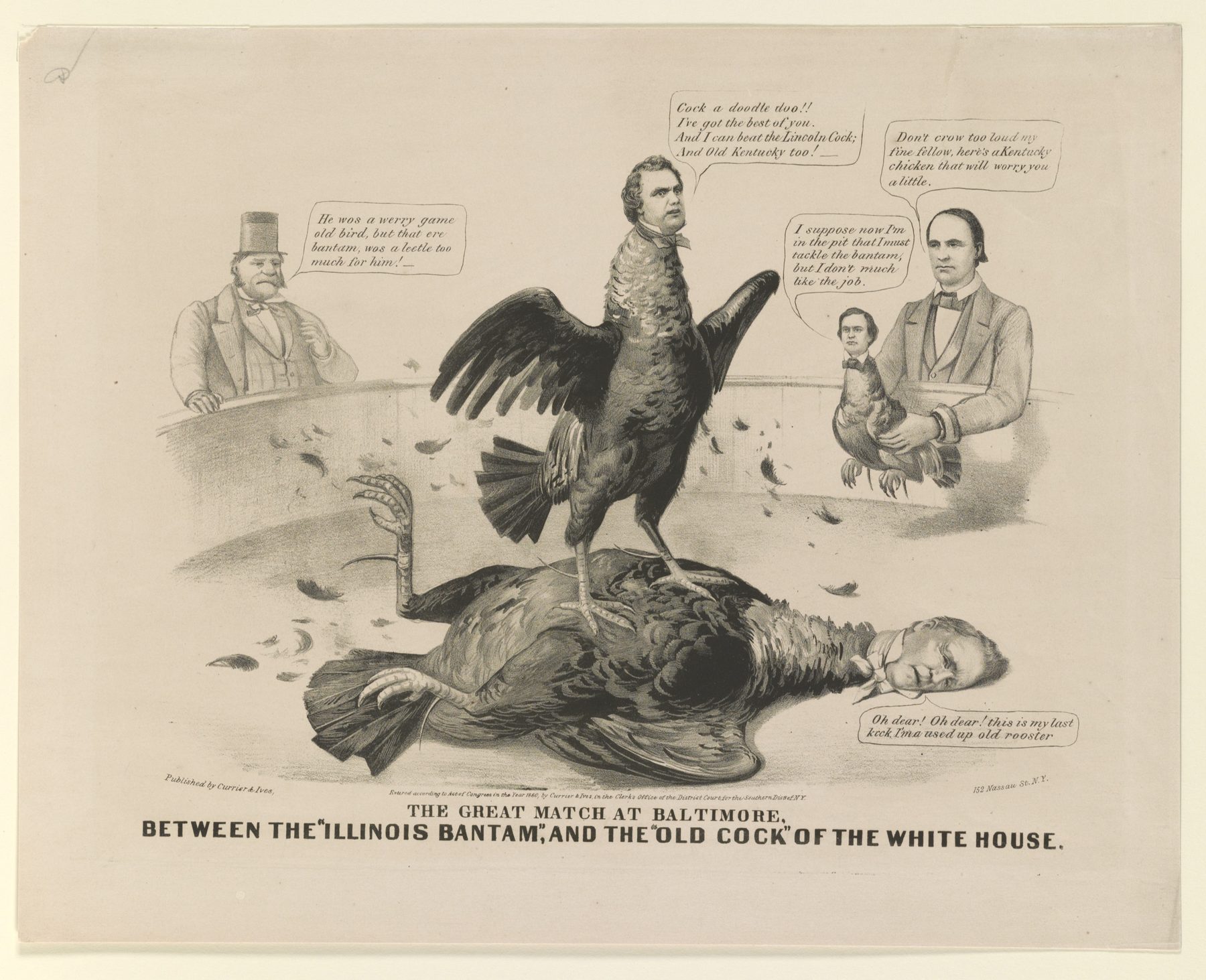 The great match at Baltimore, between the "Illinois Bantam" and the "Old Cock" of the White House. Currier & Ives, probably drawn by Louis Maurer, New York, 1860. Lithograph. Library of Congress Prints and Photographs Division, LC-DIG-pga-04863.
Both birds are Democrats. Douglas's speech balloon boasts that he can also beat "the Lincoln Cock," so the image does not reserve the rooster for one party. But here the fight between roosters has become a fight inside the Democratic Party, drawn for a public that would understand the metaphor. Half a century later, in Indiana, Ohio, Alabama, and elsewhere, the rooster would be printed on official ballots as the Democrats' device. That story belongs to a later chapter.
A new Republican Party without an elephant
The Republican Party of the 1850s took its name from the old Jeffersonian vocabulary, but it was a new organization. The National Park Service's landmark nomination for the schoolhouse in Ripon, Wisconsin, describes how protest meetings against the Kansas-Nebraska bill, drawing "disaffected Whigs, Democrats, and Free Soilers," coalesced into a national party "over the next 2 years." It states candidly that the first adoption of the name Republican "is a disputed issue," with Ripon and Jackson, Michigan, both claiming the honor npgallery.nps.gov. The chapter on names and symbols on this site follows that dispute in more detail.
Its first presidential campaign, in 1856, used exactly the kind of imagery the Jefferson banner used in 1800.
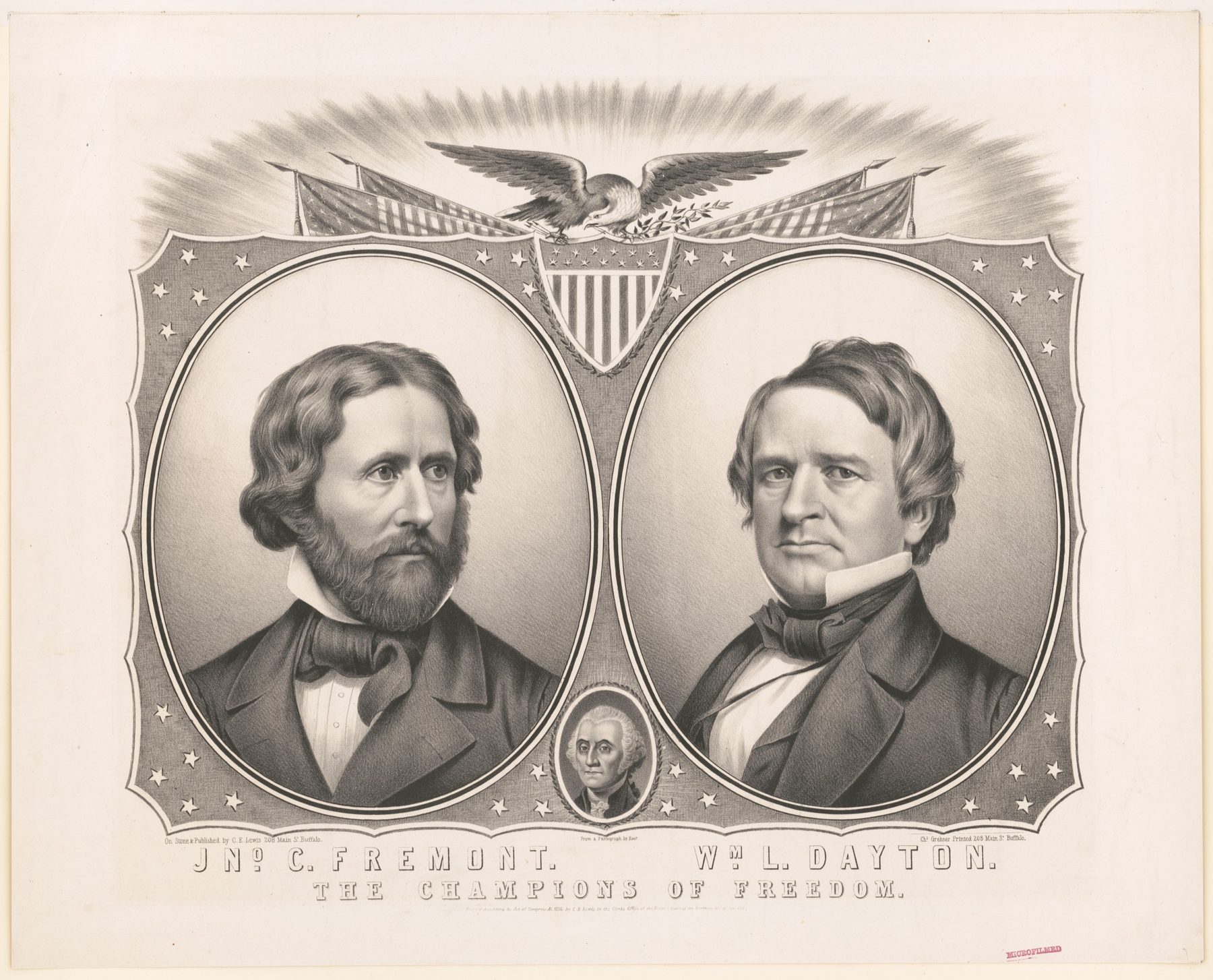 Jno C. Fremont [and] Wm. L. Dayton. The champions of freedom! C.E. Lewis, lithographer and publisher, Buffalo, about 1856, from a photograph by Marcus Root. Library of Congress Prints and Photographs Division, LC-DIG-pga-07356.
The Library describes this print as "a campaign banner for Republican candidates John C. Fremont and William L. Dayton," with portraits framed by stars and a shield and, above them, "an eagle clutching arrows and an olive branch, flanked by American flags" loc.gov. There is no elephant. As with the Democrats, the new party's first visual identity was a pair of faces wrapped in national symbols.
When did an elephant first appear in a Republican context? Several secondary accounts point to an illustration in a Lincoln campaign newspaper, Father Abraham, in 1864, showing an elephant celebrating Union victories; the History News Network explainer cited above repeats this historynewsnetwork.org. A claim that an elephant appeared in an 1860 pro-Lincoln paper also circulates, and is disputed. The date, the wording, and what the elephant represented remain open until the original 1864 page surfaces in an open archive. The same is true of the attractive idea that the elephant drew on the slang phrase "seeing the elephant," used for experiencing something overwhelming, including combat. It may be right. It is an explanation proposed by later writers, not something the cartoonists recorded.
Thomas Nast and the making of the modern pair
The animals that Americans recognize today were fixed in the public mind by one artist working for one magazine in the decade after the Civil War. Thomas Nast, a German-born illustrator, drew for Harper's Weekly, a New York illustrated weekly with a national readership. The Ohio State University's Billy Ireland Cartoon Library describes his role with care: Nast "popularized the elephant to symbolize the Republican Party and the donkey as the symbol for the Democratic Party" library.osu.edu. The library uses a stronger verb for a different animal: it says he "devised" the Tammany tiger. That distinction, popularized versus invented, is the heart of this chapter.
January 1870: the donkey kicks a dead lion
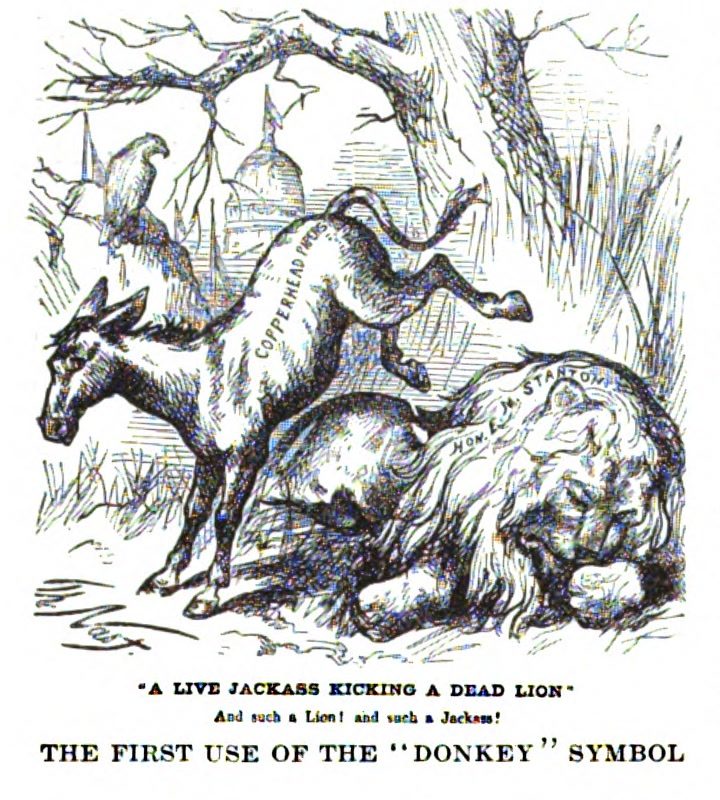 "A Live Jackass Kicking a Dead Lion." Thomas Nast, Harper's Weekly, January 15, 1870. Reproduced in Albert Bigelow Paine, Th. Nast, His Period and His Pictures (New York: Harper & Brothers, 1904), p. 146. HathiTrust Digital Library, hvd.32044011706926, page scan 176, Public Domain.
The first Nast donkey that matters was published in Harper's Weekly on January 15, 1870. Its caption reads "A Live Jackass Kicking a Dead Lion," with the line "And such a Lion! and such a Jackass!" beneath. The donkey is labeled "Copperhead Press," and the dead lion "Hon. E. M. Stanton," Lincoln's secretary of war. Nast's first biographer, Albert Bigelow Paine, writing in 1904, explains that the jackass was "the Copperhead Press," the lion "Edwin M. Stanton, who had died on December 24th and whose memory had been assailed, even as he lay in his coffin" hdl.handle.net. "Copperheads" was the hostile nickname for Northern Democrats who had opposed the war historynewsnetwork.org.
The image reproduced above is the one Paine printed in his book, captioned "The First Use of the 'Donkey' Symbol," and his text calls the cartoon "chiefly notable now as being the earliest in which the donkey is used to typify Democratic sentiment" hdl.handle.net. The original Harper's Weekly page was not available in an open, rights-cleared scan for this paper, which is why the book reproduction is used and labeled as such.
Paine's claim is the origin of much of what people repeat about this cartoon, and it deserves a historian's reading. It is a statement made in 1904, by an admirer, thirty-four years after the fact. The earlier prints in the previous chapter show that cartoonists had drawn asses to mock Jacksonian Democrats in 1837 and a Democratic nominee in 1848. What Paine can fairly claim is narrower: in Nast's work, this is the first donkey standing for a Democratic constituency, here a set of newspapers, rather than for one man. Notice too that even in 1870 the donkey does not stand for "the Democratic Party" as an organization. It stands for the Copperhead press.
November 1874: the elephant flees a donkey in a lion's skin
Four years later Nast drew the cartoon that is usually called the birth of the Republican elephant.
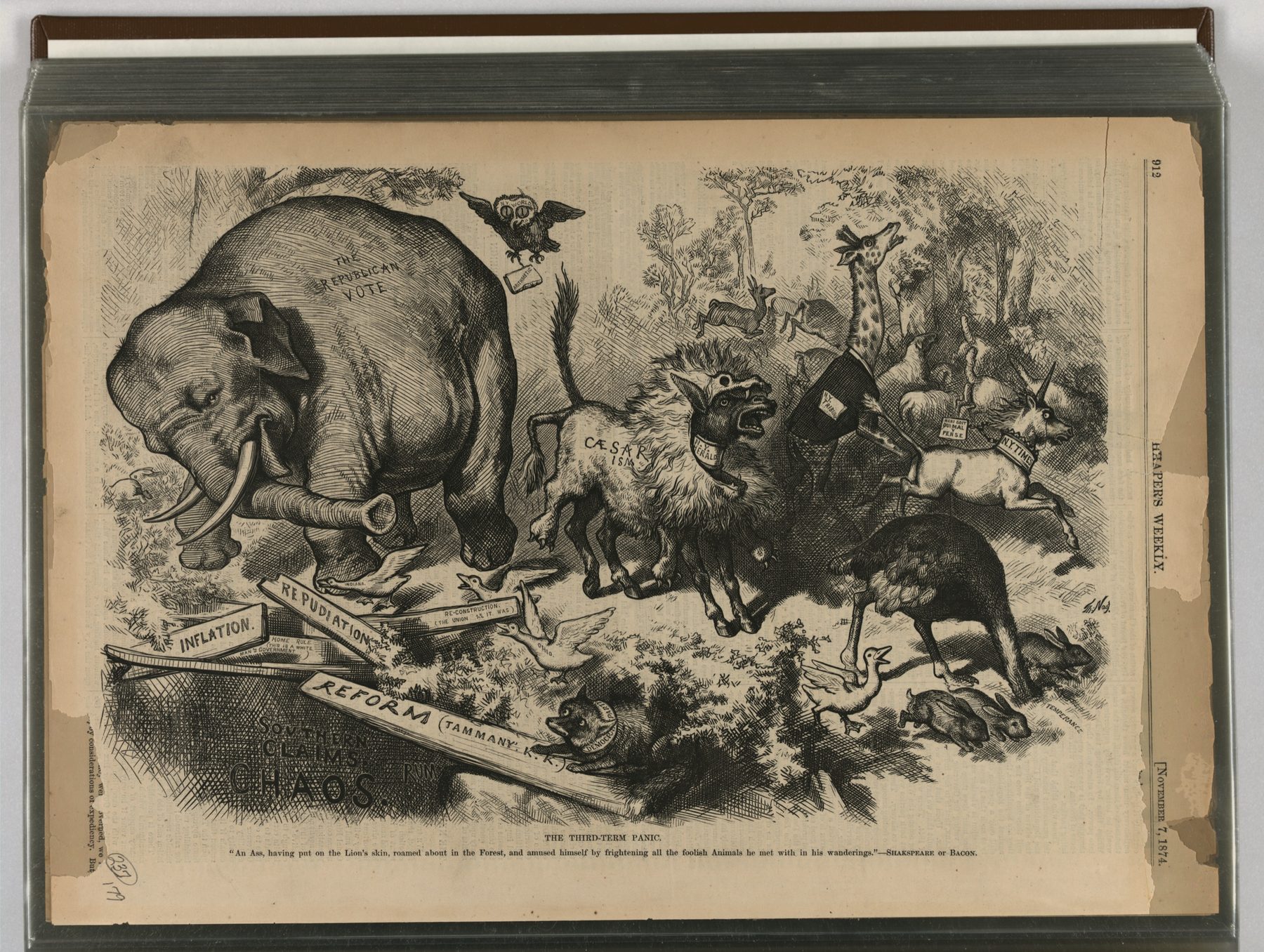 The Third-term Panic. Thomas Nast, Harper's Weekly, vol. 18, no. 932, November 7, 1874, p. 912. Wood engraving. Library of Congress Prints and Photographs Division, LC-DIG-ppmsca-15785.
"The Third-Term Panic" appeared in Harper's Weekly dated November 7, 1874, on page 912 loc.gov. Its target was the New York Herald, which had been warning of "Caesarism," the idea that President Ulysses S. Grant would seek a third term. The Library of Congress describes the scene: a braying ass "in a lion's coat and 'N.Y. Herald' collar" frightens the animals of the forest; a giraffe represents the New York Tribune, a unicorn the New York Times, and an owl the New York World. An elephant labeled "The Republican Party" by the Library's cataloger, and "The Republican Vote" on the print itself, stands near broken planks over a pit, and a fox represents the Democratic Party loc.gov.
Three details in this cartoon overturn the usual summary.
First, the donkey here is not the Democratic Party. It is the New York Herald. The Democrats are a fox. Paine noticed this in 1904: "The Democratic party, hitherto represented by the Donkey, which eventually became its fixed symbol, is here impersonated by a fox" hdl.handle.net.
Second, the elephant is not "the Republican Party" but "The Republican Vote," the mass of Republican voters, large and easily frightened. Paine wrote that Nast introduced the symbol "under the name of 'The Republican Vote'" hdl.handle.net. The Republican National Committee's own 1956 history makes the same point: the elephant "was labeled the Republican vote," which the booklet stresses meant "not the Party, but the vote" hdl.handle.net. In other words, the first Republican elephant was not flattering. It was a strong animal about to be stampeded into a trap.
Third, the timing is not what the most popular version says. That version holds that Nast combined the Herald's Caesarism campaign with another Herald stunt, a fake report that the animals of the Central Park menagerie had escaped. The RNC's 1956 history tells it this way and dates the menagerie hoax to "one summer morning" hdl.handle.net. But the Herald's hoax, headlined "The Wild Animals Broken Loose" and "A Shocking Sabbath Carnival of Death," was published on November 9, 1874 loc.gov, two days after the date printed on Nast's cartoon. Paine adds that weekly papers of the period "were dated considerably in advance of publication" hdl.handle.net, which would put the cartoon on newsstands even earlier. The menagerie hoax cannot have inspired a cartoon that preceded it. The connection is a later retelling, and a good example of how a neat origin story can quietly reverse the order of events.
Two weeks later, after the 1874 elections had gone against the Republicans, Nast returned to the image hdl.handle.net.
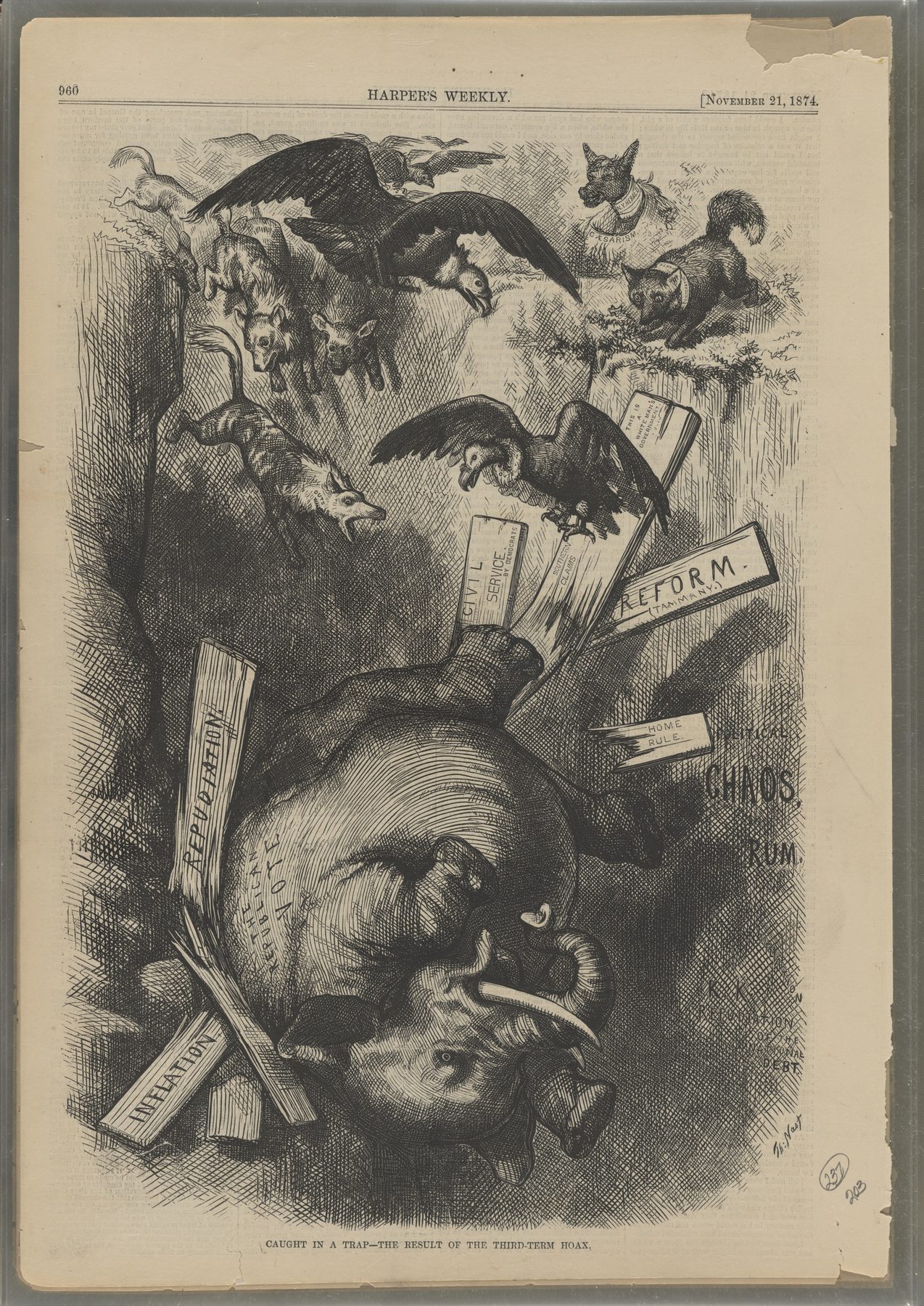 Caught in a trap: the result of the third term hoax. Thomas Nast, Harper's Weekly, November 21, 1874, p. 960. Wood engraving. Library of Congress Prints and Photographs Division, LC-DIG-ds-14908.
In "Caught in a Trap," dated November 21, 1874, the elephant "representing the Republican vote" breaks through the planks and falls headlong into the pit, followed by wolves wearing collars labeled "N.Y. Herald" and "Democratic Party" loc.gov. The Republican elephant's first two appearances, then, are a scare and a fall. Nast was criticizing his own side's voters for being panicked by a newspaper, and recording the price of it. A year later the mood had changed: after the New York elections of November 1875, Nast drew a trumpeting elephant standing on the crushed remnants of "Reformed Tammany Hall," a scene the Library of Congress catalogs as relating to the Republican defeat of Tammany Hall candidates loc.gov. Within twelve months the frightened herd had become a victor.
1879: the pair, finally together
By the end of the decade Nast was using both animals as party symbols in the same frame.
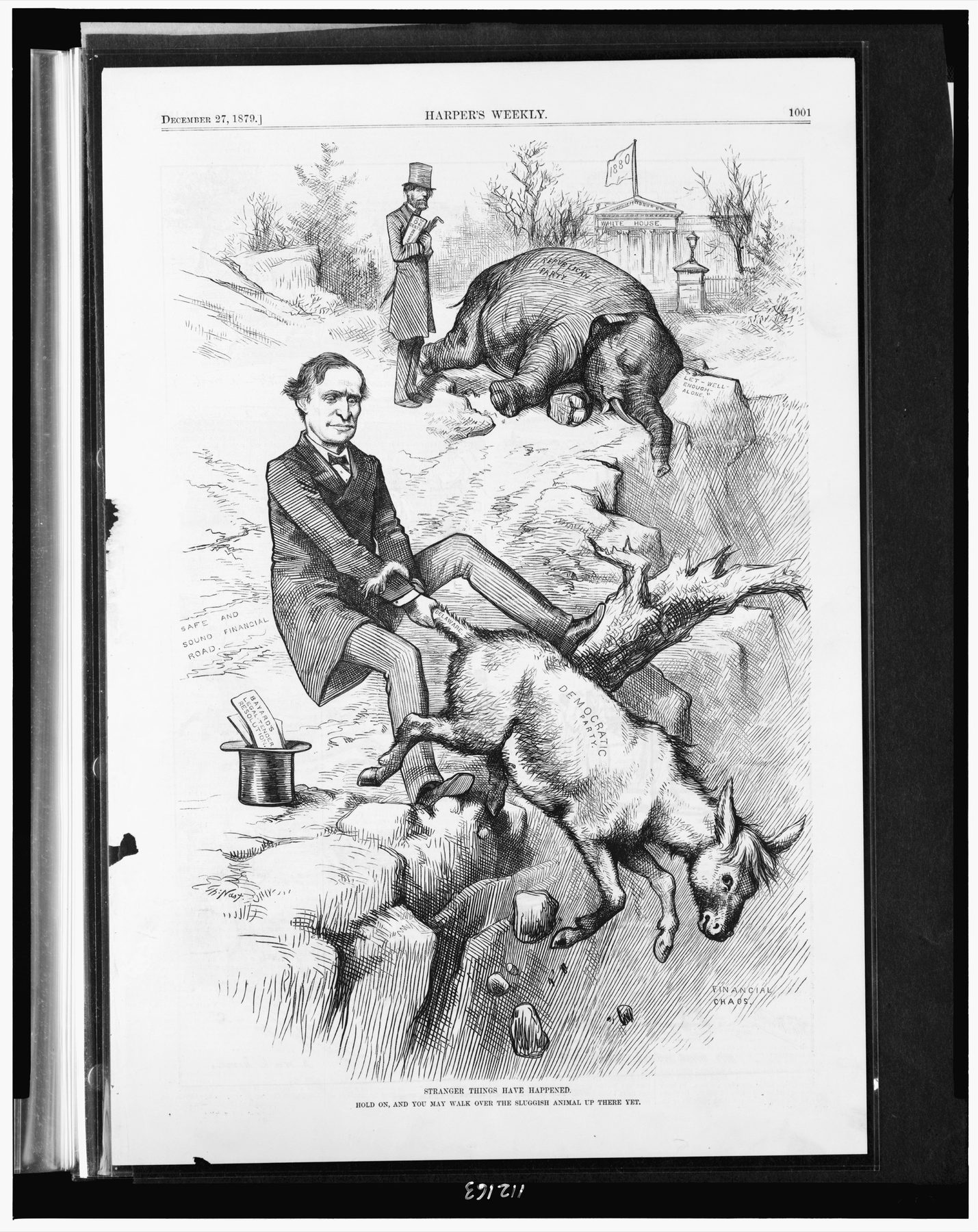 Stranger things have happened. Hold on, and you may walk over the sluggish animal up there yet. Thomas Nast, Harper's Weekly, December 27, 1879, p. 1001. Wood engraving. Library of Congress Prints and Photographs Division, LC-USZ62-112163.
The Library's description of "Stranger Things Have Happened," from Harper's Weekly of December 27, 1879, is plain: Thomas F. Bayard holds on to the tail of the "Democratic donkey, which is going over cliff," while a man stands by the "Republican elephant, which is lying on ground," with the White House flying an "1880" flag behind loc.gov. Here, at last, are the two animals as Americans know them: one for each party, sharing a scene, in a cartoon about the next presidential race.
Popularized, not invented
So who made the donkey and the elephant? The honest answer has three parts.
Nast did not invent the donkey's association with the Democrats; earlier cartoonists had drawn asses to mock Jacksonians and a Democratic nominee. He did not invent the elephant in politics; a Republican-context elephant is reported from 1864, though the original page is still being sought. What Nast did was use both animals often enough, in a magazine read widely enough, that other cartoonists adopted them as shorthand.
The retrospective claims grew stronger with time. Paine wrote in 1904 that the elephant "was originated by Nast" hdl.handle.net. The RNC's 1956 history said Nast "originated the elephant as the symbol of the Republican Party" hdl.handle.net. A 1940 newspaper cartoon by Karl Kae Knecht in the Evansville Courier, cataloged by the Library of Congress under the title "Our ever constant 'Elephant' and 'Donkey' emblems," carries a note crediting the animals as first used by Thomas Nast, with the years 1874 and 1870 loc.gov. By the middle of the twentieth century the origin story had hardened into a caption. The more cautious formulation, that Nast popularized both animals, is the one the documents support.
One more fact belongs here, because it is part of the honest record of the man who fixed these symbols. Nast's pictorial language could be cruel toward groups as well as politicians. His "The American River Ganges," published in Harper's Weekly on September 30, 1871, which the Library describes as an indictment of sectarianism in the public schools and of Tammany's sacrifice of children's education for Catholic votes, drew Catholic bishops as crocodiles advancing on schoolchildren loc.gov. The same visual habits that made his animals memorable made his prejudices memorable too. The symbols outlived their maker; their meanings were not fixed by his intentions alone.
From cartoon shorthand to national emblem
After Nast, other cartoonists took up the animals and gave them new jobs. The color weeklies of the 1890s and 1900s were especially fond of the elephant as a large, slow, burdened creature.
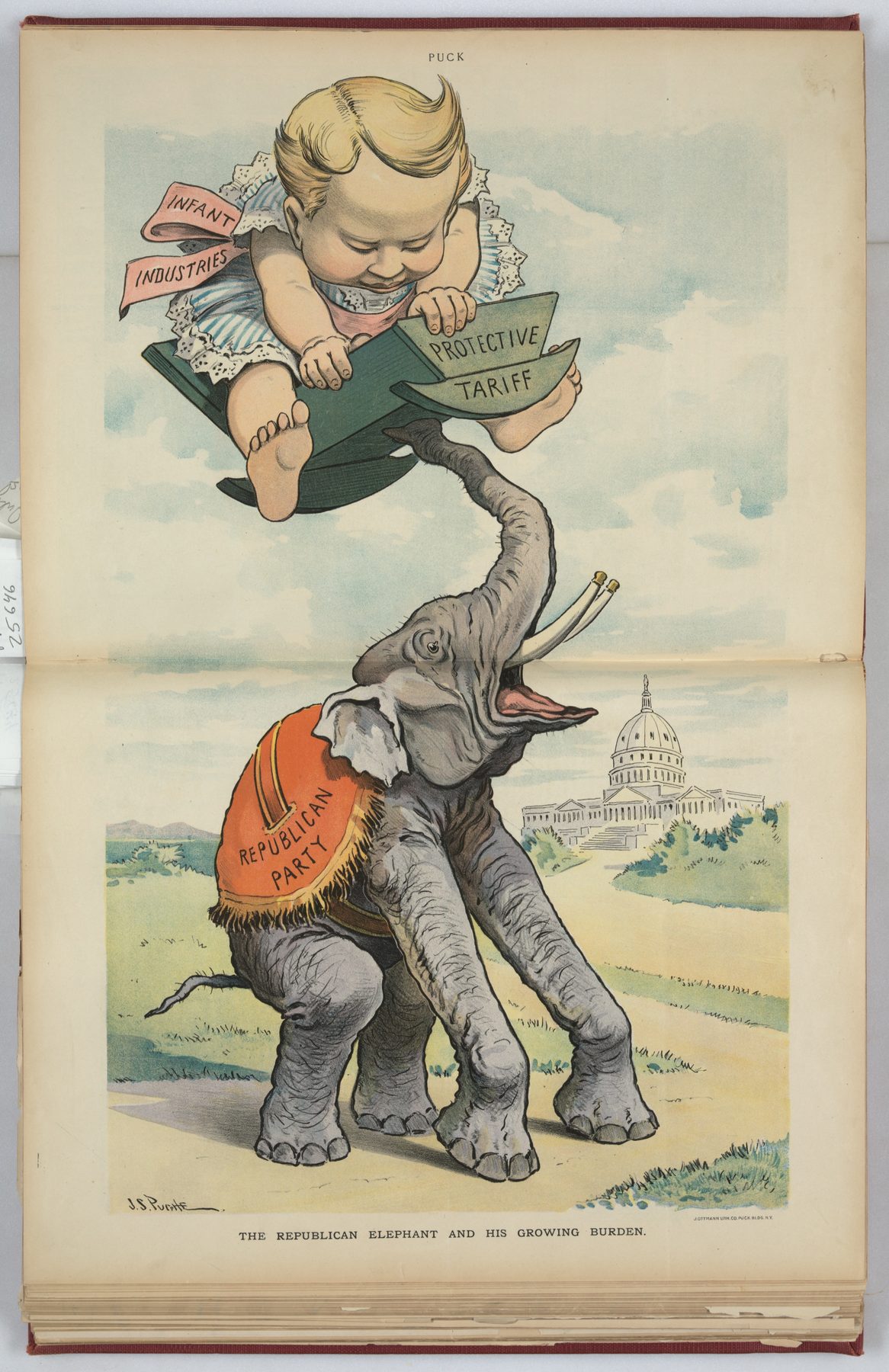 The Republican elephant and his growing burden. J.S. Pughe, Puck, vol. 51, no. 1320, June 18, 1902, centerfold. Chromolithograph. Library of Congress Prints and Photographs Division, LC-DIG-ppmsca-25645.
In J.S. Pughe's 1902 centerfold for Puck, the elephant supports, overhead, "an infant labeled 'Infant Industries' in a cradle labeled 'Protective Tariff'" loc.gov. The animal now carries a policy argument, the tariff, and the cartoon's whole point depends on the reader already knowing that the elephant means Republicans. Thirty years after Nast, the symbol no longer needed a label.
The animals also gave cartoonists a ready way to draw third parties as different creatures. The best known is the bull moose of 1912, when Theodore Roosevelt ran as the Progressive Party candidate against the Republican William Howard Taft and the Democrat Woodrow Wilson.
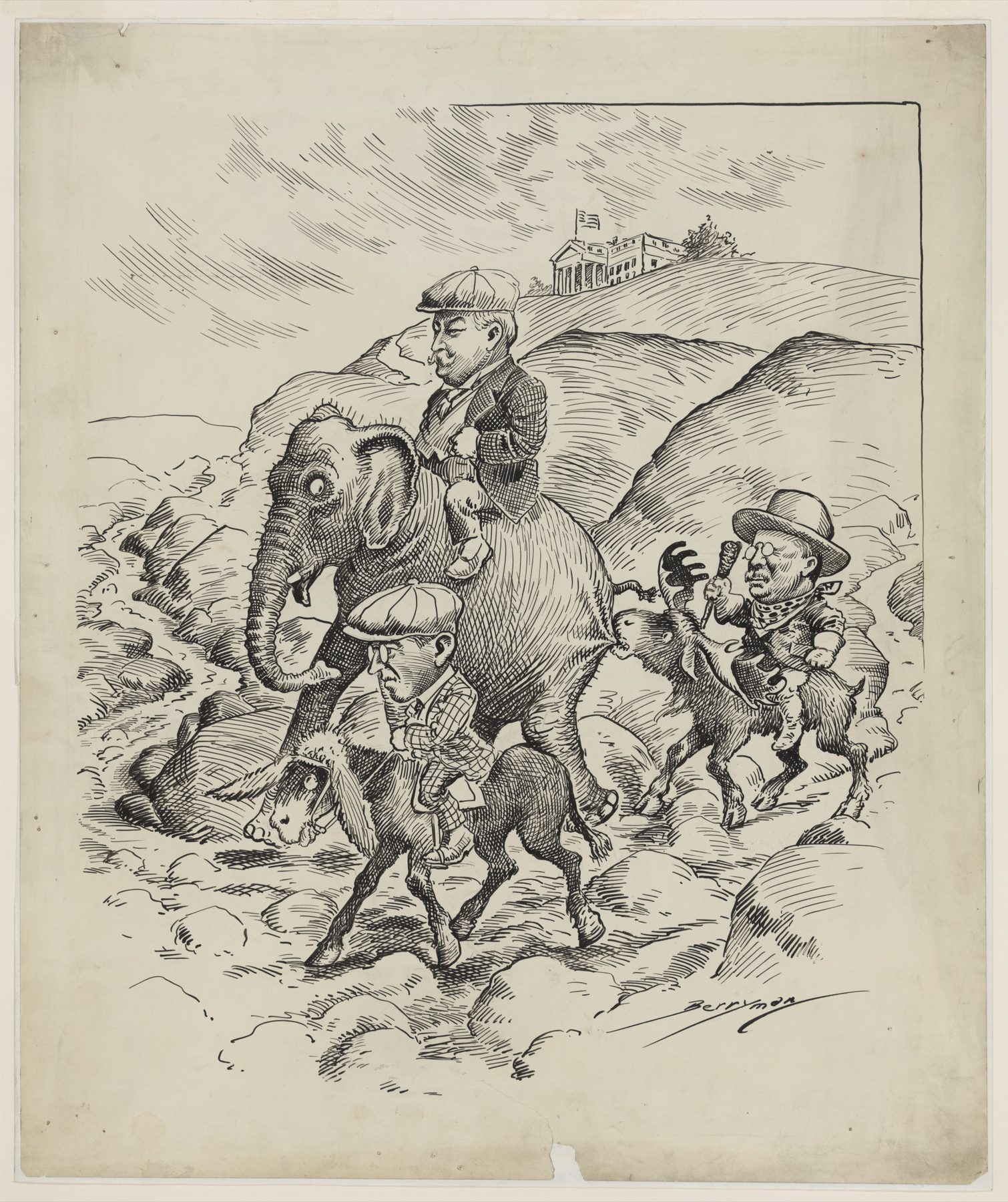 Race to the White House with Wilson on a donkey and Taft on an elephant being bitten by T. Roosevelt on a bull moose. Clifford K. Berryman, 1912, probably published in the Washington Star. Drawing. Library of Congress Prints and Photographs Division, LC-DIG-acd-2a06705.
Clifford K. Berryman's drawing, in the Library's catalog description, shows "Wilson on a donkey and Taft on an elephant being bitten by T. Roosevelt on a bull moose" loc.gov. The three-animal race became a standard way of picturing 1912. It is a reminder that the two-animal system was never closed: a third party could join the menagerie, and the cartoon would still be readable.
Ballot emblems: pictures for voters
The most consequential use of party symbols in American history is also the least known. It was not in cartoons but on ballots.
For much of the nineteenth century, American parties and their supporters printed their own ballots, often called tickets, like the 1828 Ohio Jackson ticket with its broom loc.gov. Late in the century, states adopted what was called the Australian ballot: a single official ballot printed by the government, listing every party's candidates, and marked in secret. The Jasper Weekly Courier, discussed below, still felt the need in 1908 to explain "the Australian ballot system" to first-time voters loc.gov. That reform created a practical problem. A voter who could not read now faced a sheet of names in columns. Several states answered by printing a party device, a small picture, at the head of each party's column, and allowing a voter to mark a single circle under it to vote a straight ticket.
Ohio's law shows how such emblems were chosen. In 1926 the Ohio Attorney General quoted Section 5014 of the state's General Code, which allowed a party's state convention to select a "figure or device" for its candidates on the ballot, and specified: "Such device may be the figure of a star, an eagle, a rooster, a flower, a plow or some other appropriate symbol." The same section barred "the coat of arms or seal of the state or of the United States, the national flag or any other emblem common to the people at large" ohioattorneygeneral.gov. Notice what the statute forbids. The shared national emblems of the early republic, the seal and the flag, could no longer stand for one party. Parties now needed something of their own. (The opinion itself concerned whether the Socialist Party could keep its recognized emblem on the ballot; the Attorney General held that it could.)
A 1908 newspaper from southern Indiana shows what a voter actually saw.
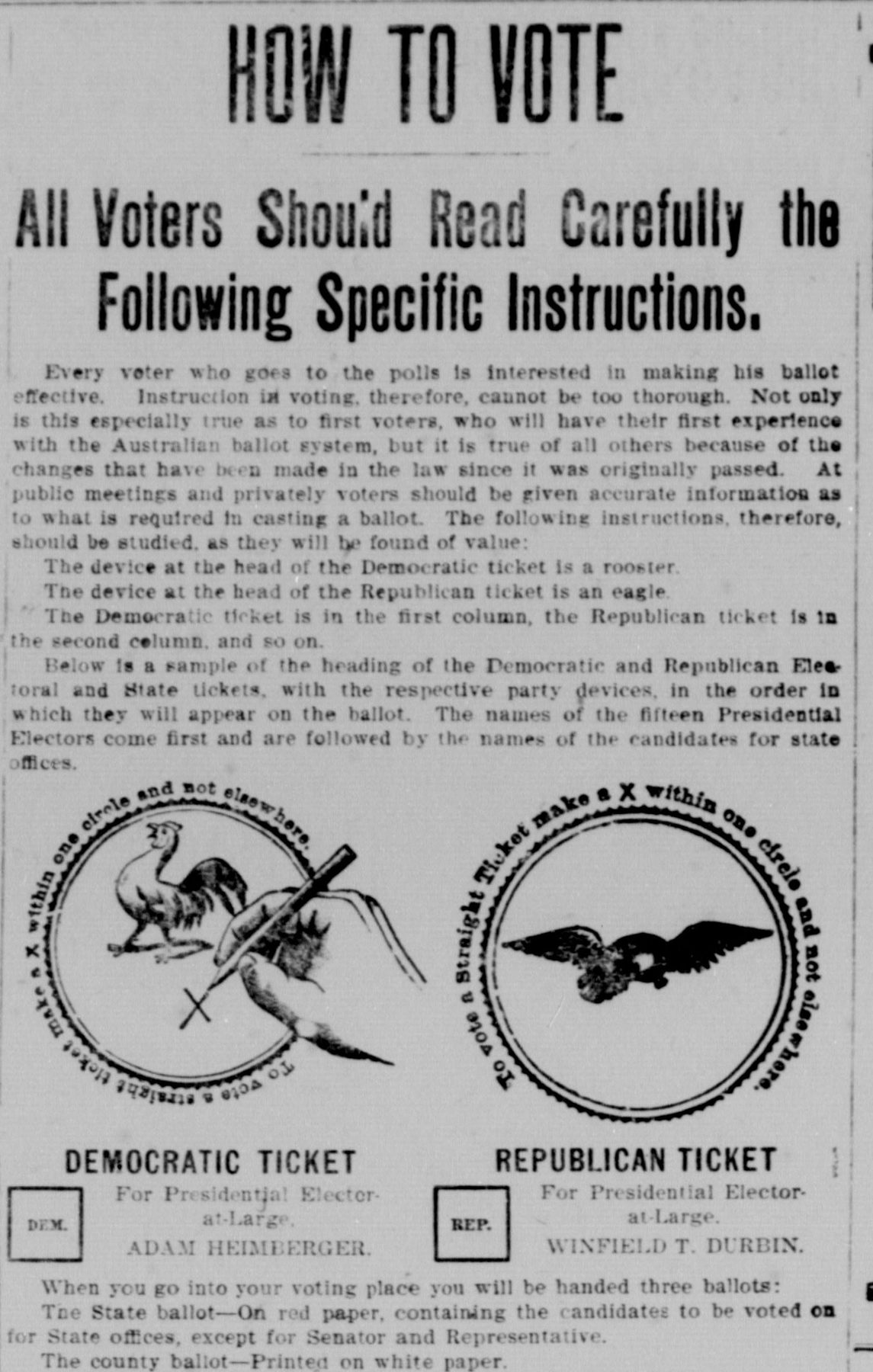 "How to Vote." The Jasper Weekly Courier (Jasper, Indiana), October 30, 1908, p. 8. Chronicling America: Historic American Newspapers, Library of Congress (LCCN sn84023963).
The Jasper Weekly Courier's "How to Vote" column of October 30, 1908, instructed readers: "The device at the head of the Democratic ticket is a rooster. The device at the head of the Republican ticket is an eagle." It printed the two circles as they would appear on the ballot, each ringed with the instruction "To vote a straight ticket make a X within one circle and not elsewhere" loc.gov. On this ballot, the Democrats were a rooster and the Republicans an eagle. Neither a donkey nor an elephant appears. For an Indiana voter in 1908, the party's official picture and the party's cartoon animal were different creatures.
Alabama's rooster and the words above it
The ballot emblem also carries the most uncomfortable chapter in this history, and it must be told plainly.
In May 1904, Alabama's Democratic State Executive Committee met in Montgomery to choose an emblem "as provided by the new election law." The Montgomery Advertiser reported the result on its front page on May 26, 1904, under the headline "Game Cock Is Emblem."
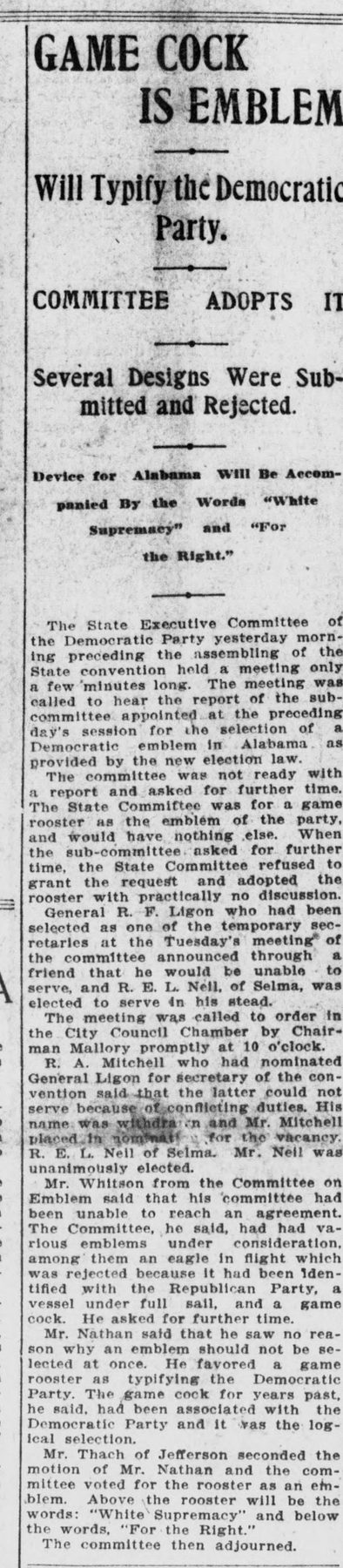 "Game Cock Is Emblem." The Montgomery Advertiser (Montgomery, Alabama), May 26, 1904, p. 1. Chronicling America: Historic American Newspapers, Library of Congress (LCCN sn84020645).
The article records that a subcommittee had considered several designs, "among them an eagle in flight which was rejected because it had been identified with the Republican Party, a vessel under full sail, and a game cock." The full committee would accept nothing but the rooster. One member argued that "the game cock for years past" had been associated with the Democratic Party. The report ends: "Above the rooster will be the words: 'White Supremacy' and below the words, 'For the Right'" loc.gov.
That emblem was adopted three years after Alabama's 1901 constitution, which the Encyclopedia of Alabama describes as "written primarily to codify White supremacy by disfranchising Black voters" encyclopediaofalabama.org. The words on the ballot announced the purpose the constitution had already put into law.
The slogan stayed with the emblem for six decades. Reform-minded members of the Alabama Democratic Conference pressed for its removal from 1964, and the Encyclopedia of Alabama records that in January 1966 "the Alabama Democratic Party voted 39-32 to strike 'White Supremacy' from the party's slogan that had accompanied the rooster since 1904," and that "the revamped emblem stated, 'Democrats for the Right'" encyclopediaofalabama.org. The commonly cited date, 1966, is correct; the margin, seven votes, is the detail that the short version leaves out.
Several precise statements follow from this record, and each matters. This was the emblem of the Democratic Party of Alabama, a state party, not of the national Democratic Party. It was chosen by a party committee under a state election law, not merely drawn by a partisan cartoonist. And the 1904 committee's choice was explicitly defined against the other party: the eagle was rejected because voters already identified it with Republicans. Party symbols were never only about the party that used them. They were also about whom the party meant to exclude and whom it meant to oppose.
Official marks in the age of television
By the middle of the twentieth century, the animals had moved from the work of cartoonists into the self-presentation of the parties themselves, though the record of exactly when is thinner than one might expect.
On the Republican side, the 1956 RNC publication The History of the Republican Party, 1854 to 1956 devotes a section to "The Origin of the Republican Elephant" and reproduces Nast's 1874 cartoon under the heading "The Republican Elephant Appears," with the caption "The party symbol as introduced by Thos. Nast in Harper's Weekly for Nov. 7, 1874" hdl.handle.net. By then, the national committee itself called the elephant "the party symbol" and told its history in its own publications. That is a dated, documented instance of the party embracing the mark, and it is treated here as an official retrospective: evidence of how the party described its symbol in 1956, not independent evidence of what happened in 1874.
The familiar modern Republican logo, an elephant silhouette in red and blue with three white stars on its back, is widely reproduced, and design commentators have written that the orientation of its stars changed around 2000. The research for this paper did not locate a dated primary record, such as a committee announcement or a trademark filing, that establishes when the stars were reoriented or why.
On the Democratic side, the national committee used donkey imagery through much of the twentieth century, but a dated record of a formal adoption vote was not found. What is well documented is a later change in the other direction. On September 15, 2010, Democratic National Committee chairman Tim Kaine unveiled a new logo and website; the George Washington University student newspaper reported Kaine presenting it as "the new symbol of today's Democratic Party" gwhatchet.com. The logo was a capital "D" inside a circle, and its reception was cool even among sympathetic writers: Paul Waldman wrote in The American Prospect that the "D" in a circle "almost looks like a placeholder for when they get a real logo later on" prospect.org. The donkey did not disappear from Democratic materials, but the party's chosen corporate mark in 2010 was a letter, not an animal.
Both modern marks are trademarks of the national committees and are not reproduced on this site.
Red and blue: a color scheme fixed by an election night
The last layer of American party identity is not an animal at all, but a pair of colors. It is also the newest, and the most often misremembered.
The Washington Post's Paul Farhi reconstructed the history in 2004. Before 2000, he wrote, "there was no consensus" on the colors, and "the scheme was often reversed." His examples are specific: "In 1976, NBC identified states won by Gerald Ford in blue and Jimmy Carter's states in red"; ABC in 1980 showed Ronald Reagan's victory "as a series of blue lights on a map"; Time magazine "assigned red to the Democrats and blue to the Republicans in its election graphics" in every election from 1988 to 2000; and the Post's own graphics for 2000 were "Republican-blue, Democrat-red" nbcnews.com.
Farhi's database search of newspapers, magazines, and television transcripts since 1980 found the first reference to "red states" and "blue states" on NBC's Today show about a week before the 2000 election, using a color scheme that had appeared a few days earlier on MSNBC. During the thirty-six-day recount that followed, he wrote, "the commentariat magically reached consensus on the proper colors" nbcnews.com. The convention that Republicans are red and Democrats are blue is therefore about a quarter century old, younger than many of the voters who take it for granted, and it was settled by television graphics and recount coverage, not by either party.
Other animals, other objects
The donkey and elephant dominate, but they were never alone.
The rooster remained the Democrats' ballot device in several states into the twentieth century, as the Indiana and Alabama records show, and a defined party symbol long after cartoonists had given the party a donkey loc.govloc.gov.
The eagle served as a Republican ballot emblem in states such as Indiana, and its identification with Republicans was strong enough in 1904 for Alabama's Democrats to reject it on that ground loc.govloc.gov. It never ceased to be a national symbol as well, which is exactly why statutes such as Ohio's later separated the eagle "figure" a party could choose from the national seal it could not ohioattorneygeneral.gov.
The star, the flower, and the plow appear in Ohio's statutory list of acceptable devices ohioattorneygeneral.gov, a reminder that ballot emblems were chosen from ordinary, legible pictures rather than from the cartoonist's zoo.
The tiger, which Nast "devised" for New York's Tammany Hall organization according to Ohio State's cartoon library library.osu.edu, shows that cartoon animals could attach to a political machine rather than a party.
The bull moose of 1912 loc.gov shows a third party entering the system by being drawn as a third animal.
Each of these needs its own source-checked history, and the method that follows is meant to make that possible.
How to read a political symbol
The material in this paper suggests a short method that works for any party symbol, in any country, in any period. It is the method used throughout this site, and it is offered here so readers can test it on images we have not discussed.
1. Who made it? A cartoonist working for an opponent, a party printer, a state election board, and a branding agency produce different kinds of symbols. Nast's first elephant was drawn by a supporter who was criticizing his own side's voters; Alabama's rooster was chosen by a party committee under a state law. Identify the maker before interpreting the image.
2. For whom? A Harper's Weekly reader, a voter who could not read the names on a ballot, and a television audience on election night are different audiences. A symbol that persuades one may simply identify for another.
3. When, exactly? Dates do real work. The Central Park menagerie hoax story collapses as soon as the dates are lined up. The red and blue convention looks ancient until one notices that Time magazine was using the opposite scheme in 1988.
4. In what medium? An etching sold as a single sheet, a wood engraving in a weekly, a printed ballot, and a logo file carry different authority. A ballot emblem is the state recording a party's choice; a cartoon is one artist's argument.
5. What does it argue? Most political images are claims. "A Live Jackass Kicking a Dead Lion" argues that the Copperhead press was dishonoring a dead patriot. "The Third-Term Panic" argues that Republican voters were being frightened by a newspaper. Ask what the image wants the viewer to believe.
6. What does it leave out? The 1800 banner leaves out the Federalists' case; the 1904 rooster leaves out the citizens the state's constitution had disfranchised; a modern logo leaves out the history of its own animal. Every symbol is a choice about emphasis. Listing what a symbol omits is often the fastest route to what it meant.
7. What happened to it later? Symbols are reused, relabeled, and retold. The donkey in "The Modern Balaam" is now often described as the first Democratic donkey, even though the print does not label it. Paine's 1904 phrasing became the RNC's 1956 phrasing. Track the retellings separately from the originals.
For other countries
The United States is not unusual in giving parties pictures. What is unusual is that its two great symbols began as insults and cartoon shorthand and were adopted informally over decades. In other systems, the state assigns symbols by law from the start.
India is the clearest documented example. The Election Commission of India's Election Symbols (Reservation and Allotment) Order, 1968, issued as S.O. 2959 on August 31, 1968, provides "for specification, reservation, choice and allotment of symbols at elections in Parliamentary and Assembly Constituencies" and "for the recognition of political parties in relation thereto." Under the Order, symbols are "either reserved or free," and a reserved symbol is one "reserved for a recognised political party for exclusive allotment to contesting candidates set up by that party" ceopuducherry.py.gov.in. The function is the one that led Indiana and Ohio to print roosters and eagles: helping every voter find a party on the ballot. The method in the previous section applies unchanged. Who assigned the symbol, for whom, when, in what medium, what it argues, and what it leaves out are questions that can be asked of an Indian ballot symbol, a European party rose, or an American elephant.
This site's first round covers the United States. The same structure is built to hold the history of other political systems, one documented symbol at a time.
A new symbol on an old name
Symbols accumulate meaning faster than anyone can control it. The donkey began as an opponent's insult and became a party's affectionate mascot. The elephant began as a panicked herd of voters and became a party's emblem of strength. Alabama's Democratic rooster carried the words "White Supremacy" from 1904 until a committee voted, narrowly, to remove them in 1966. Nothing about the animals themselves determined those meanings. People did, in print, over time, and the record of what they did is still there to be read.
That is why any new symbol attached to an old political name deserves scrutiny, including on this site. This project uses a modern dolphin mark.
Evidence
The core evidence for this paper consists of the following items, each identified in the captions and sources:
- Shared national imagery before party emblems: Savage's 1796 "Liberty" with eagle and liberty cap loc.gov; "Congressional Pugilists," 1798, a partisan scene without party insignia loc.gov; the 1800 Jefferson banner, partisan words on a national eagle si.edu.
- Jackson-era imagery: the 1828 Childs campaign portrait with no animal loc.gov; "The Modern Balaam and His Ass," 1837, the earliest dated print located in this research that pairs Jackson with an ass, unlabeled loc.gov; "Brother, Beware. C-Ass," 1848, a pun on Lewis Cass's name loc.gov.
- Roosters: the Indiana State Sentinel masthead from 1841 as described by the Indiana State Library library.in.gov; cockfight prints of 1844, 1848, and 1860 showing the rooster used for Whigs and for Democrats loc.govloc.govloc.gov.
- Early Republican imagery: the 1856 Fremont and Dayton banner with eagle, stars, and shield loc.gov; the National Park Service account of the party's 1854 origins and the disputed first use of its name npgallery.nps.gov.
- Nast: "A Live Jackass Kicking a Dead Lion," January 15, 1870, as reproduced and discussed by Paine hdl.handle.net; "The Third-Term Panic," November 7, 1874 loc.gov; "Caught in a Trap," November 21, 1874 loc.gov; "Stranger Things Have Happened," December 27, 1879 loc.gov; the New York Herald zoo hoax of November 9, 1874, which postdates the cartoon it is said to have inspired loc.gov.
- Later cartoons and retrospectives: Puck, 1902 loc.gov; Berryman, 1912 loc.gov; Knecht, 1940 loc.gov; the RNC's 1956 history hdl.handle.net; Ohio State's Billy Ireland Cartoon Library library.osu.edu.
- Ballots and law: Ohio General Code Section 5014 as quoted in the 1926 Attorney General opinion ohioattorneygeneral.gov; the Jasper Weekly Courier's 1908 sample ballot instructions loc.gov; the Montgomery Advertiser's report of May 26, 1904 loc.gov; the Encyclopedia of Alabama on the 1966 vote and the 1901 constitution encyclopediaofalabama.orgencyclopediaofalabama.org.
- Modern marks and colors: reporting on the DNC's 2010 logo gwhatchet.comprospect.org; Farhi's 2004 history of red and blue nbcnews.com.
- Comparison: India's Election Symbols Order, 1968 ceopuducherry.py.gov.in.
What the evidence does not show
The evidence does not show that the Democratic-Republican Party of the 1790s to 1820s had an official emblem. None was found in the collections searched, and the party had no national body that could have adopted one.
It does not show that Andrew Jackson put a donkey on his 1828 campaign materials. No such item was located, and the popular explainers that repeat the story cite none.
It does not show that "The Modern Balaam and His Ass" (1837) was intended or understood as the Democratic Party's emblem. The animal is unlabeled.
It does not show the content or exact date of the 1864 Father Abraham elephant, or of an 1860 elephant in a Lincoln paper. Both are reported in secondary sources and are queued until an original page is examined.
It does not show that Thomas Nast invented either animal. It shows that he used both repeatedly and that later writers, beginning with Paine in 1904, credited him with originating them.
It does not support the story that the Herald's Central Park menagerie hoax inspired "The Third-Term Panic." The hoax was published on November 9, 1874, after the cartoon's printed date.
It does not show when either national committee formally adopted its animal, or when and why the stars on the Republican logo changed orientation. Those questions are queued.
It does not show that the Alabama rooster's slogan was used by the national Democratic Party. The record shows a state party emblem on Alabama ballots. Nor does a party's historical symbol tell us anything about the character of the people who vote for that party today; a symbol records the choices of the people who made it.
It does not establish the exact wording of Theodore Roosevelt's "bull moose" remark, which is therefore not quoted.
Sources
- Edward Savage, "Liberty. In the form of the goddess of youth, giving support to the bald eagle," Philadelphia, June 11, 1796, Library of Congress Prints and Photographs Division. loc.gov (locator: catalog summary; LC-DIG-ppmsca-13641). Accessed 2026-10-28.
- "Congressional pugilists," [Philadelphia], 1798, Library of Congress Prints and Photographs Division. loc.gov (locator: catalog summary; LC-DIG-ppmsca-19356). Accessed 2026-10-28.
- National Museum of American History, Smithsonian Institution, "Jefferson Banner," 1800, ID PL.227739.1800.C01. si.edu (locator: object description). Accessed 2026-10-28.
- Library of Congress, "Formation of Political Parties," Creating the United States exhibition. loc.gov (locator: Congressional Pugilists entry and introduction). Accessed 2026-10-28.
- U.S. Senate, "About Parties and Leadership: Historical Overview." senate.gov (locator: section on the first parties). Accessed 2026-10-28.
- U.S. Senate, "Key to Party Abbreviations." senate.gov (locator: entry DR and footnote on Republican). Accessed 2026-10-28.
- George Washington's Mount Vernon, "Democratic-Republican Societies," Digital Encyclopedia. mountvernon.org (locator: sections on Washington's 1794 address and decline). Accessed 2026-10-28.
- Cephas G. Childs after Joseph Wood, "Genl. Andrew Jackson, 1828. Protector & defender of beauty & booty, Orleans," Philadelphia, 1828, Library of Congress. loc.gov (locator: catalog summary; LC-DIG-ds-00682). Accessed 2026-10-28.
- Henry R. Robinson, "The modern balaam and his ass," New York, 1837, Library of Congress. loc.gov (locator: catalog record; LC-DIG-ppmsca-15775; image inscriptions read from the digital file). Accessed 2026-10-28.
- "Brother, Beware. C-Ass," wood engraving in The John-Donkey, June 10, 1848, Library of Congress. loc.gov (locator: catalog summary; LC-USZ6-781). Accessed 2026-10-28.
- James S. Baillie, publisher, H. Bucholzer, artist, "Political cock fighters," New York, 1844, Library of Congress. loc.gov (locator: catalog summary; LC-USZ62-1972). Accessed 2026-10-28.
- Abel & Durang, publishers, "Cock of the walk," Philadelphia, 1848, Library of Congress. loc.gov (locator: catalog summary). Accessed 2026-10-28.
- Currier & Ives, "The great match at Baltimore, between the 'Illinois Bantam' and the 'Old Cock' of the White House," New York, 1860, Library of Congress. loc.gov (locator: catalog summary; LC-DIG-pga-04863). Accessed 2026-10-28.
- Chandler Lighty, "The Indiana Sentinel: Indianapolis's Democratic Voice," newspaper blog of the Indiana State Library, October 17, 2013. library.in.gov (locator: paragraph on the 1841 masthead). Accessed 2026-10-28.
- C.E. Lewis, "Jno C. Fremont [and] Wm. L. Dayton. The champions of freedom!," Buffalo, about 1856, Library of Congress. loc.gov (locator: catalog summary; LC-DIG-pga-07356). Accessed 2026-10-28.
- Benjamin Levy, National Park Service, National Register of Historic Places Inventory, Nomination Form, "Little White Schoolhouse," Ripon, Wisconsin. npgallery.nps.gov (locator: Statement of Significance and continuation sheet, "Who were the First Republicans?"). Accessed 2026-10-28.
- Katherine DeFonzo, "Why is the Republican symbol an elephant? Why is the Democratic symbol a donkey?," History News Network, March 18, 2016. historynewsnetwork.org (locator: full article; cited only as an example of the popular account). Accessed 2026-10-28.
- Albert Bigelow Paine, Th. Nast, His Period and His Pictures (New York and London: Harper & Brothers, 1904), HathiTrust Digital Library. hdl.handle.net (locator: pp. 146 to 147, page scans 176 to 177; pp. 299 to 300, page scans 329 to 330, including footnote on dating). Accessed 2026-10-28.
- Thomas Nast, "The Third-term Panic," Harper's Weekly, vol. 18, no. 932, November 7, 1874, p. 912, Library of Congress. loc.gov (locator: catalog summary; LC-DIG-ppmsca-15785). Accessed 2026-10-28.
- Thomas Nast, "Caught in a trap: the result of the third term hoax," Harper's Weekly, November 21, 1874, p. 960, Library of Congress. loc.gov (locator: catalog summary; LC-DIG-ds-14908). Accessed 2026-10-28.
- The New York Herald, November 9, 1874, page 3, "The Wild Animals Broken Loose," Chronicling America, Library of Congress. loc.gov (locator: page 3, headline and opening columns). Accessed 2026-10-28.
- Thomas Nast, "Stranger things have happened," Harper's Weekly, December 27, 1879, p. 1001, Library of Congress. loc.gov (locator: catalog summary; LC-USZ62-112163). Accessed 2026-10-28.
- Thomas Nast, cartoon on the 1875 New York elections ("Tammany's Waterloo"), Harper's Weekly, November 20, 1875, Library of Congress. loc.gov (locator: catalog title). Accessed 2026-10-28.
- The Ohio State University Libraries, Billy Ireland Cartoon Library and Museum, "Thomas Nast: Prince of Caricaturists." library.osu.edu (locator: introductory text on symbols). Accessed 2026-10-28.
- Republican National Committee, The History of the Republican Party, 1854 to 1956 (Washington, 1956), HathiTrust Digital Library. hdl.handle.net (locator: p. 17, caption; p. 46, "The Origin of the Republican Elephant"). Accessed 2026-10-28.
- J.S. Pughe, "The Republican elephant and his growing burden," Puck, vol. 51, no. 1320, June 18, 1902, Library of Congress. loc.gov (locator: catalog summary; LC-DIG-ppmsca-25645). Accessed 2026-10-28.
- Clifford K. Berryman, [Race to the White House with Wilson on a donkey and Taft on an elephant being bitten by T. Roosevelt on a bull moose], 1912, Library of Congress. loc.gov (locator: catalog title; LC-DIG-acd-2a06705). Accessed 2026-10-28.
- Karl Kae Knecht, "Our ever constant 'Elephant' and 'Donkey' emblems," Evansville Courier, July 1, 1940, Library of Congress. loc.gov (locator: catalog title and note; image not reproduced, rights may be restricted). Accessed 2026-10-28.
- Ohio Attorney General, Opinion No. 3633, September 20, 1926, Opinions of the Attorney General of Ohio for 1926, pp. 372 to 373. ohioattorneygeneral.gov (locator: syllabus and quotation of General Code Section 5014). Accessed 2026-10-28.
- "How to Vote," The Jasper Weekly Courier (Jasper, Indiana), October 30, 1908, p. 8, Chronicling America, Library of Congress. loc.gov (locator: page 8, center column). Accessed 2026-10-28.
- "Game Cock Is Emblem," The Montgomery Advertiser (Montgomery, Alabama), May 26, 1904, p. 1, Chronicling America, Library of Congress. loc.gov (locator: page 1, column headed "Game Cock Is Emblem"). Accessed 2026-10-28.
- Justin Martin, "Alabama Democratic Conference," Encyclopedia of Alabama, published January 27, 2025, last updated July 1, 2026. encyclopediaofalabama.org (locator: paragraphs on the 1964 to 1966 slogan debate). Accessed 2026-10-28.
- Sarah A. Warren, "Alabama Constitution of 1901," Encyclopedia of Alabama, published March 8, 2011, last updated June 4, 2026. encyclopediaofalabama.org (locator: opening summary). Accessed 2026-10-28.
- Thomas Nast, "The American River Ganges," Harper's Weekly, vol. 15, no. 770, September 30, 1871, p. 916, Library of Congress. loc.gov (locator: catalog summary). Accessed 2026-10-28.
- Paul Farhi, "Elephants are red, donkeys are blue," The Washington Post, as published by NBC News, November 1, 2004. nbcnews.com (locator: full article). Accessed 2026-10-28.
- Justin Kits, article on the DNC's new website and logo, The GW Hatchet, September 15, 2010. gwhatchet.com (locator: opening paragraphs). Accessed 2026-10-28.
- Paul Waldman, column on the DNC's 2010 logo, The American Prospect, September 17, 2010. prospect.org (locator: paragraph on the logo). Accessed 2026-10-28.
- Election Commission of India, The Election Symbols (Reservation and Allotment) Order, 1968, S.O. 2959, August 31, 1968, as amended, copy published by the Chief Electoral Officer, Puducherry. ceopuducherry.py.gov.in (locator: preamble and paragraphs 4 and 5). Accessed 2026-10-28.
- "[Cut of broom] To sweep the Augean Stable. For President Andrew Jackson for Vice-President John C. Calhoun," Ohio election ticket, 1828, Printed Ephemera Collection, Portfolio 136, Folder 6, Library of Congress. loc.gov (locator: catalog title and physical description). Accessed 2026-10-28.
Last checked against its sources on October 28, 2026. Report a correction.