
Chapter 8
How to Read a Political Cartoon or Campaign Object: Three Public Domain Examples, 1798 to 1837
The short answer
Read a political cartoon or campaign object by asking, in order, who made it, for whom, when, in what medium, what it argues, what it leaves out, and how it has been retold since. Applied to three public domain items, a 1798 etching of a fight in Congress, a celebratory banner from 1800, and an 1837 lithograph of Andrew Jackson on a donkey, the method shows how much each object can prove and where common interpretations go beyond the evidence.
Historical setting
Political images survive far better than political conversation. A satirical print sold for a few cents in 1837, or a banner carried through a town in 1800, can still be examined today, while the talk around it is gone. That makes these objects precious evidence, and also dangerous evidence, because a vivid picture invites us to supply its meaning from our own time.
In the early republic and the Jacksonian era, political images were made in a handful of media. Copperplate engravings and etchings were costly and usually sold as separate sheets. Lithography, drawn directly on stone, made single-sheet cartoons cheaper and faster to produce; by the 1830s New York publishers were selling lithographed political cartoons such as the third example in this chapter. Textiles, ribbons, and printed tickets were made for supporters to carry, wear, or deposit. Each medium reached a different audience and served a different purpose.
This chapter offers a method in seven questions and applies it to three items held by public institutions that state no known restrictions on publication or have dedicated the image to the public domain. The same method is used across this site, and in our longer paper on party symbols, The Donkey, the Elephant, and the Long Life of Political Symbols.
The method: seven questions
- Who made it? An opponent, a supporter, a commercial publisher, or a government office?
- For whom? Buyers of prints, members of a crowd, voters at a polling place?
- When, exactly? A date often changes what an image can mean.
- In what medium? An etching, a lithograph, a banner, a ticket, a newspaper woodcut?
- What does it argue? Most political images make a claim. State it in a sentence.
- What does it leave out? Every image selects. What is missing is often as revealing as what is shown.
- How has it been retold? Catalog descriptions, textbooks, and websites add interpretations. Separate them from what the object itself shows.
Example 1: "Congressional Pugilists," 1798
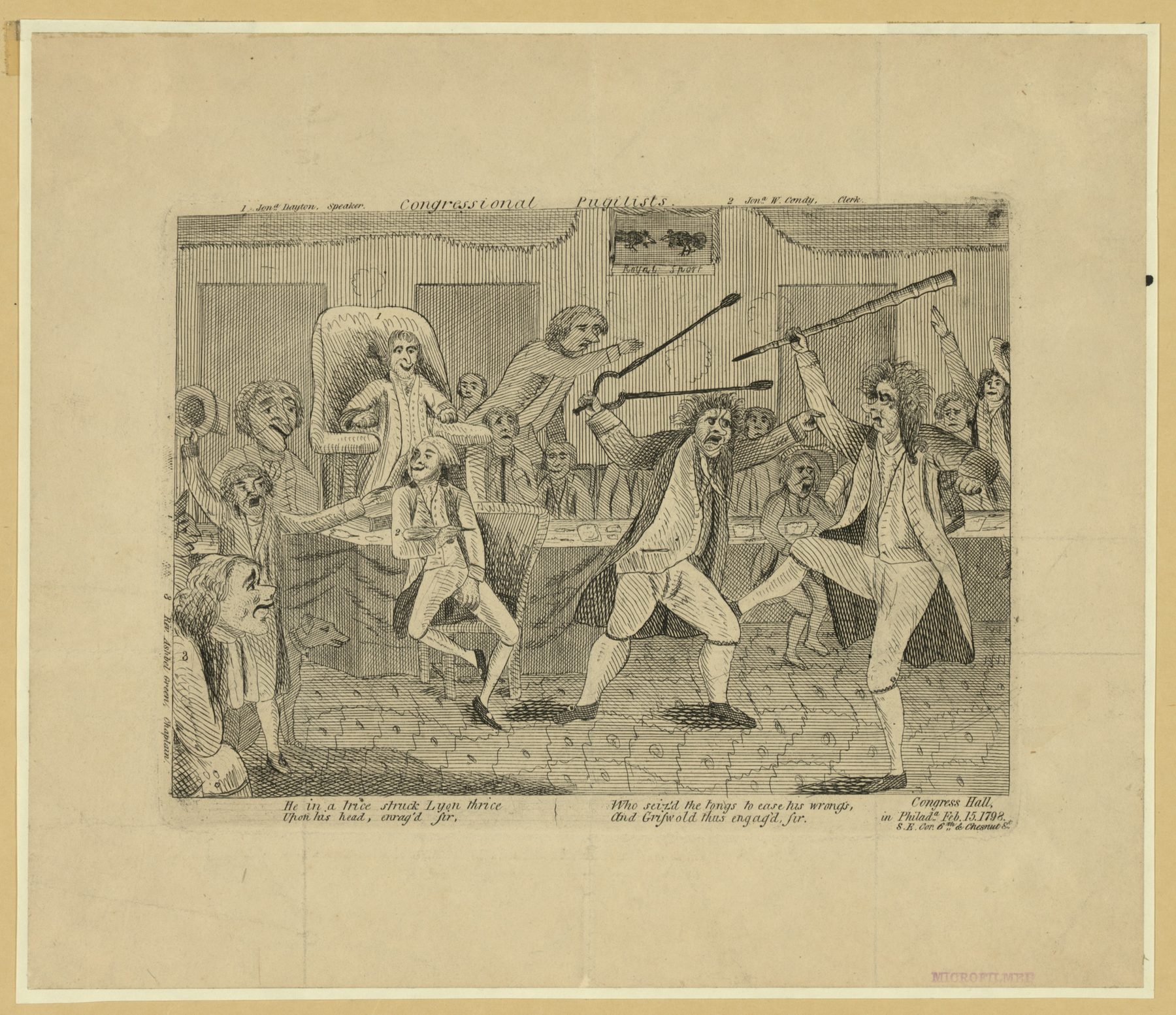 Congressional pugilists. Artist unknown, Philadelphia, 1798 (scene dated February 15, 1798). Library of Congress Prints and Photographs Division, LC-DIG-ppmsca-19356 (second state).
Who made it? The artist is unknown. The Library of Congress holds three states of the plate, which tells us it was reworked and reprinted; the later states add keyed references identifying onlookers loc.gov.
For whom? A buyer of prints in Philadelphia, then the national capital, who would recognize the room and probably the men.
When? The plate is inscribed "Congress Hall, in Philada. Feb.15.1798" loc.gov. That places it in the year of the undeclared quasi-war with France and the Alien and Sedition Acts, both of which the Library's exhibition describes as sharp points of conflict between Federalists and Republicans loc.gov.
Medium? An etching on wove paper, a small plate about 16 by 22 centimeters loc.gov.
What does it argue? The Library describes "a crude portrayal of a fight on the floor of Congress" between Representative Matthew Lyon of Vermont and Roger Griswold of Connecticut, with Griswold "armed with a cane" and Lyon raising "a pair of fireplace tongs" loc.gov. The Library's exhibition on party formation identifies Lyon as a Jeffersonian Republican and Griswold as a Federalist loc.gov. The print's argument is less about either party than about the indignity of the scene: the nation's legislature reduced to a brawl.
What does it leave out? Any party insignia. Neither man carries a badge or stands beside a symbol, because in 1798 there were no party emblems to draw. Party identity lives in the viewer's knowledge, not in the image.
How has it been retold? It now appears in exhibitions as an illustration of early partisan conflict loc.gov. That is fair, as long as we remember that the print itself names no party.
Example 2: The Jefferson Banner, 1800
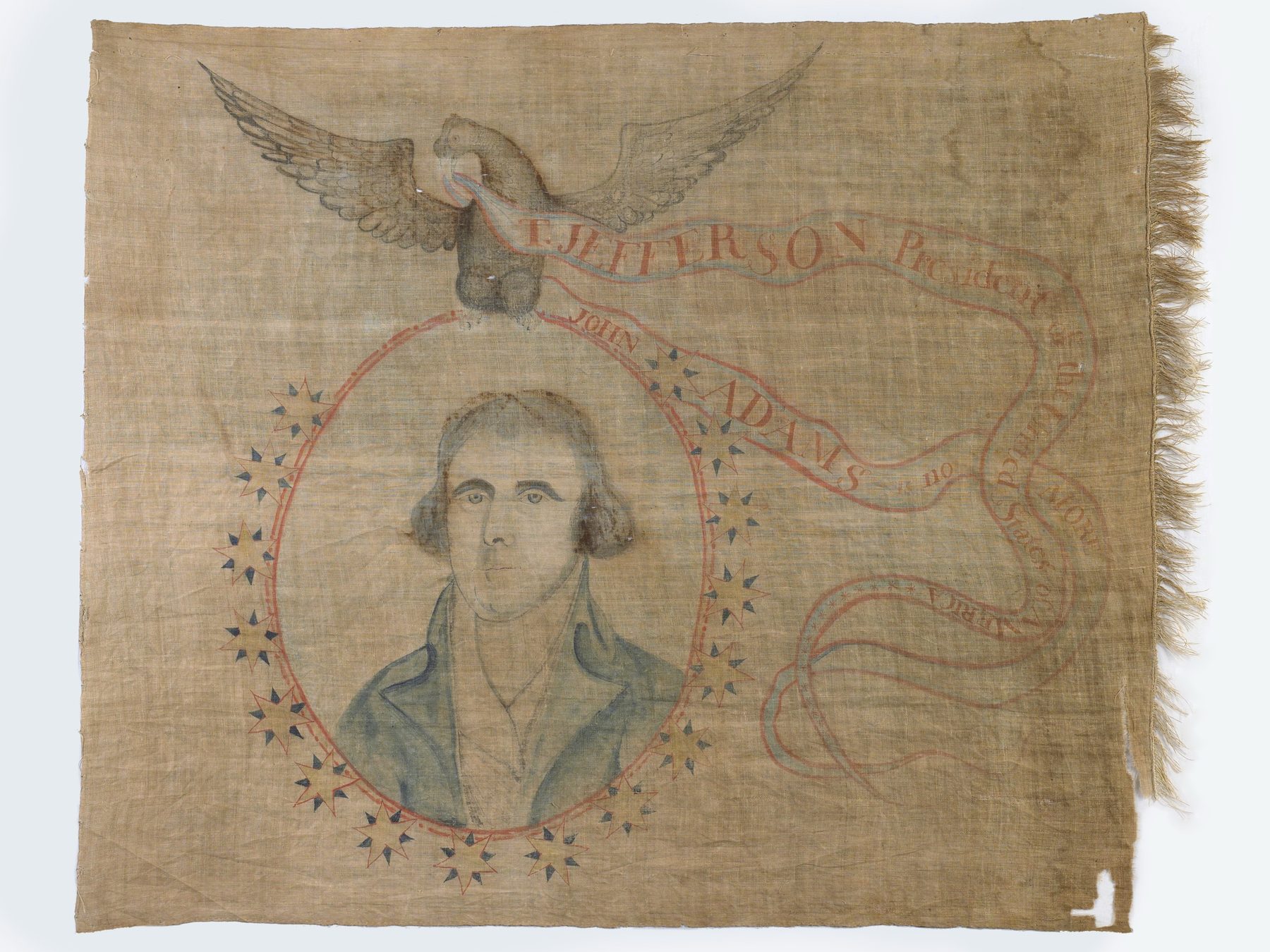 Jefferson Banner. Maker unknown, 1800. Linen, 30 by 37 inches. National Museum of American History, Smithsonian Institution, ID PL.227739.1800.C01, gift of Ralph E. Becker. Smithsonian Open Access, CC0.
Who made it? Unknown. It was made by supporters, not opponents; it celebrates.
For whom? For display, presumably in public. The museum does not record where it was first shown, so we should not guess.
When? The museum dates it to 1800 and connects it to Jefferson's victory over John Adams in that year's presidential election si.edu.
Medium? Linen, 30 by 37 inches. The museum calls it "one of the earliest surviving textiles carrying partisan imagery" si.edu. A textile was made to be carried or hung, seen by a crowd rather than held in the hand.
What does it argue? That Jefferson's victory is the nation's victory. The design places his portrait beneath an eagle whose streamer reads, in the museum's transcription, "T. Jefferson President of the United States of America / John Adams is no more" si.edu.
What does it leave out? The opponent's case, of course. Less obviously, it leaves out any party emblem. The eagle is the national eagle, available to everyone. The partisanship is carried by the words and the face.
How has it been retold? Accounts of how the banner reached the museum differ in their details, and those details are not repeated here. The object's own testimony, its imagery and inscription, is secure.
Example 3: "The Modern Balaam and His Ass," 1837
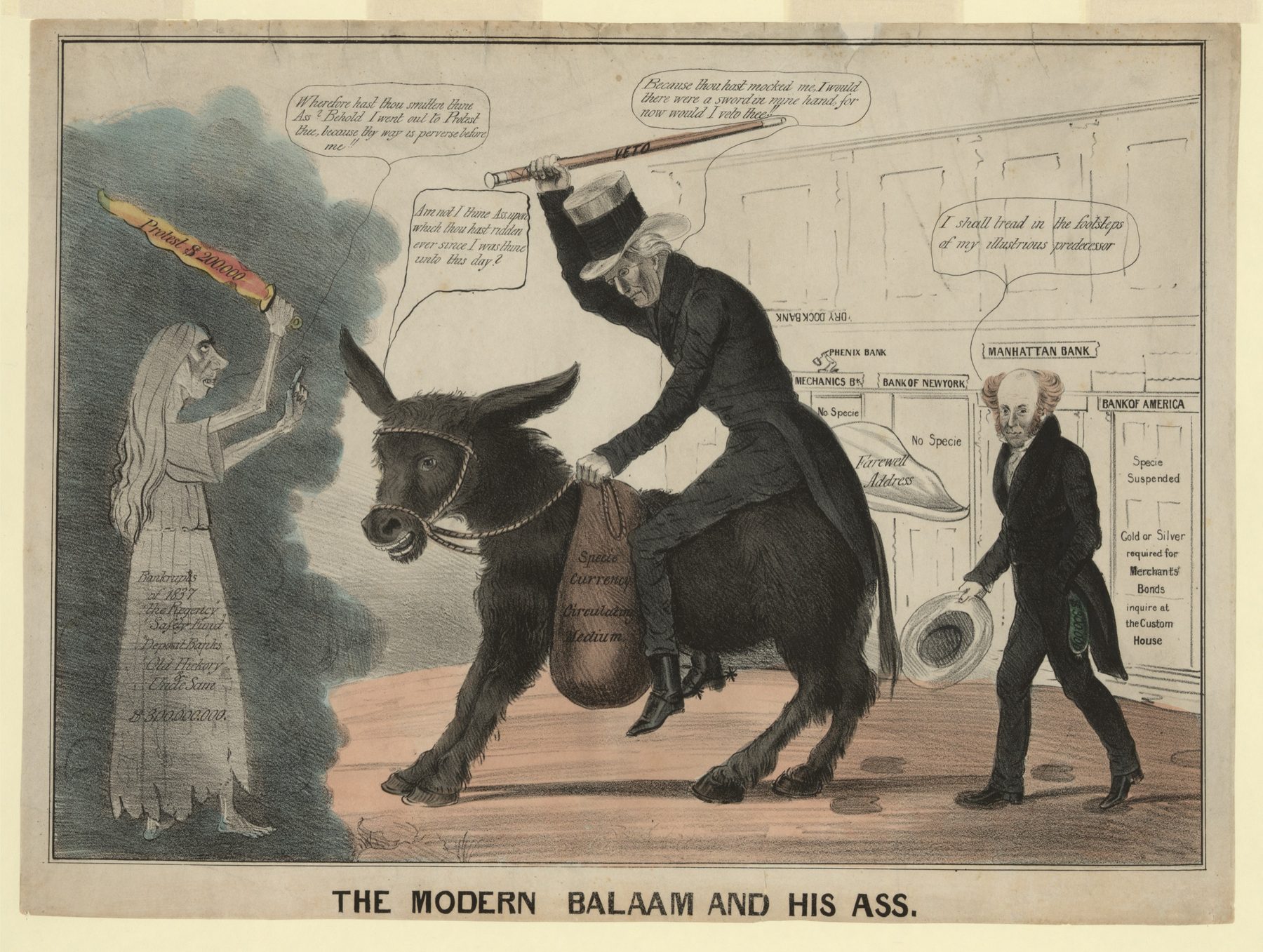 The modern Balaam and his ass. Henry R. Robinson, publisher, New York, 1837. Lithograph with watercolor. Library of Congress Prints and Photographs Division, LC-DIG-ppmsca-15775.
Who made it? The Library of Congress attributes it to Henry R. Robinson, a New York publisher loc.gov.
For whom? Buyers of single-sheet cartoons in New York during the financial panic of 1837.
When? 1837 loc.gov. Martin Van Buren had succeeded Jackson as president that March, and, as another Library of Congress catalog record explains, New York banks suspended payments in coin on May 10, 1837 loc.gov.
Medium? A hand-colored lithograph, the cheap, fast medium of Jacksonian satire.
What does it argue? The print adapts the biblical story of Balaam, who beats his donkey for refusing to move, not seeing the angel in the road. Jackson, riding, raises a cane labeled "Veto." A ghostly figure looms at left. The animal carries a sack marked "Specie Currency, Circulating Medium." Van Buren follows on foot, saying he will "tread in the footsteps of my illustrious predecessor." Bank buildings behind display signs reading "No Specie" and "Specie Suspended." The argument, as the inscriptions suggest, is that Jackson's financial policy, which Van Buren promises to continue, has brought the country's money to ruin.
What does it leave out? A label on the animal. The donkey is not marked as the Democratic Party, the public, or anything else. The biblical source even makes the donkey the wiser of the pair.
How has it been retold? This print is often described as the first appearance of the Democratic donkey. Read with the seven questions, that claim goes beyond the object. The print shows that an opponent found it useful to put Jackson on an ass in 1837. It does not show that anyone, friend or foe, yet treated the donkey as the party's emblem. That happened decades later, through Thomas Nast's cartoons, as our paper on party symbols explains.
Evidence
- The Library of Congress catalog records for "Congressional Pugilists" and "The Modern Balaam and His Ass," including dates, media, attributions, and descriptions loc.govloc.gov.
- The Library's exhibition text identifying Lyon's and Griswold's parties loc.gov.
- The Smithsonian's object record for the Jefferson Banner, including its date, material, dimensions, description, and inscription si.edu.
- Direct observation of the inscriptions on the digitized Balaam print, read from the Library's high-resolution file.
What the evidence does not show
It does not show who designed the 1798 etching or the 1800 banner. Both makers are unknown.
It does not show where the Jefferson banner was first displayed, or how many like it once existed.
It does not show how buyers in 1837 understood the donkey in Robinson's print. Interpretations of the animal as the Democratic Party are later readings, not statements made by the print.
It does not show that any of these objects reflects the views of all supporters or opponents. A print or banner records one maker's argument for one audience.
Sources
- "Congressional pugilists," [Philadelphia], 1798, Library of Congress Prints and Photographs Division. loc.gov (locator: catalog notes on states and inscription; summary). Accessed 2026-10-28.
- Library of Congress, "Formation of Political Parties," Creating the United States exhibition. loc.gov (locator: Congressional Pugilists entry). Accessed 2026-10-28.
- National Museum of American History, Smithsonian Institution, "Jefferson Banner," 1800, ID PL.227739.1800.C01. si.edu (locator: object description and physical description). Accessed 2026-10-28.
- Henry R. Robinson, "The modern balaam and his ass," New York, 1837, Library of Congress Prints and Photographs Division. loc.gov (locator: catalog record; inscriptions read from LC-DIG-ppmsca-15775). Accessed 2026-10-28.
- Anthony Fleetwood, "6 cents. Humbug glory bank," New York, 1837, Library of Congress Prints and Photographs Division. loc.gov (locator: catalog summary on the Panic of 1837 and the May 10 suspension). Accessed 2026-10-28.
Last checked against its sources on October 28, 2026. Report a correction.