
Chapter 6
Religion and the Parties, from the Founding to Today
The short answer
Religion has been part of American party conflict since the 1780s. Jefferson's Republicans allied with Baptists against tax-supported churches and were attacked by Federalist clergy as infidels, Jacksonian Democrats refused Sabbath and fast-day demands while courting Catholic immigrants, and in 1856 the Democratic platform condemned the anti-Catholic Know-Nothings while the first Republican platform called polygamy and slavery "twin relics of barbarism." In Pew Research Center data through 2023, 54% of Democratic voters and 81% of Republican voters identify as Christian.
Historical setting
In 1778, in Virginia, a gang of men came up to the stage where two Baptist preachers, David Barrow, pastor of the Mill Swamp Baptist Church in the Portsmouth area, and Edward Mintz, were holding a service. They "plunged" both preachers, pressing Barrow into the mud. The Library of Congress displays the account, and records that persecution of Baptists, and to a lesser degree Presbyterians, continued in Virginia after the Declaration of Independence, carried out by members of the Church of England, sometimes with local authorities loc.gov.
At that time several states still taxed citizens to support churches. General religious taxes, which let each taxpayer direct his share to the church of his choice, took effect in Massachusetts, Connecticut, and New Hampshire loc.gov. The federal Constitution's only religious clause, in Article VI, provides that "no religious Test shall ever be required as a Qualification" for federal office. The First Amendment, ratified in December 1791, barred Congress from making any law "respecting an establishment of religion" loc.gov. It did not apply to the states firstamendment.mtsu.edu.
This chapter follows religion through party politics in order: Federalists and Democratic-Republicans to the 1820s, Democrats and their opponents to the 1850s, Democrats and Republicans from 1856, and the religious makeup of each party's voters today. Paired quotations put the strongest case of each side in its own words, the Democratic or Democratic-Republican side first.
Virginia, 1785: before the parties
Jefferson drafted a Bill for Establishing Religious Freedom as part of his revision of Virginia's laws; the Library of Congress dates his draft to 1777 and its first debate to 1779, when it was postponed loc.gov. It opens: "Almighty God hath created the mind free" founders.archives.gov. Its enacting clause provides "that no man shall be compelled to frequent or support any religious worship, place, or ministry whatsoever," nor suffer "on account of his religious opinions or belief" founders.archives.gov.
In 1784 Patrick Henry introduced "A Bill establishing a provision for Teachers of the Christian Religion," a church tax that let each taxpayer choose the church founders.archives.gov. Its supporters, mainly Anglicans, argued that Christianity was the "best means of promoting Virtue, Peace, and Prosperity" loc.gov. John Marshall, later Chief Justice, voted against postponing it; Madison led the postponement loc.gov. George Washington wrote to George Mason on October 3, 1785, that he did not oppose in principle "making people pay towards the support of that which they profess," but thought the bill "impolitic" loc.gov.
"The Religion then of every man must be left to the conviction and conscience of every man; and it is the right of every man to exercise it as these may dictate." founders.archives.gov
James Madison, later a founder of the Democratic-Republican opposition, Memorial and Remonstrance against Religious Assessments, about June 20, 1785
"True Religion is most friendly to social and political Happiness." loc.gov
Supporters of the assessment bill, petition to the Virginia General Assembly from Surry County, 1785
Madison circulated his petition without his name and acknowledged authorship only in 1826 founders.archives.gov. The editors of his papers count at least thirteen copies of it, with 1,552 signatures. A different anonymous petition, in 29 copies signed by 4,899 Virginians, argued that the tax was contrary to "the Spirit of the Gospel" and would do nothing to check "that Deism with its banefull Influence [which] is spreading itself over the state." The editors call it "easily the most popular" of the protests. In all, some 10,929 Virginians signed petitions against the assessment, and eleven counties sent petitions in favor founders.archives.gov. The Library of Congress describes the winning side as "an incongruous coalition of Baptists and theological liberals" loc.gov.
The assessment died. The House of Delegates passed Jefferson's bill 74 to 20 on December 17, 1785, and agreed to the Senate's cuts to its preamble on January 16, 1786 founders.archives.gov. Jefferson later wrote in his Autobiography that the legislature rejected an amendment to insert "Jesus Christ" before "the holy author of our religion," so that the law would protect "the Jew and the Gentile, the Christian and Mahometan, the Hindoo, and infidel of every denomination." The editors of his papers note that the legislative journals have no record of that amendment founders.archives.gov.
The Constitution and the Baptists
The Baptist preacher John Leland sent objections to the proposed Constitution that were passed to Madison. The last was that it did not sufficiently secure religious liberty, which he called "dearest of all": "if a Majority of Congress with the President favour one System more than another, they may oblige all others to pay to the support of their System as much as they please" loc.gov. The Library of Congress notes that Madison's constituents included large numbers of Baptists who wanted religious freedom secured loc.gov. On June 8, 1789, Madison moved in the House that "the civil rights of none shall be abridged on account of religious belief or worship, nor shall any national religion be established" loc.gov.
Federalists and Democratic-Republicans: fast days
On March 23, 1798, when, in the Library of Congress's words, the nation "appeared to be on the brink of a war with France," President John Adams proclaimed a national fast day loc.gov. Supporters of Washington and Adams had taken the label Federalists; the opposition led by Jefferson became the Democratic Republicans senate.gov. Ten years later, President Jefferson refused a request for a national fast day.
"fasting & prayer are religious exercises. the enjoining them an act of discipline, every religious society has a right to determine for itself the times for these exercises & the objects proper for them according to their own particular tenets." founders.archives.gov
Thomas Jefferson, Democratic-Republican president, letter to Samuel Miller, January 23, 1808
"acknowledge before God the manifold sins and transgressions with which we are justly chargeable as individuals and as a nation; beseeching him at the same time, of His infinite grace, through the Redeemer of the World, freely to remit all our offences." loc.gov
John Adams, Federalist president, fast day proclamation, March 23, 1798
Jefferson acknowledged in the same letter that "the practice of my predecessors may be quoted," and concluded that "civil powers alone have been given to the President of the US. and no authority to direct the religious exercises of his constituents" founders.archives.gov. Washington, in his Farewell Address of 1796, called virtue or morality, as products of religion, "a necessary spring of popular government" loc.gov.
1800: the infidel charge
In the campaign of 1800, the Library of Congress states, Federalists attacked Jefferson as an infidel and claimed that his attachment to the religious and political extremism of the French Revolution disqualified him from office loc.gov. An etching of about 1800 by an unknown artist, The Providential Detection, shows the eye of God and an American eagle stopping Jefferson from throwing the "Constitution & Independence" onto an "Altar to Gallic Despotism" fed by the writings of Thomas Paine and other freethinkers loc.gov. Paine's The Age of Reason, in the Library's description, was denounced as the "atheist's bible" and read by many as the entering wedge of French revolutionary "infidelity" loc.gov.
William Linn, a Presbyterian clergyman and associate minister of the Collegiate Dutch Reformed Church in New York City, published Serious Considerations on the Election of a President anonymously in 1800 founders.archives.gov. DeWitt Clinton, writing as Grotius, answered with A Vindication of Thomas Jefferson founders.archives.gov. In 1807 Jefferson wrote that he had guessed Linn was the author and had left him with other "slanderers … to the scourge of public opinion" founders.archives.gov.
"Believing with you that religion is a matter which lies solely between Man & his God, that he owes account to none other for his faith or his worship, that the legitimate powers of government reach actions only, & not opinions, I contemplate with sovereign reverence that act of the whole American people which declared that their legislature should 'make no law respecting an establishment of religion, or prohibiting the free exercise thereof,' thus building a wall of separation between Church & State." founders.archives.gov
Thomas Jefferson, Democratic-Republican president, reply to the Danbury Baptist Association, January 1, 1802
Jefferson should not be elected because of "his disbelief of the Holy Scriptures … his rejection of the Christian Religion and open profession of Deism"; his election would "destroy religion, introduce immorality, and loosen all the bonds of society." founders.archives.gov
William Linn, Presbyterian clergyman, Serious Considerations on the Election of a President, 1800, as quoted by the editors of The Papers of Thomas Jefferson
The Danbury Baptists described the attack from Jefferson's side. Their address of October 1801 said that those "who seek after power & gain under the pretence of goverment & Religion" reproached him "as an enemy of religion Law & good order because he will not, dares not assume the prerogative of Jehovah and make Laws to govern the Kingdom of Christ" founders.archives.gov.
Jefferson's religion, in his words
In a letter to Benjamin Rush of April 21, 1803, Jefferson called himself a "Christian, in the only sense in which [Jesus] wished any one to be." In an attached syllabus he ranked the doctrines of Jesus above those of the classical philosophers and declined to consider whether Jesus was "a member of the god-head" loc.gov. Around 1820, according to the Library of Congress, he assembled The Life and Morals of Jesus of Nazareth from New Testament passages in Greek, Latin, French, and English, keeping what he considered Jesus's authentic acts and sayings and leaving out the miraculous. It ends with the crucifixion and burial and omits any resurrection appearance. The volume is held by the Smithsonian's National Museum of American History loc.gov.
January 1802: the cheese, the letter, the Capitol
On December 30, 1801, a wheel of cheese from Cheshire, Massachusetts, a predominantly Baptist town, arrived in Washington. The editors of Jefferson's papers write that the Baptist preacher John Leland presented it, together with the Danbury Baptist Association's address, that day; their note to Jefferson's account book dates the presentation to New Year's Day 1802 founders.archives.govfounders.archives.gov. The Danbury association was a group of 26 churches in western Connecticut and eastern New York founders.archives.gov. Jefferson's account book for January 4, 1802, reads: "Gave Revd. Mr. Leland bearer of the cheese of 1235 ℔ weight 200.D." The editors explain that he paid under his policy of not accepting gifts while in office founders.archives.gov.
The Danbury Baptists wrote that in Connecticut "religion is consider'd as the first object of Legislation; & therefore what religious privileges we enjoy (as a minor part of the State) we enjoy as favors granted, and not as inalienable rights" founders.archives.gov.
Jefferson consulted two New England Republicans on his reply, Postmaster General Gideon Granger and Attorney General Levi Lincoln. Lincoln advised him to be more guarded about fast days, and Jefferson removed a sentence founders.archives.gov. The Library of Congress reports that the deleted passage explained why he would not proclaim fast and thanksgiving days, and that Jefferson wrote in the margin that he cut it to avoid offending "our republican friends in the eastern states" who cherished those days. The Library states that he regarded the reply as "a political letter." FBI laboratory work recovered his first wording: "a wall of eternal separation between church and state" loc.gov. The reply first appeared in print in a New York newspaper on January 18, 1802; the Danbury Baptist Association's minutes do not mention it founders.archives.gov.
Two days after writing it, Jefferson began attending Sunday services in the House of Representatives loc.gov. The Library of Congress writes that during the Jefferson and Madison administrations "the state became the church" on Sundays in Washington: services met in the House chamber, in executive buildings including the Treasury, and in the Supreme Court chamber, with preachers of every Protestant denomination loc.gov. Margaret Bayard Smith, wife of the publisher of the National Intelligencer, wrote that "Jefferson during his whole administration was a most regular attendant" loc.gov. The Library reads the attendance as "symbolic support to religion as a prop for republican government," and the "wall" phrase as opposition to a "national" religion loc.gov.
Madison in office: two vetoes and a prayer day
On February 21, 1811, President Madison vetoed a bill incorporating the Protestant Episcopal Church in Alexandria, in the District of Columbia, because it set rules for the church, including "the election and removal of the Minister," and so would make it "a religious establishment by law" founders.archives.gov. The House voted on February 23 against passing it over the veto founders.archives.gov. On February 28, 1811, he vetoed a bill reserving federal land in the Mississippi Territory for the Baptist church at Salem Meeting House as "a principle and precedent for the appropriation of funds of the United States, for the use and support of Religious Societies" founders.archives.gov. Congress passed the bill again without the church section founders.archives.gov.
On July 9, 1812, at the request of Congress by joint resolution, Madison recommended the third Thursday in August "as a day of public Humiliation and Prayer," asking that God "bestow His blessing on their arms" in the war with Britain founders.archives.gov. The editors of his papers note that he later repudiated such proclamations, writing that they "imply a religious agency, making no part of the trust delegated to political rulers" and "nourish the erronious idea of a national religion" founders.archives.gov.
Connecticut, 1818: the vote that ended the Standing Order
On October 5, 1818, Connecticut voters ratified a new constitution, 13,918 to 12,364, largely along party lines: Tolerationists for, Federalists against ctexplored.org. Before 1817 the state had been governed by the Federalist Party under the Standing Order, closely tied to the Congregational Church, which "was supported by taxpayer money and was heavily involved in politics"; its ministers "marched in processions, drank rum, and decided who got to be governor" ctexplored.org. In 1817 Oliver Wolcott Jr. was elected governor as the candidate of the Toleration Party, which sought to disestablish the Congregational Church ctexplored.org. The Connecticut State Library summarizes: "the newly empowered state republicans called for a constitutional Convention," and "the republican aim was disestablishment of the Congregational Church" portal.ct.gov.
The convention met in Hartford from August 26 to September 16, 1818. The new constitution guaranteed free exercise of religion "without discrimination." At the convention, former governor John Treadwell, a Congregationalist, won a change so that the no-preference clause covered any "Christian" sect rather than any "religious" sect. Members could leave a church, and its taxes, by written notice to the church clerk ctexplored.org. Massachusetts ended tax support for churches in 1833 loc.gov.
Democrats and their opponents: Sunday mails
The Democratic Party formed around Andrew Jackson's winning coalition of 1828; his opponents organized as Whigs senate.gov.
An 1810 law kept the nation's post offices open and the mail moving seven days a week, and religious denominations petitioned Congress for repeal firstamendment.mtsu.edu. In 1828 the General Union for the Promotion of the Christian Sabbath, cofounded by the Rev. Lyman Beecher, organized petitions and boycotted companies that ran coaches and boats on Sunday; its members argued that Sunday mail violated God's will and threatened the nation's future firstamendment.mtsu.edu.
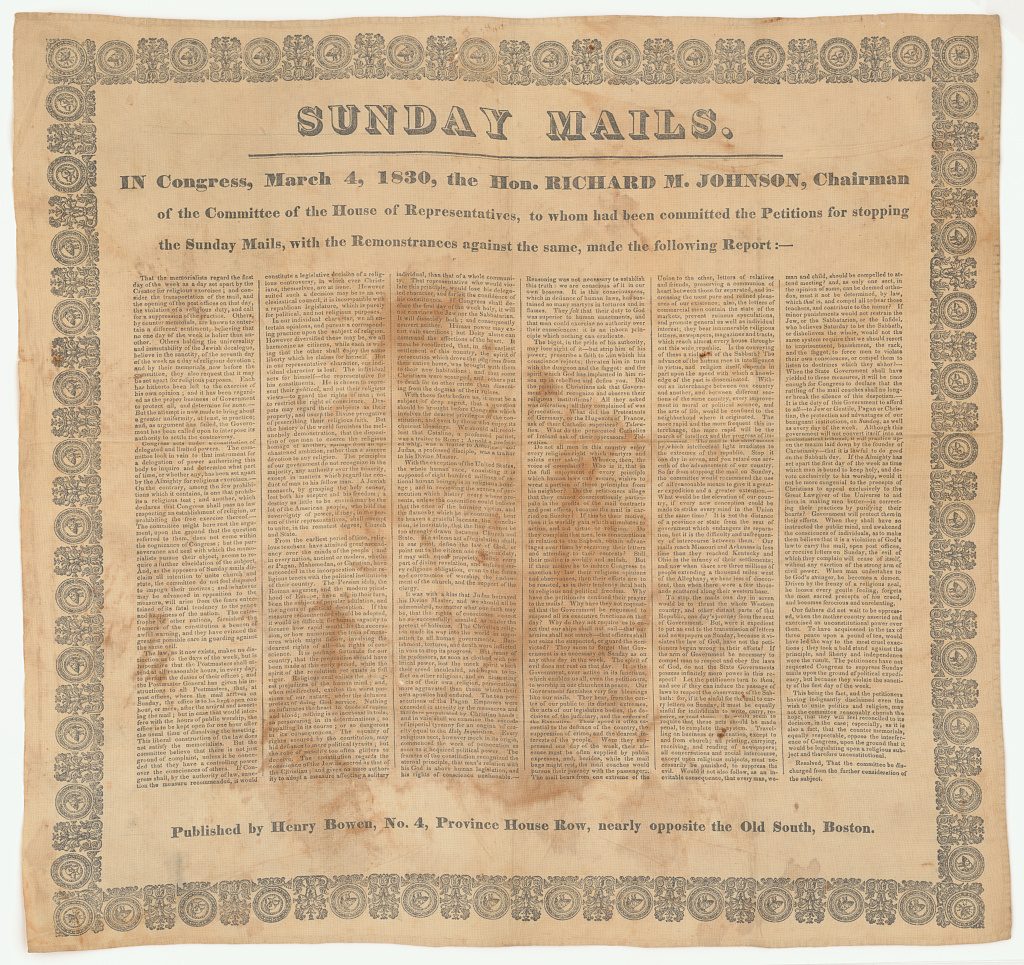
Richard M. Johnson of Kentucky chaired the Post Office committees first in the Senate, where he was elected as a Jackson Republican, and then in the House, where he served as a Jacksonian; he later served as Martin Van Buren's vice president from 1837 to 1841 history.house.gov. The First Amendment Encyclopedia describes him as a devout Baptist firstamendment.mtsu.edu. His committees reported against the petitions in the Senate on January 19, 1829, and in the House in March 1830. A member of the House committee, Mr. McCreery, filed a separate statement on March 5, 1830 dheller.orgdheller.org.
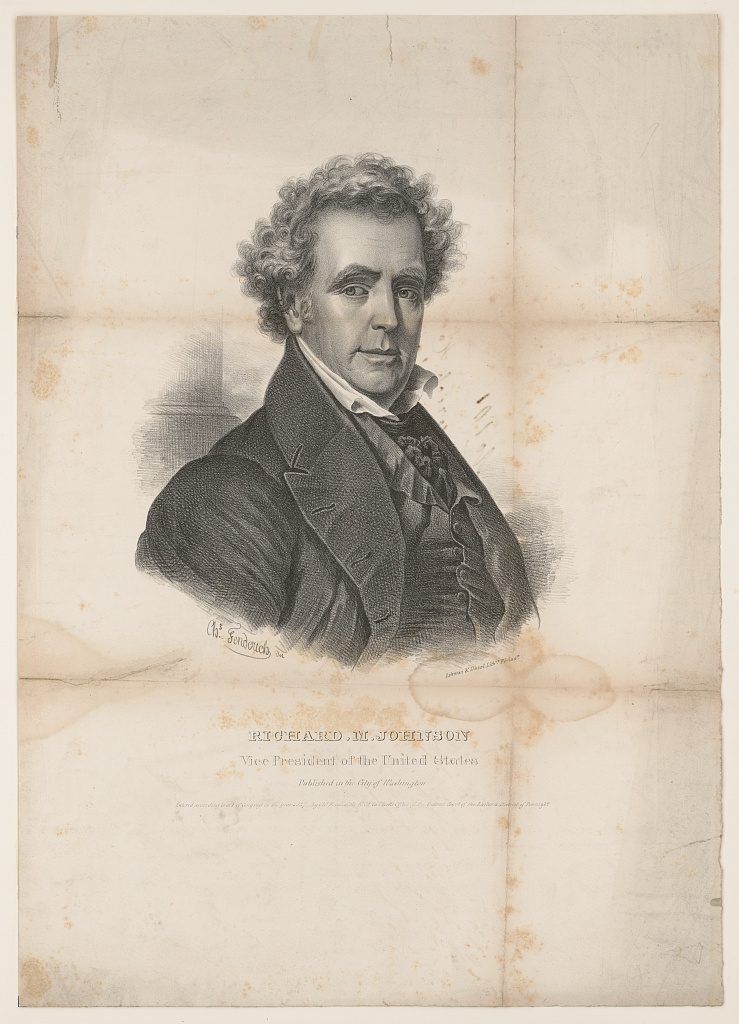
"Our Government is a civil and not a religious institution. … What other nations call religious toleration, we call religious rights." dheller.org
Richard M. Johnson, Jacksonian senator from Kentucky, Senate Post Office committee report on Sunday mails, January 19, 1829
"All Christian nations acknowledge the first day of the week to be the Sabbath." The petitioners "approach the Government, not for personal emolument, but as patriots and Christians, to express their high sense of the moral energy and necessity of the Sabbath for the perpetuity of our republican institutions." dheller.org
Mr. McCreery, member of the House Committee on the Post Office and Post Roads, separate statement, March 5, 1830
Johnson's 1829 report also warned: "Extensive religious combinations to effect a political object are, in the opinion of the committee, always dangerous" dheller.org. Sunday mail continued. By the 1850s, after the telegraph made market news available without the mail, postmasters general were eliminating most Sunday mail movement firstamendment.mtsu.edu.
Democrats and their opponents: the 1832 fast day
In 1832, as cholera spread through New York City, the Dutch Reformed Synod asked civil authorities, including President Jackson, to proclaim a day of fasting, humiliation, and prayer. Historian Michael E. Woods, citing the work of Adam Jortner, writes that Jackson refused on constitutional grounds about church and state; that Henry Clay, his opponent in that year's election, introduced his own fast day resolution in Congress; and that this helped recruit evangelicals into the anti-Jackson coalition that became the Whig Party journalofthecivilwarera.org.
Democrats, Catholics, and the nativists, 1840s to 1850s
In the 1850s most immigrants came from Ireland and Germany; in the three decades before Pierce left office, more than five million arrived, and most of the Irish were Roman Catholic millercenter.org. The Miller Center writes that many Protestants viewed Catholics as less loyal to the nation than to the pope, that "Democrats were less anti-Catholic," and that the Democratic President Franklin Pierce named James Campbell of Pennsylvania postmaster general, the first Roman Catholic cabinet officer millercenter.org. In the 1852 campaign, the Whig candidate Winfield Scott told Irish Catholic voters that his daughter had been schooled in a convent, and his operatives tried to tie Pierce to an old New Hampshire law barring Catholics from state office. Pierce's side reminded immigrant voters that Scott had ordered the hanging of more than sixty men, mostly Irish immigrants who had deserted the American Army and fought for Mexico millercenter.org.
In Philadelphia the conflict turned on the Bible in public schools. Catholic Bishop Francis Patrick Kenrick objected to Protestant teachers leading students in Protestant hymns and requiring them to read from the King James Bible philadelphiaencyclopedia.org. In 1842, Protestant clergymen formed the American Protestant Association, and in December 1843 a nativist party, the American Republican Association, was founded philadelphiaencyclopedia.org. On May 6, 1844, a nativist rally in Kensington ended in gunfire, and a young nativist, George Shiffler, was killed. On May 8, mobs burned St. Michael's and St. Augustine's churches and a Catholic seminary. On July 7, a crowd armed with cannon forced the militia to give up the Church of St. Philip de Neri in Southwark; by the next morning four militiamen and probably a dozen rioters were dead philadelphiaencyclopedia.org. That October, nativist candidates won two Philadelphia congressional seats philadelphiaencyclopedia.org.
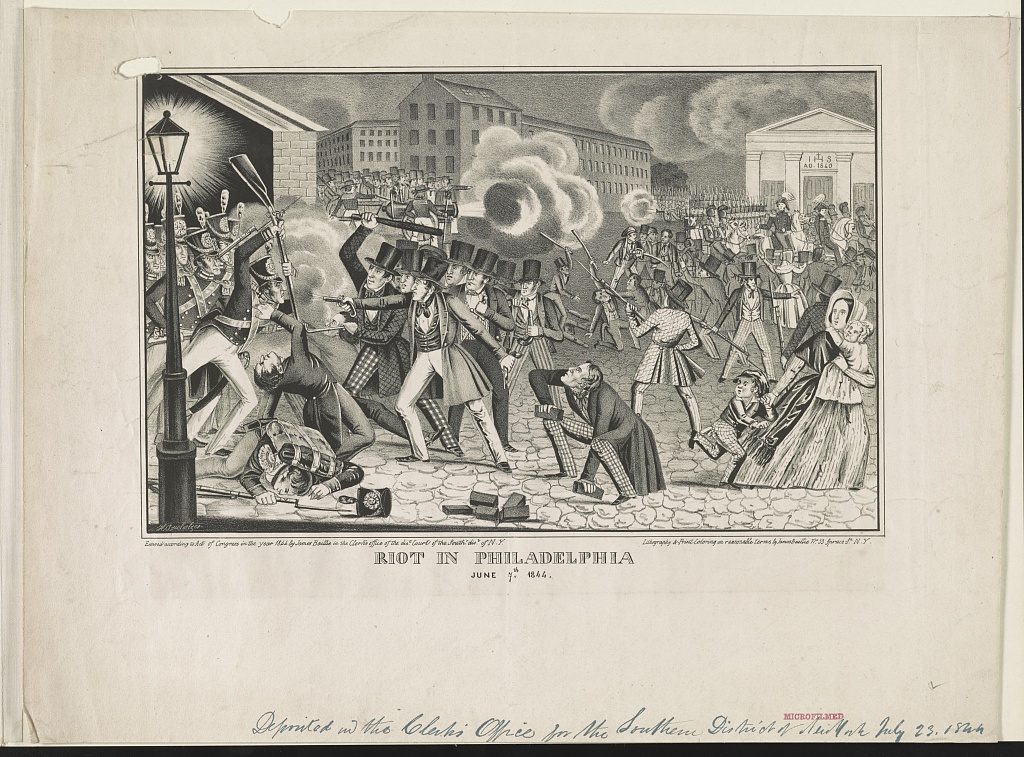
By the mid-1850s the movement had become the American Party, the Know-Nothings, which in the Miller Center's words "railed against the Catholic faith and sought to restrict Catholic immigration." It won several governorships and legislative seats and, with former President Millard Fillmore as its candidate, more than 20 percent of the presidential vote in 1856 millercenter.orgmillercenter.org.
Democrats and Republicans, 1856
When the Whig Party dissolved over slavery in the 1850s, the Senate Historical Office writes, it was replaced by "a new Republican Party, a coalition dedicated to blocking the spread of slavery into the nation's western territories"; the Democratic Party also split, between some Northern Democrats with antislavery positions and proslavery Southern Democrats senate.gov. In 1856 each party's national platform addressed religion.
"no party can justly be deemed national, constitutional, or in accordance with American principles, which bases its exclusive organization upon religious opinions and accidental birth-place. And hence a political crusade in the nineteenth century, and in the United States of America, against Catholic and foreign-born is neither justified by the past history or the future prospects of the country." presidency.ucsb.edu
Democratic Party platform, June 2, 1856
"the spirit of our institutions as well as the Constitution of our country, guarantees liberty of conscience and equality of rights among citizens, we oppose all legislation impairing their security." It is "the right and the imperative duty of Congress to prohibit in the Territories those twin relics of barbarism," which the platform names as polygamy and slavery. presidency.ucsb.edu
Republican Party platform, read at the national convention, June 18, 1856
The same Democratic platform pledged to resist "all attempts at renewing, in Congress or out of it, the agitation of the slavery question," and to abide by the compromise measures of 1850, "the act for reclaiming fugitives from service or labor" included presidency.ucsb.edu. The first parties of Latter-day Saints had arrived in Utah in July 1847 loc.gov.
In the campaign, the Miller Center records, the Know-Nothings "charged Frémont with being a Catholic, damaging his support" millercenter.org. Abraham Lincoln, who made dozens of speeches for Frémont millercenter.org, had written to Joshua Speed on August 24, 1855: "I am not a Know-Nothing," and "How can any one who abhors the oppression of negroes, be in favor of degrading classes of white people?" Under the Know-Nothings, he wrote, the Declaration would read "all men are created equal except negroes, and foreigners, and Catholics" papersofabrahamlincoln.org.
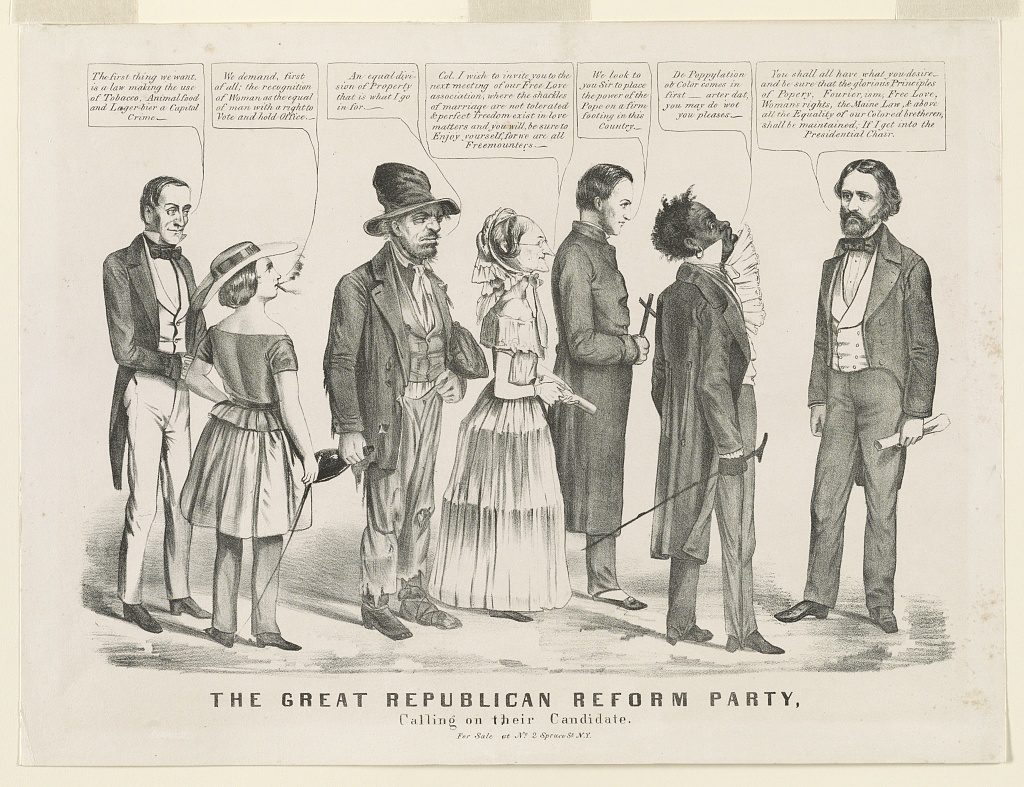
The Miller Center writes that as the Whig Party disintegrated and the Republicans replaced it, voting constituencies "fragmented increasingly along ethnic and religious lines": German American voters in the rural Midwest and Protestants from the Northeast moved into the Republican Party, and Southern whites remained in the Democratic Party millercenter.org.
The churches and slavery
The Southern Baptist Convention was founded in 1845. Its 1995 resolution on its 150th anniversary states that its relationship with African Americans had been hindered "by the role that slavery played in the formation of the Southern Baptist Convention," and that "Many of our Southern Baptist forbears defended the right to own slaves" sbc.net. Richard Allen and his colleagues broke away from the Methodist Church in Philadelphia in 1787 and founded the African Methodist Episcopal Church in 1815. The Library of Congress writes that many Black converts were disappointed at their treatment by fellow believers and at the backsliding of many white Baptists and Methodists on the abolition of slavery loc.gov.
Today
Pew Research Center's April 9, 2024, study of party coalitions, based on its surveys through 2023, reports the religious makeup of registered voters in each party, including those who lean toward it pewresearch.org:
| Democratic and Democratic-leaning voters | Republican and Republican-leaning voters | |
|---|---|---|
| Christian | 54% (74% in 2008) | 81% (86% in 2008) |
| Religiously unaffiliated | 38% | 15% (9% in 2008) |
| White evangelical Protestant | 5% | 30% |
| White nonevangelical Protestant | 10% | 15% |
Pew also reports that 8% of Democratic voters belong to non-Christian faiths and 14% are Black Protestants, and that 18% of Republican voters are White Catholics pewresearch.org.
Pew also reports that in 2023, 62% of registered voters who attended religious services at least once a month aligned with Republicans, compared with 41% of those who attended less often pewresearch.org.
Evidence
Primary documents, each linked in full: Jefferson's bill and the Virginia legislative record founders.archives.gov; Madison's Memorial and Remonstrance with the petition counts founders.archives.gov; the Danbury Baptists' address and Jefferson's reply founders.archives.govfounders.archives.gov; Jefferson's account book founders.archives.gov; his letter to Samuel Miller founders.archives.gov; Madison's veto messages and 1812 proclamation founders.archives.govfounders.archives.govfounders.archives.gov; Johnson's Senate and House reports and McCreery's statement dheller.orgdheller.org; Lincoln's letter to Speed papersofabrahamlincoln.org; the 1856 Republican and Democratic platforms presidency.ucsb.edupresidency.ucsb.edu; and the Southern Baptist Convention's 1995 resolution sbc.net.
Context and secondary accounts: the Library of Congress exhibition Religion and the Founding of the American Republic loc.govloc.govloc.govloc.gov; editorial notes in the Jefferson and Madison papers founders.archives.govfounders.archives.govfounders.archives.govfounders.archives.gov; the Connecticut State Library and Connecticut Explored portal.ct.govctexplored.org; the First Amendment Encyclopedia firstamendment.mtsu.edu; the House and Senate historical offices history.house.govsenate.gov; Michael E. Woods journalofthecivilwarera.org; the Encyclopedia of Greater Philadelphia philadelphiaencyclopedia.org; the Miller Center millercenter.orgmillercenter.org; and Pew Research Center pewresearch.orgpewresearch.org.
What the evidence does not show
It does not show what most voters in 1800 believed about Jefferson's religion. No surveys exist; the record holds what clergy, editors, and churches wrote.
It does not show a clean religious split between the early parties. Federalist presidents proclaimed fast days, and Democratic-Republican presidents attended worship in the Capitol; Madison proclaimed a day of prayer in 1812 loc.govfounders.archives.gov.
It does not settle what the "wall of separation" meant. The Library of Congress notes that the meaning of the establishment clause has been in passionate dispute, and reads Jefferson's phrase as aimed at a national religion loc.gov.
It does not confirm Jefferson's account of the "Jesus Christ" amendment in Virginia, which the legislative journals do not record founders.archives.gov.
It does not give the party of Mr. McCreery, whose 1830 statement is quoted above; the sources cited here do not state it.
It does not explain why today's voters align as they do. Pew's figures describe who is in each coalition, not their reasons pewresearch.org.
Sources
- Library of Congress, "Religion and the State Governments," Religion and the Founding of the American Republic exhibition. loc.gov (locator: introduction; items 133, 137, 140, 141, 143, 144, and the Surry County petition). Accessed 2026-10-30.
- Thomas Jefferson, "82. A Bill for Establishing Religious Freedom, 18 June 1779," with editorial note, Founders Online, National Archives; original source: The Papers of Thomas Jefferson, vol. 2, ed. Julian P. Boyd (Princeton University Press, 1950), pp. 545 to 553. founders.archives.gov (locator: preamble; enacting clause; editorial note on passage, December 17, 1785, and January 16, 1786; note 3). Accessed 2026-10-30.
- James Madison, "Memorial and Remonstrance against Religious Assessments, [ca. 20 June] 1785," with editorial note, Founders Online, National Archives; original source: The Papers of James Madison, vol. 8 (University of Chicago Press, 1973), pp. 295 to 306. founders.archives.gov (locator: paragraph 1; editorial note on petitions and authorship). Accessed 2026-10-30.
- Library of Congress, "Religion and the Federal Government, Part 1," Religion and the Founding of the American Republic exhibition. loc.gov (locator: introduction; items 148, 149, 156, 158). Accessed 2026-10-30.
- Library of Congress, "Religion and the Federal Government, Part 2," Religion and the Founding of the American Republic exhibition. loc.gov (locator: introduction; items 159, 160, 162, 163a, 163b, 166). Accessed 2026-10-30.
- "Thomas Jefferson to William Linn, 31 July 1791," editorial note, Founders Online, National Archives; original source: The Papers of Thomas Jefferson, vol. 20 (Princeton University Press, 1982), pp. 706 to 707. founders.archives.gov (locator: editorial note, second paragraph). Accessed 2026-10-30.
- "Danbury Baptist Association to Thomas Jefferson, [after 7 October 1801]," Founders Online, National Archives; original source: The Papers of Thomas Jefferson, vol. 35, pp. 407 to 409. founders.archives.gov (locator: second paragraph). Accessed 2026-10-30.
- "Reply to the Danbury Baptist Association [Editorial Note]," Founders Online, National Archives; original source: The Papers of Thomas Jefferson, vol. 36, ed. Barbara B. Oberg (Princeton University Press, 2009), pp. 253 to 254. founders.archives.gov (locator: full note). Accessed 2026-10-30.
- "Thomas Jefferson to the Danbury Baptist Association, 1 January 1802," Founders Online, National Archives; original source: The Papers of Thomas Jefferson, vol. 36, p. 258. founders.archives.gov (locator: second paragraph). Accessed 2026-10-30.
- Thomas Jefferson, "Memorandum Books, 1802," Founders Online, National Archives. founders.archives.gov (locator: entry for January 4, 1802, and note 33). Accessed 2026-10-30.
- "From Thomas Jefferson to Samuel Miller, 23 January 1808," Founders Online, National Archives, early access document. founders.archives.gov (locator: full letter). Accessed 2026-10-30.
- James Madison, "Presidential Proclamation, [9 July] 1812," Founders Online, National Archives. founders.archives.gov (locator: proclamation text; note 2). Accessed 2026-10-30.
- "James Madison to the House of Representatives, 21 February 1811," Founders Online, National Archives. founders.archives.gov (locator: veto message; note 1). Accessed 2026-10-30.
- "James Madison to the House of Representatives, 28 February 1811," Founders Online, National Archives. founders.archives.gov (locator: veto message; note 1). Accessed 2026-10-30.
- Connecticut State Library, "Douglas Arnold," Third Thursday Presentations. portal.ct.gov (locator: presentation summary). Accessed 2026-10-30.
- Jon Blue and Henry Cohn, "What We Got in the Constitution of 1818," Connecticut Explored, Fall 2018. ctexplored.org (locator: sections on 1818 and on religion). Accessed 2026-10-30.
- Library of Congress, "Religion and the New Republic," Religion and the Founding of the American Republic exhibition. loc.gov (locator: introduction; items 181, 190, 198 to 200). Accessed 2026-10-30.
- Richard M. Johnson, report of the Senate Committee on the Post Office and Post Roads, "Sunday Mails," communicated to the Senate January 19, 1829, American State Papers, Post Office Department, No. 74, pp. 211 to 212 (facsimile). dheller.org (locator: pp. 211 to 212). Accessed 2026-10-30.
- "Sunday Mails," report of the House Committee on the Post Office and Post Roads by Richard M. Johnson and separate statement by Mr. McCreery, communicated to the House March 4 and 5, 1830, American State Papers, Post Office Department, No. 87 (facsimile). dheller.org (locator: opening of Johnson report; McCreery statement of March 5, 1830). Accessed 2026-10-30.
- Caryn E. Neumann, "Sunday Mail," The First Amendment Encyclopedia, Free Speech Center at Middle Tennessee State University, July 31, 2023. firstamendment.mtsu.edu (locator: full article). Accessed 2026-10-30.
- U.S. House of Representatives, History, Art and Archives, "JOHNSON, Richard Mentor." history.house.gov (locator: biography and party labels). Accessed 2026-10-30.
- Michael E. Woods, "Presidential Politics in a Public Health Crisis: Cholera and the 1832 Election," The Journal of the Civil War Era, July 14, 2020. journalofthecivilwarera.org (locator: paragraphs on Clay and the fast day). Accessed 2026-10-30.
- Zachary M. Schrag, "Nativist Riots of 1844," Encyclopedia of Greater Philadelphia, 2013. philadelphiaencyclopedia.org (locator: full essay). Accessed 2026-10-30.
- Miller Center, University of Virginia, "Franklin Pierce: The American Franchise." millercenter.org (locator: sections on immigration and the Know-Nothings). Accessed 2026-10-30.
- Miller Center, University of Virginia, "James Buchanan: Campaigns and Elections." millercenter.org (locator: 1856 campaign). Accessed 2026-10-30.
- "Abraham Lincoln to Joshua F. Speed, 24 August 1855," The Papers of Abraham Lincoln. papersofabrahamlincoln.org (locator: paragraph on the Know-Nothings). Accessed 2026-10-30.
- "Republican Party Platform of 1856," June 18, 1856, The American Presidency Project, ed. Gerhard Peters and John T. Woolley. presidency.ucsb.edu (locator: territorial and final resolutions; APP note on date). Accessed 2026-10-30.
- Southern Baptist Convention, "Resolution On Racial Reconciliation On The 150th Anniversary Of The Southern Baptist Convention," June 1, 1995. sbc.net (locator: preamble clauses). Accessed 2026-10-30.
- Pew Research Center, "The changing demographic composition of voters and party coalitions," in Changing Partisan Coalitions in a Politically Divided Nation, April 9, 2024. pewresearch.org (locator: section on religious affiliation). Accessed 2026-10-30.
- U.S. Senate, "Parties and Leadership: Overview." senate.gov (locator: sections on the 1790s, the 1820s, and the 1850s). Accessed 2026-10-30.
- Pew Research Center, "Party identification among religious groups and religiously unaffiliated voters," April 9, 2024. pewresearch.org (locator: section on religious attendance). Accessed 2026-10-30.
- "1856 Democratic Party Platform," June 2, 1856, The American Presidency Project, ed. Gerhard Peters and John T. Woolley. presidency.ucsb.edu (locator: resolutions on religious tests and on slavery). Accessed 2026-10-30.
Last checked against its sources on October 30, 2026. Report a correction.