
How we got here
Changed Their Minds: Presidents and Politicians Who Changed Position
The short answer
Madison opposed a national bank in 1791 and signed one in 1816. Lincoln said in 1861 he had no purpose to interfere with slavery in the states and issued the Emancipation Proclamation in 1863. Wilson, Vandenberg, Lyndon Johnson, Nixon, George Wallace, George H. W. Bush, Barack Obama, Joe Biden and Rob Portman each stated a position and later stated a different one. Each change is followed here by the vote, the law or the result.
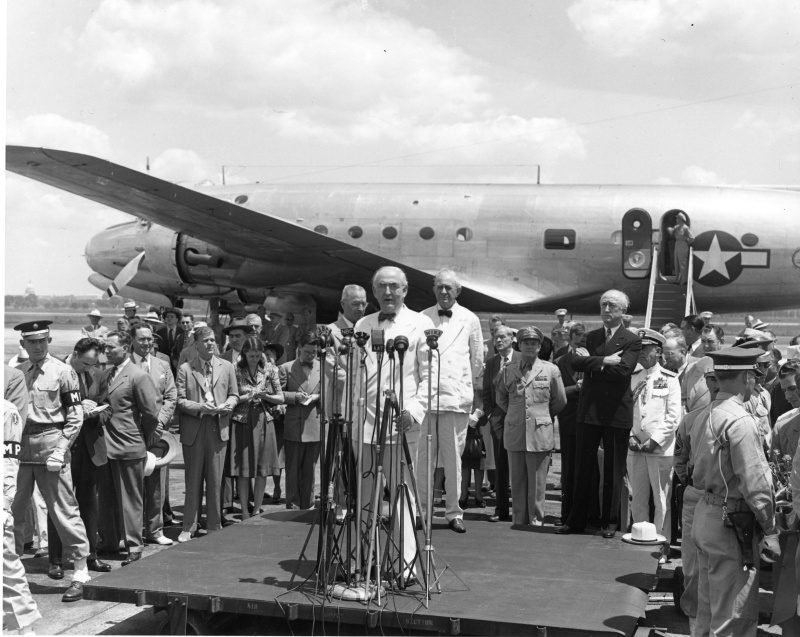
On Wednesday, January 10, 1945, Senator Arthur H. Vandenberg of Michigan, a Republican seventeen years into his Senate career, took the floor govinfo.govsenate.gov. Five years earlier he had argued for an arms embargo to keep the country out of the war in Europe govinfo.gov. That day he said:
"I have always been frankly one of those who has believed in our own self-reliance. ... But I do not believe that any nation hereafter can immunize itself by its own exclusive action." govinfo.gov
Arthur H. Vandenberg, Republican senator from Michigan, Senate floor, January 10, 1945
Six months later the Senate approved the United Nations Charter, 89 to 2 senate.gov.
This chapter collects people who did what Vandenberg did: they said one thing in public, later said another, and the country acted on the second. Each entry gives the earlier position in the person's own words with its date, the later position in the person's own words with its date, and what followed. Entries alternate between the Democratic side and the Republican side. Before 1854 the parties are those of the era and are labeled.
James Madison and the national bank
Democratic-Republican. On February 2, 1791, Representative James Madison of Virginia spoke in the House against the bill chartering the Bank of the United States founders.archives.gov.
"The latitude of interpretation required by the bill is condemned by the rule furnished by the constitution itself. ... In fine, if the power were in the constitution, the immediate exercise of it cannot be essential ... if not there, the exercise of it involves the guilt of usurpation, and establishes a precedent of interpretation, levelling all the barriers which limit the powers of the general government, and protect those of the state governments." founders.archives.gov
James Madison, representative from Virginia (Democratic-Republican), House speech on the bank bill, February 2, 1791
The first bank's charter lapsed, and the bank closed in 1811 millercenter.org. By January 1815 the country had been without a national bank for almost four years federalreservehistory.org. On January 30, 1815, President Madison vetoed a bank bill, but not on constitutional grounds:
"Waiving the question of the constitutional authority of the Legislature to establish an incorporated bank as being precluded in my judgment by repeated recognitions under varied circumstances of the validity of such an institution in acts of the legislative, executive, and judicial branches of the Government, accompanied by indications, in different modes, of a concurrence of the general will of the nation, the proposed bank does not appear to be calculated to answer the purposes of reviving the public credit." presidency.ucsb.edu
James Madison, president (Democratic-Republican), veto message to the Senate, January 30, 1815
In his annual message of December 5, 1815, he wrote that if the state banks could not provide a uniform national currency, "the probable operation of a national bank will merit consideration" presidency.ucsb.edu.
What followed. On April 10, 1816, Madison signed a bill chartering a new national bank in Philadelphia for a term of 21 years millercenter.org. The Second Bank of the United States opened in January 1817 with capital of $35 million, compared with $10 million for the first bank federalreservehistory.org. In 1831 Madison answered the charge of inconsistency in a letter. "The charge of inconsistency between my objection to the constitutionality of such a Bank in 1791, and my assent in 1817," he wrote, "turns on the question, how far legislative precedents expounding the constitution, ought to guide succeeding legislatures, and to overule individual opinions" founders.archives.gov. The letter gives the year of his assent as 1817; the bill was signed on April 10, 1816 millercenter.orgfounders.archives.gov.
Abraham Lincoln and emancipation
Republican. In his first inaugural address, on March 4, 1861, Lincoln addressed the slave states directly.
"I have no purpose, directly or indirectly, to interfere with the institution of slavery in the States where it exists. I believe I have no lawful right to do so, and I have no inclination to do so." presidency.ucsb.edu
Abraham Lincoln, president (Republican), first inaugural address, March 4, 1861
On August 22, 1862, answering the editor Horace Greeley, he wrote: "My paramount object in this struggle is to save the Union, and is not either to save or destroy Slavery. If I could save the Union without freeing any slave, I would do it, and if I could save it by freeing all the slaves, I would do it" presidency.ucsb.edu.
"I do order and declare that all persons held as slaves within said designated States and parts of States are and henceforward shall be free. ... And upon this act, sincerely believed to be an act of justice, warranted by the Constitution upon military necessity, I invoke the considerate judgment of mankind and the gracious favor of Almighty God." presidency.ucsb.edu
Abraham Lincoln, president (Republican), Emancipation Proclamation, January 1, 1863
What followed. The proclamation applied only to the states in rebellion. It left slavery untouched in the loyal border states and exempted parts of the Confederacy already under Union control archives.gov. It also announced that Black men would be accepted into the Union Army and Navy; by the end of the war almost 200,000 Black soldiers and sailors had served archives.gov. On April 4, 1864, Lincoln explained his reasoning in a letter: "I am naturally anti-slavery. If slavery is not wrong, nothing is wrong. ... And yet I have never understood that the Presidency conferred upon me an unrestricted right to act officially upon this judgment and feeling" presidency.ucsb.edu. In the same letter: "I claim not to have controlled events, but confess plainly that events have controlled me" presidency.ucsb.edu. The Senate passed the 13th Amendment in April 1864. The House passed it on January 31, 1865, by 119 to 56. It was ratified on December 6, 1865 archives.gov.
Woodrow Wilson and the vote for women
Democrat. In October 1915 the White House released a statement from President Wilson about a referendum on woman suffrage in his home state of New Jersey historicnewspapers.sc.edu.
"I intend to vote for woman suffrage in New Jersey because I believe that the time has come to extend that privilege and responsibility to the women of the State. ... My position with regard to the way in which the great question should be handled is well known. I believe that it should be settled by the States and not by the national government, and that in no circumstances should it be made a party question; and my view has grown stronger at every turn of the agitation." historicnewspapers.sc.edu
Woodrow Wilson, president (Democrat), White House statement, October 1915, as printed in the Horry Herald, October 14, 1915
On January 10, 1918, the House passed a federal suffrage amendment, 274 to 136. On September 30, 1918, with the amendment pending in the Senate, Wilson went to the Senate in person everycrsreport.com.
"I regard the concurrence of the Senate in the constitutional amendment proposing the extension of the suffrage to women as vitally essential to the successful prosecution of the great war of humanity in which we are engaged. ... We have made partners of the women in this war; shall we admit them only to a partnership of suffering and sacrifice and toil and not to a partnership of privilege and right?" presidency.ucsb.edu
Woodrow Wilson, president (Democrat), address to the Senate, September 30, 1918
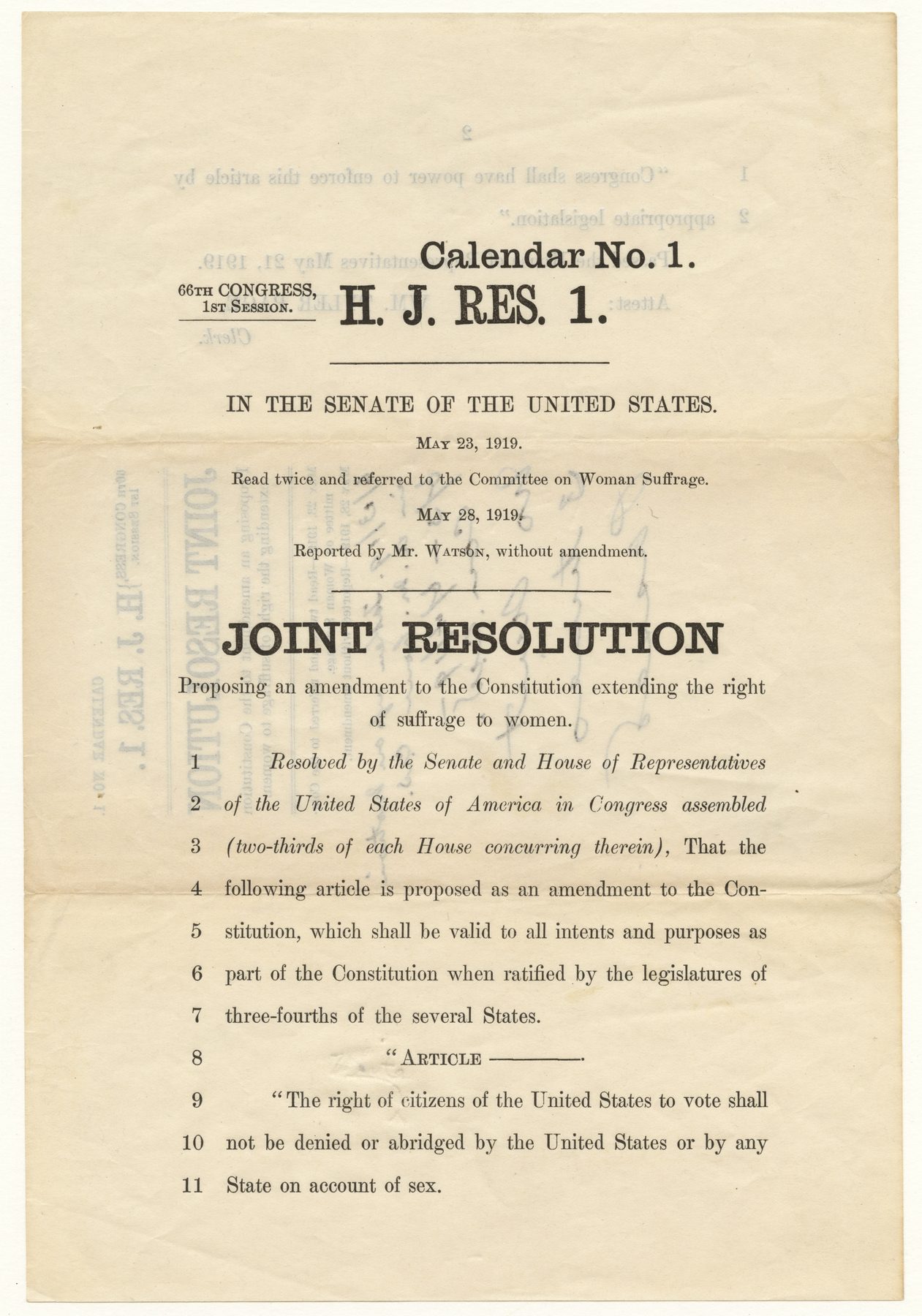
What followed. On October 1, 1918, the Senate vote was 53 to 31, two votes short of the two-thirds required. On February 10, 1919, it failed again, 55 to 29, one vote short. In the next Congress the House passed H.J. Res. 1 on May 21, 1919, by 304 to 89, and the Senate passed it on June 4, 1919, by 56 to 25. Tennessee became the 36th state to ratify on August 18, 1920, and the Secretary of State certified the 19th Amendment on August 26, 1920 everycrsreport.com.
Arthur Vandenberg and the world
Republican. In the fall of 1939, after war began in Europe, the Senate debated repealing the arms embargo in the Neutrality Act. Vandenberg spoke against repeal on October 4, 1939 govinfo.gov.
"I must think solely of the welfare of our own America. I believe that welfare is inseverably linked to immunity to any foreign war which does not come to us. 'America first' is now a literal necessity. The single, paramount question is, Shall America stay out of this war, and how?" govinfo.gov
Arthur H. Vandenberg, Republican senator from Michigan, Senate floor, October 4, 1939
The Senate passed the repeal, 63 to 30, on October 27, 1939: Democrats 54 to 12, Republicans 8 to 15, and Vandenberg voted no voteview.com. On January 10, 1945, he spoke again:
"I have always been frankly one of those who has believed in our own self-reliance. ... But I do not believe that any nation hereafter can immunize itself by its own exclusive action. Since Pearl Harbor, World War No. 2 has put the gory science of mass murder into new and sinister perspective. Our oceans have ceased to be moats." govinfo.gov
Arthur H. Vandenberg, Republican senator from Michigan, Senate floor, January 10, 1945
What followed. President Roosevelt, a Democrat, appointed Vandenberg a delegate to the United Nations Conference on International Organization, which met in San Francisco on April 25, 1945. The Senate approved the United Nations Charter on July 28, 1945, by 89 to 2 senate.gov; Democrats voted 53 to 0 and Republicans 35 to 2 voteview.com. In 1948 Vandenberg proposed the resolution that led to negotiations for the North Atlantic Treaty history.state.gov. The Senate approved the treaty on July 21, 1949, by 82 to 13: Democrats 49 to 2, Republicans 33 to 11, and Vandenberg voted yes voteview.com.
Lyndon Johnson and civil rights
Democrat. On March 9, 1949, two months after taking his Senate seat, Lyndon Johnson of Texas spoke against Senate Resolution 15, which would have amended the Senate's cloture rule for ending debate. He tied the rule to "the President's civil-rights program" govinfo.gov.
"When we of the South rise here to speak against this resolution or to speak against the civil-rights proposals, we are not speaking against the Negro race. ... We are trying to tell the rest of the Nation that this is not the way to accomplish what so many want to do for the Negro." govinfo.gov
Lyndon B. Johnson, Democratic senator from Texas, Senate floor, March 9, 1949
In the same speech he said he opposed the poll tax and lynching, called the federal anti-poll-tax bills "wholly unconstitutional," and said of the filibuster that it "is the last defense of reason, the sole defense of minorities who might be victimized by prejudice" govinfo.gov.
Five days after President Kennedy was killed, Johnson, now president, addressed a joint session of Congress.
"No memorial oration or eulogy could more eloquently honor President Kennedy's memory than the earliest possible passage of the civil rights bill for which he fought so long. We have talked long enough in this country about equal rights. We have talked for one hundred years or more. It is time now to write the next chapter, and to write it in the books of law." presidency.ucsb.edu
Lyndon B. Johnson, president (Democrat), address to a joint session of Congress, November 27, 1963
What followed. In the Senate the civil rights bill met a filibuster. On June 10, 1964, after the bill had occupied the Senate for 60 working days, the Senate voted 71 to 29 to end debate. It was the first time the Senate had cut off a filibuster on a civil rights bill. Nine days later it passed the bill senate.gov. Johnson signed the Civil Rights Act on July 2, 1964. "Our Constitution, the foundation of our Republic, forbids it," he said of discrimination. "The principles of our freedom forbid it. Morality forbids it. And the law I will sign tonight forbids it" presidency.ucsb.edu.
Richard Nixon and China
Republican. On October 8, 1960, Vice President Nixon, the Republican nominee for president, was asked on a Milwaukee television program about a United Nations vote on seating the People's Republic of China presidency.ucsb.edu.
"Now, if we were to change our position and to vote for admitting Red China to the United Nations, we would in effect, I think, reduce the moral power of the United Nations a great deal. I don't think we can do it. I think that once Red China changes its position, once it qualifies as a civilized member of the community of nations, we can change our position on admission but until it changes its position we can't change ours." presidency.ucsb.edu
Richard Nixon, vice president (Republican), "The Open Question," WTMJ-TV, Milwaukee, October 8, 1960
"There can be no stable and enduring peace without the participation of the People's Republic of China and its 750 million people. That is why I have undertaken initiatives in several areas to open the door for more normal relations between our two countries." presidency.ucsb.edu
Richard Nixon, president (Republican), televised remarks announcing his visit to China, July 15, 1971
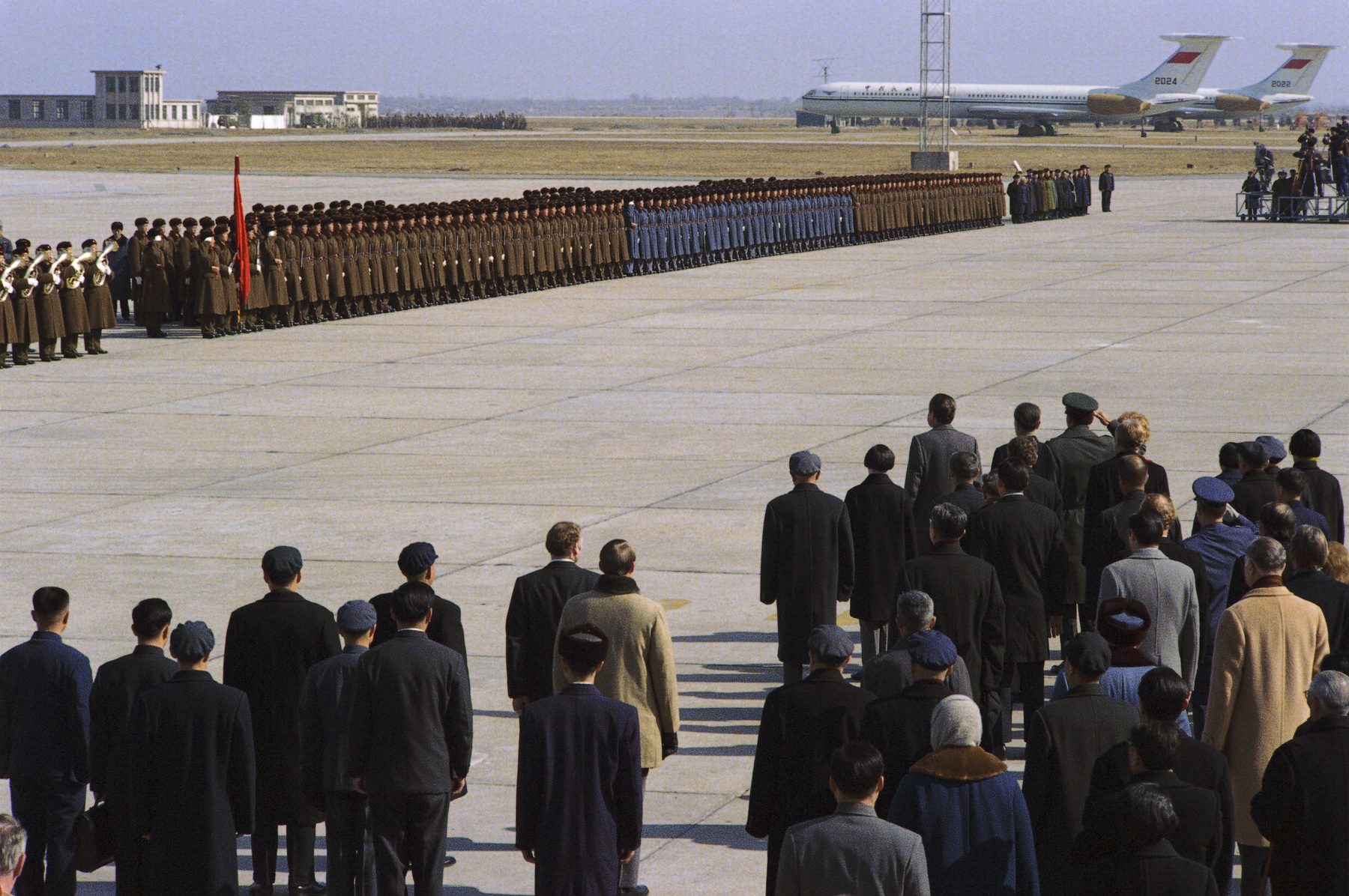
What followed. In October 1971 the United Nations voted to seat the People's Republic of China in place of the delegation from Taiwan. The United States had proposed seating both; it opposed Taiwan's expulsion and supported the People's Republic taking the Security Council seat history.state.gov. Nixon visited China from February 21 to 28, 1972, the first president to visit mainland China while in office, and the two governments issued the Shanghai Communiqué history.state.gov. On December 15, 1978, President Carter, a Democrat, announced that the United States would establish diplomatic relations with the People's Republic on January 1, 1979 history.state.gov.
George Wallace and segregation
Democrat. George Wallace took the oath as governor of Alabama on January 14, 1963, at the Capitol in Montgomery archives.alabama.gov.
"Today I have stood, where once Jefferson Davis stood, and took an oath to my people. ... In the name of the greatest people that have ever trod this earth, I draw the line in the dust and toss the gauntlet before the feet of tyranny ... and I say ... segregation now ... segregation tomorrow ... segregation forever." archives.alabama.gov
George C. Wallace, governor of Alabama (Democrat), inaugural address, Montgomery, January 14, 1963
"I did stand, with a majority of the white people, for the separation of the schools. But that was wrong, and that will never come back again." pbs.org
George C. Wallace, former governor of Alabama (Democrat), to a Birmingham meeting of the Southern Christian Leadership Conference, 1982
What followed. In 1982 Wallace ran for governor again. Black voters gave him one third of their votes in the first Democratic primary, and in the general election he carried 90 percent of the state's Black electorate and defeated the Republican, Emory Folmar, the mayor of Montgomery encyclopediaofalabama.org. In that term he appointed African Americans to advisory panels encyclopediaofalabama.org.
George H. W. Bush and taxes
Republican. On August 18, 1988, Vice President Bush accepted the Republican nomination in New Orleans.
"My opponent won't rule out raising taxes, but I will, and the Congress will push me to raise taxes, and I'll say no, and they'll push, and I'll say no, and they'll push again, and I'll say to them, 'Read my lips: no new taxes.'" presidency.ucsb.edu
George Bush, vice president (Republican), acceptance address, Republican National Convention, August 18, 1988
"It is clear to me that both the size of the deficit problem and the need for a package that can be enacted require all of the following: entitlement and mandatory program reform, tax revenue increases, growth incentives, discretionary spending reductions, orderly reductions in defense expenditures, and budget process reform." presidency.ucsb.edu
George Bush, president (Republican), statement on the federal budget negotiations, June 26, 1990
What followed. The House adopted the conference report on the Omnibus Budget Reconciliation Act of 1990 on October 26, 1990, by 228 to 200: Democrats 181 to 74, Republicans 47 to 126 clerk.house.gov. The Senate adopted it on October 27, 1990, by 54 to 45: Democrats 35 to 20, Republicans 19 to 25 voteview.com. Bush signed it on November 5, 1990. His signing statement listed "higher excise taxes on luxury items and limitations on itemized deductions and the personal exemption for higher income taxpayers," a top rate cut from 33 percent to 31 percent for about 3.5 million taxpayers, and said "the total net tax changes comprise 28 percent of the deficit reduction package" presidency.ucsb.edu.
Barack Obama and Joe Biden on marriage
Democrats. On September 10, 1996, Senator Joe Biden of Delaware voted for the Defense of Marriage Act, which passed the Senate 85 to 14: Democrats 32 to 14, Republicans 53 to 0 voteview.com. On August 16, 2008, the pastor Rick Warren asked Senator Barack Obama, the Democratic candidate for president, to define marriage.
"I believe that marriage is the union between a man and a woman. Now, for me as a Christian ... it is also a sacred union. God's in the mix." presidency.ucsb.edu
Barack Obama, Democratic senator from Illinois, Saddleback Civil Forum, Lake Forest, California, August 16, 2008
Asked in the vice presidential debate on October 2, 2008, whether he supported gay marriage, Biden answered: "No. Barack Obama nor I support redefining from a civil side what constitutes marriage" presidency.ucsb.edu. In the same answer he supported equal legal benefits for same-sex couples presidency.ucsb.edu.
"And I had hesitated on gay marriage ... in part, because I thought civil unions would be sufficient. ... At a certain point, I've just concluded that ... for me personally, it is important for me to go ahead and affirm that ... I think same-sex couples should be able to get married." presidency.ucsb.edu
Barack Obama, president (Democrat), interview with Robin Roberts of ABC News, May 9, 2012
What followed. On June 26, 2015, the Supreme Court held 5 to 4 in Obergefell v. Hodges that the 14th Amendment requires a state to license a marriage between two people of the same sex and to recognize one lawfully performed in another state. Justice Kennedy wrote for the Court; Chief Justice Roberts and Justices Scalia, Thomas and Alito dissented tile.loc.gov. Obama said that day: "compared to so many other issues, America's shift has been so quick. I know that Americans of good will continue to hold a wide range of views on this issue" presidency.ucsb.edu. On December 13, 2022, President Biden signed the Respect for Marriage Act congress.govpresidency.ucsb.edu.
Rob Portman and marriage
Republican. On July 12, 1996, Representative Rob Portman of Ohio voted for the Defense of Marriage Act, which passed the House 342 to 67: Republicans 224 to 1, Democrats 118 to 65 clerk.house.gov. On March 15, 2013, Senator Portman described his position and its change in an opinion column in the Columbus Dispatch nbcnews.com.
"As a congressman, and more recently as a senator, I opposed marriage for same-sex couples." nbcnews.com
Rob Portman, Republican senator from Ohio, describing his earlier position, Columbus Dispatch, March 15, 2013
"I have come to believe that if two people are prepared to make a lifetime commitment to love and care for each other in good times and in bad, the government shouldn't deny them the opportunity to get married." nbcnews.com
Rob Portman, Republican senator from Ohio, Columbus Dispatch, March 15, 2013
He wrote: "That isn't how I've always felt. ... Then something happened that led me to think through my position in a much deeper way" nbcnews.com. In the same column: "Two years ago, my son Will, then a college freshman, told my wife Jane and me that he was gay" toledoblade.com.
What followed. The Senate passed the Respect for Marriage Act on November 29, 2022, by 61 to 36. Democrats voted 47 to 0, the two independents 2 to 0, and Republicans 12 to 36; Portman voted yes congress.govvoteview.com. The House agreed on December 8, 2022, by 258 to 169: Democrats 219 to 0, Republicans 39 to 169 clerk.house.gov. At the signing, Biden named Portman among the senators who made the bipartisan vote happen presidency.ucsb.edu.
Evidence
Each change, its dates and the recorded result.
| Person | Party | Earlier position, date | Later position, date | Recorded result |
|---|---|---|---|---|
| James Madison | Democratic-Republican | Bank unconstitutional, Feb. 2, 1791 | Question "precluded" by precedent, Jan. 30, 1815 | Signed Second Bank charter, Apr. 10, 1816 millercenter.org |
| Abraham Lincoln | Republican | "No purpose" to interfere with slavery in the states, Mar. 4, 1861 | Emancipation Proclamation, Jan. 1, 1863 | 13th Amendment, House 119 to 56, Jan. 31, 1865 archives.gov |
| Woodrow Wilson | Democrat | Suffrage "settled by the States," Oct. 1915 | Federal amendment "vitally essential," Sept. 30, 1918 | 19th Amendment certified Aug. 26, 1920 everycrsreport.com |
| Arthur Vandenberg | Republican | "America first," Oct. 4, 1939 | No nation can "immunize itself," Jan. 10, 1945 | UN Charter 89 to 2; North Atlantic Treaty 82 to 13 senate.govvoteview.com |
| Lyndon Johnson | Democrat | Against cloture and the civil rights bills, Mar. 9, 1949 | "Write it in the books of law," Nov. 27, 1963 | Cloture 71 to 29, June 10, 1964; signed July 2, 1964 senate.govpresidency.ucsb.edu |
| Richard Nixon | Republican | Against seating Beijing at the UN, Oct. 8, 1960 | Visit to China announced, July 15, 1971 | Diplomatic relations Jan. 1, 1979 history.state.gov |
| George Wallace | Democrat | "Segregation forever," Jan. 14, 1963 | "That was wrong," 1982 | Won 1982 general election with 90 percent of Black voters encyclopediaofalabama.org |
| George H. W. Bush | Republican | "No new taxes," Aug. 18, 1988 | "Tax revenue increases," June 26, 1990 | Budget act signed Nov. 5, 1990 presidency.ucsb.edu |
| Barack Obama and Joe Biden | Democrat | Marriage "between a man and a woman," Aug. 16, 2008 | Same-sex couples "should be able to get married," May 9, 2012 | Respect for Marriage Act signed Dec. 13, 2022 congress.gov |
| Rob Portman | Republican | Voted for DOMA, July 12, 1996 | Government "shouldn't deny them," Mar. 15, 2013 | Voted for Respect for Marriage Act, Nov. 29, 2022 voteview.com |
The parties' votes, counted from Voteview member records and the House Clerk; only senators and representatives recorded yea or nay are counted, and the totals match the official tallies voteview.comclerk.house.govclerk.house.govclerk.house.gov.
| Vote | Total | Democrats | Republicans |
|---|---|---|---|
| Repeal of the arms embargo, Senate, Oct. 27, 1939 | 63 to 30 | 54 to 12 | 8 to 15 |
| United Nations Charter, Senate, July 28, 1945 | 89 to 2 | 53 to 0 | 35 to 2 |
| North Atlantic Treaty, Senate, July 21, 1949 | 82 to 13 | 49 to 2 | 33 to 11 |
| Budget reconciliation conference report, House, Oct. 26, 1990 | 228 to 200 | 181 to 74 | 47 to 126 |
| Budget reconciliation conference report, Senate, Oct. 27, 1990 | 54 to 45 | 35 to 20 | 19 to 25 |
| Defense of Marriage Act, House, July 12, 1996 | 342 to 67 | 118 to 65 | 224 to 1 |
| Defense of Marriage Act, Senate, Sept. 10, 1996 | 85 to 14 | 32 to 14 | 53 to 0 |
| Respect for Marriage Act, Senate, Nov. 29, 2022 | 61 to 36 | 47 to 0 | 12 to 36 |
| Respect for Marriage Act, House, Dec. 8, 2022 | 258 to 169 | 219 to 0 | 39 to 169 |
Members outside the two parties are left out of the party columns: in 1939 one independent voted yes and three members of minor parties voted no; in 1945 one Progressive voted yes; in 2022 two independent senators voted yes, and one House Republican voted present voteview.comclerk.house.gov.
What the evidence does not show
The quotations record what each person said in public. They do not record private reasons, except where the person stated a reason, and those reasons are quoted.
Madison's 1791 remarks are the text printed from his House speech in his papers. Wilson's 1915 statement is the text as one newspaper printed it. Wallace's 1982 words are as quoted by PBS American Experience; this chapter did not locate a transcript or recording of that meeting.
For Rob Portman, the sources used here record his 1996 vote and his own 2013 description of his earlier position. They do not include a statement of that earlier position made at the time.
A vote that followed a change of position is recorded here because it came next, not as proof that the change caused it. Where a source states a cause, the source is cited.
Two candidates were researched and left out. Ronald Reagan said in 1964, "I have spent most of my life as a Democrat. I recently have seen fit to follow another course" presidency.ucsb.edu, but the sources used here did not include a statement of his earlier Democratic positions in his own words from the time. Strom Thurmond's 1948 and 1983 positions were not located in his own words in the sources used.
Sources
- James Madison, "The Bank Bill, [2 February] 1791," The Papers of James Madison, vol. 13, Founders Online, National Archives. founders.archives.gov (locator: speech text, paragraphs beginning "The latitude of interpretation" and "In fine"). Accessed 2026-10-30.
- James Madison, "Message to the Senate Returning Without Approval an Act to Incorporate the Subscribers to the Bank of the United States of America," January 30, 1815, The American Presidency Project. presidency.ucsb.edu (locator: paragraph beginning "Waiving the question"). Accessed 2026-10-30.
- James Madison, "Seventh Annual Message," December 5, 1815, The American Presidency Project. presidency.ucsb.edu (locator: paragraph on a uniform national currency). Accessed 2026-10-30.
- Miller Center, University of Virginia, "James Madison: Key Events." millercenter.org (locator: entries for March 20, 1811, January 30, 1815, and April 10, 1816). Accessed 2026-10-30.
- Andrew T. Hill, "The Second Bank of the United States," Federal Reserve History. federalreservehistory.org (locator: opening sections on 1815 to 1817 and capitalization). Accessed 2026-10-30.
- James Madison to Charles J. Ingersoll, 25 June 1831, Founders Online, National Archives. founders.archives.gov (locator: paragraphs beginning "The charge of inconsistency" and "It was in conformity"). Accessed 2026-10-30.
- Abraham Lincoln, "Inaugural Address," March 4, 1861, The American Presidency Project. presidency.ucsb.edu (locator: paragraph beginning "I have no purpose"). Accessed 2026-10-30.
- Abraham Lincoln, "Letter in Reply to Horace Greeley on Slavery and the Union," August 22, 1862, The American Presidency Project. presidency.ucsb.edu (locator: paragraph beginning "I would save the Union"). Accessed 2026-10-30.
- Abraham Lincoln, "Proclamation 95: Regarding the Status of Slaves in States Engaged in Rebellion Against the United States," January 1, 1863, The American Presidency Project. presidency.ucsb.edu (locator: operative paragraph and closing paragraph). Accessed 2026-10-30.
- Abraham Lincoln, "Letter to Albert G. Hodges," April 4, 1864, The American Presidency Project. presidency.ucsb.edu (locator: quoted paragraph and final paragraph). Accessed 2026-10-30.
- National Archives, "13th Amendment to the U.S. Constitution: Abolition of Slavery (1865)," Milestone Documents. archives.gov (locator: summary and passage paragraphs). Accessed 2026-10-30.
- National Archives, "The Emancipation Proclamation," Featured Documents. archives.gov (locator: paragraphs on the proclamation's limits and on Black soldiers and sailors). Accessed 2026-10-30.
- "Believes Benefit Will Come of It," The Horry Herald (Conway, S.C.), October 14, 1915, image 7, Chronicling America, Library of Congress National Digital Newspaper Program, hosted by the University of South Carolina Libraries. historicnewspapers.sc.edu (locator: Washington item quoting the White House statement). Accessed 2026-10-30.
- Woodrow Wilson, "Address to the Senate on the Nineteenth Amendment," September 30, 1918, The American Presidency Project. presidency.ucsb.edu (locator: opening paragraph and paragraph beginning "Are we alone"). Accessed 2026-10-30.
- Congressional Research Service, "Women's Suffrage: Fact Sheet," R45805, updated February 22, 2021. everycrsreport.com (locator: timeline of congressional action, 1918 to 1920). Accessed 2026-10-30.
- Congressional Record, Senate, October 4, 1939, vol. 85, part 1, pp. 94 to 101 (speech of Senator Vandenberg). govinfo.gov (locator: Mr. VANDENBERG, beginning "Mr. President, because the words"). Accessed 2026-10-30.
- Jeffrey B. Lewis, Keith Poole, Howard Rosenthal, Adam Boche, Aaron Rudkin and Luke Sonnet, Voteview: Congressional Roll-Call Votes Database, UCLA, Senate roll call, vote and member files for the 76th, 79th, 81st, 101st, 104th and 117th Congresses. voteview.com and voteview.com (also S076, S079, S081, S101, S104) (locator: S076 roll 112, October 27, 1939; S081 roll 128, July 21, 1949; S101 roll 638, October 27, 1990; S104 roll 893, September 10, 1996; S117 roll 890, November 29, 2022). Accessed 2026-10-30.
- Congressional Record, Senate, January 10, 1945, vol. 91, part 1, pp. 164 to 167 (speech of Senator Vandenberg). govinfo.gov (locator: Mr. VANDENBERG, passage beginning "I hasten to make my own personal viewpoint clear"). Accessed 2026-10-30.
- United States Senate, "Classic Senate Speeches: Arthur H. Vandenberg, January 10, 1945." senate.gov (locator: full page). Accessed 2026-10-30.
- Office of the Historian, U.S. Department of State, "North Atlantic Treaty Organization (NATO), 1949," Milestones in the History of U.S. Foreign Relations. history.state.gov (locator: paragraph on the Vandenberg Resolution). Accessed 2026-10-30.
- Congressional Record, Senate, March 9, 1949, vol. 95, part 2, pp. 2042 to 2050 (speech of Senator Johnson of Texas). govinfo.gov (locator: Mr. JOHNSON of Texas, beginning "Mr. President, I rise with some reluctance"; passages on minorities, the poll tax and lynching). Accessed 2026-10-30.
- Lyndon B. Johnson, "Address Before a Joint Session of the Congress," November 27, 1963, The American Presidency Project. presidency.ucsb.edu (locator: paragraph beginning "First, no memorial oration"). Accessed 2026-10-30.
- United States Senate, "Civil Rights Filibuster Ended," June 10, 1964. senate.gov (locator: full page). Accessed 2026-10-30.
- Lyndon B. Johnson, "Radio and Television Remarks Upon Signing the Civil Rights Bill," July 2, 1964, The American Presidency Project. presidency.ucsb.edu (locator: paragraph beginning "But it cannot continue"). Accessed 2026-10-30.
- Richard Nixon, "Remarks of Vice President Richard M. Nixon, The Open Question, WTMJ-TV, Milwaukee, WI," October 8, 1960, The American Presidency Project. presidency.ucsb.edu (locator: answer on the United Nations vote). Accessed 2026-10-30.
- Richard Nixon, "Remarks to the Nation Announcing Acceptance of an Invitation To Visit the People's Republic of China," July 15, 1971, The American Presidency Project. presidency.ucsb.edu (locator: second paragraph). Accessed 2026-10-30.
- Office of the Historian, U.S. Department of State, "Rapprochement with China, 1972," Milestones in the History of U.S. Foreign Relations. history.state.gov (locator: paragraphs on the 1971 United Nations vote and the February 1972 visit). Accessed 2026-10-30.
- Office of the Historian, U.S. Department of State, "China Policy," Milestones in the History of U.S. Foreign Relations, 1977 to 1980. history.state.gov (locator: paragraphs on the December 15, 1978 announcement). Accessed 2026-10-30.
- Alabama Department of Archives and History, "Inaugural address of Governor George Wallace, which was delivered at the Capitol in Montgomery, Alabama," January 14, 1963, Alabama Governor administrative files, SG030847. archives.alabama.gov (locator: item description quoting the address). Accessed 2026-10-30.
- American Experience, PBS, "Wallace Quotes," from George Wallace: Settin' the Woods on Fire. pbs.org (locator: entry "1982 (to a Birmingham meeting of the Southern Christian Leadership Conference)"). Accessed 2026-10-30.
- Encyclopedia of Alabama, "George C. Wallace," Alabama Humanities Alliance. encyclopediaofalabama.org (locator: section on the 1982 campaign and fourth term). Accessed 2026-10-30.
- George Bush, "Address Accepting the Presidential Nomination at the Republican National Convention in New Orleans," August 18, 1988, The American Presidency Project. presidency.ucsb.edu (locator: passage ending "Read my lips: no new taxes"). Accessed 2026-10-30.
- George Bush, "Statement on the Federal Budget Negotiations," June 26, 1990, The American Presidency Project. presidency.ucsb.edu (locator: second paragraph). Accessed 2026-10-30.
- George Bush, "Statement on Signing the Omnibus Budget Reconciliation Act of 1990," November 5, 1990, The American Presidency Project. presidency.ucsb.edu (locator: paragraph headed Tax Changes). Accessed 2026-10-30.
- Office of the Clerk, U.S. House of Representatives, Roll Call 528, 101st Congress, 2nd session, H.R. 5835, October 26, 1990. clerk.house.gov (locator: totals by party). Accessed 2026-10-30.
- Barack Obama, "Remarks at the Saddleback Civil Forum on the Presidency in Lake Forest, California," August 16, 2008, The American Presidency Project. presidency.ucsb.edu (locator: answer to "Define marriage"). Accessed 2026-10-30.
- "Vice-Presidential Debate at Washington University in St. Louis," October 2, 2008, The American Presidency Project. presidency.ucsb.edu (locator: exchange on same-sex benefits and marriage). Accessed 2026-10-30.
- Barack Obama, "Interview with Robin Roberts of ABC News," May 9, 2012, The American Presidency Project. presidency.ucsb.edu (locator: answer on same-sex marriage). Accessed 2026-10-30.
- Obergefell v. Hodges, 576 U.S. 644 (2015), United States Reports, Library of Congress. tile.loc.gov (locator: syllabus, holding and lineup). Accessed 2026-10-30.
- Barack Obama, "Remarks on the United States Supreme Court Ruling on Same-Sex Marriage," June 26, 2015, The American Presidency Project. presidency.ucsb.edu (locator: paragraph beginning "I know change"). Accessed 2026-10-30.
- Office of the Clerk, U.S. House of Representatives, Roll Call 316, 104th Congress, 2nd session, H.R. 3396, Defense of Marriage Act, July 12, 1996. clerk.house.gov (locator: totals by party; vote of Mr. Portman). Accessed 2026-10-30.
- Congress.gov, "H.R.8404, Respect for Marriage Act, 117th Congress, All Actions." congress.gov (locator: actions of November 29, December 8 and December 13, 2022). Accessed 2026-10-30.
- Office of the Clerk, U.S. House of Representatives, Roll Call 513, 117th Congress, 2nd session, H.R. 8404, December 8, 2022. clerk.house.gov (locator: totals by party). Accessed 2026-10-30.
- Joseph R. Biden, "Remarks on Signing the Respect for Marriage Act," December 13, 2022, The American Presidency Project. presidency.ucsb.edu (locator: paragraph naming senators). Accessed 2026-10-30.
- Matthew DeLuca, "GOP's Rob Portman announces support for same-sex marriage," NBC News, March 15, 2013, quoting Portman's column in the Columbus Dispatch. nbcnews.com (locator: quoted passages from the column). Accessed 2026-10-30.
- Tom Troy, "Ohio Sen. Portman now supports gay marriage," The Blade (Toledo), March 17, 2013, quoting Portman's column in the Columbus Dispatch. toledoblade.com (locator: quoted passage on his son Will). Accessed 2026-10-30.
- Ronald Reagan, "Address on Behalf of Senator Barry Goldwater: A Time for Choosing," October 27, 1964, The American Presidency Project. presidency.ucsb.edu (locator: paragraph beginning "I have spent most of my life as a Democrat"). Accessed 2026-10-30.
Last checked against its sources on October 30, 2026. Report a correction.