
How we got here
How We Got Here, 1932 to 1968: The New Deal to Civil Rights
The short answer
From 1932 to 1968 the Democratic Party held both Northern liberals and Southern segregationists. The Civil Rights Act of 1964 split Congress by region more than by party, Strom Thurmond became a Republican that September, Barry Goldwater carried five Deep South states, and in 1968 Richard Nixon won on law and order while George Wallace carried five Southern states.
Together and Dug in, in this era
Together: a law passed with a majority of both major parties voting yes in both chambers, or a documented agreement across parties, shown with the vote. Dug in: a documented failure to settle by vote, or a break in the system, shown with what followed.
Together (7)
Together · 1935
Social Security Act
Congress created federal old-age benefits and related welfare programs.
- House, April 19, 1935: 372 to 33 (Democrats 288 yes, 13 no; Republicans 77 yes, 18 no; total 372 yes, 33 no; Progressive 6 yes, 0 no; Farmer-Labor 1 yes, 2 no) voteview.com
- Senate, June 19, 1935: 77 to 6 (Democrats 60 yes, 1 no; Republicans 15 yes, 5 no; total 77 yes, 6 no; Progressive 1 yes, 0 no; Farmer-Labor 1 yes, 0 no) voteview.com
Where it landed: Enacted as Public Act 271 of the 74th Congress, per the Voteview roll call description. Votes shown are each chamber's passage vote; later conference votes are not shown.
Voteview, House roll call 39, 74th Congress voteview.com Voteview, Senate roll call 82, 74th Congress voteview.com
Together · 1944
GI Bill (Servicemen's Readjustment Act)
Congress provided federal aid to help World War II veterans return to civilian life.
- House, June 13, 1944: 380 to 0 (Democrats 181 yes, 0 no; Republicans 195 yes, 0 no; total 380 yes, 0 no; Progressive 2 yes, 0 no; American Labor 1 yes, 0 no; Farmer-Labor 1 yes, 0 no) voteview.com
- Senate, March 24, 1944: 50 to 0 (Democrats 23 yes, 0 no; Republicans 26 yes, 0 no; total 50 yes, 0 no; Progressive 1 yes, 0 no) voteview.com
Where it landed: No recorded member of either party voted no in either chamber on the votes shown (House conference report, Senate passage).
Voteview, House roll call 131, 78th Congress voteview.com Voteview, Senate roll call 173, 78th Congress voteview.com
Together · 1948
Marshall Plan (Economic Cooperation Act, S. 2202)
Congress authorized economic aid to European countries that agreed to cooperate in their recovery.
- House, April 2, 1948: 318 to 75 (Democrats 151 yes, 11 no; Republicans 167 yes, 62 no; total 318 yes, 75 no; American Labor 0 yes, 2 no) voteview.com
- Senate, March 13, 1948: 69 to 17 (Democrats 38 yes, 4 no; Republicans 31 yes, 13 no; total 69 yes, 17 no) voteview.com
Where it landed: The House vote shown is adoption of the conference report on April 2, 1948; the Senate vote is passage on March 13, 1948.
Voteview, House roll call 109, 80th Congress voteview.com Voteview, Senate roll call 153, 80th Congress voteview.com
Together · 1956
Federal-Aid Highway Act (Interstate Highway Act)
Congress authorized funds for highway construction and new highway taxes to pay for them.
- House, April 27, 1956: 388 to 19 (Democrats 200 yes, 15 no; Republicans 188 yes, 4 no; total 388 yes, 19 no) voteview.com
- Senate, June 22, 1956: 89 to 1 (Democrats 46 yes, 1 no; Republicans 42 yes, 0 no; total 89 yes, 1 no; Independent 1 yes, 0 no) voteview.com
Where it landed: The House vote shown is passage on April 27, 1956; the Senate vote is adoption of the conference report on June 22, 1956.
Voteview, House roll call 95, 84th Congress voteview.com Voteview, Senate roll call 171, 84th Congress voteview.com
Together · 1958
National Defense Education Act
Congress authorized a seven-year program of federal aid to students and schools.
- House, August 23, 1958: 212 to 85 (Democrats 140 yes, 30 no; Republicans 72 yes, 55 no; total 212 yes, 85 no) voteview.com
- Senate, August 22, 1958: 66 to 15 (Democrats 37 yes, 7 no; Republicans 29 yes, 8 no; total 66 yes, 15 no) voteview.com
Where it landed: Both votes shown are on the conference report; the Senate description gives the authorization as $1 billion. House Republicans split 81 yes to 72 no, a narrow majority yes.
Voteview, House roll call 193, 85th Congress voteview.com Voteview, Senate roll call 300, 85th Congress voteview.com
Together · 1964
Civil Rights Act of 1964
Congress outlawed discrimination in public accommodations, federally funded programs and employment.
- House, July 2, 1964: 289 to 126 (Democrats 153 yes, 91 no; Republicans 136 yes, 35 no; total 289 yes, 126 no) voteview.com
- Senate, June 19, 1964: 73 to 27 (Democrats 46 yes, 21 no; Republicans 27 yes, 6 no; total 73 yes, 27 no) voteview.com
- House first passage, February 10, 1964: 290 to 130 (Democrats 152 yes, 96 no; Republicans 138 yes, 34 no; total 290 yes, 130 no) voteview.com
Where it landed: The House gave final approval on July 2, 1964 by adopting H. Res. 789, accepting the Senate version; the Senate passed it on June 19, 1964. A majority of each party voted yes in both chambers.
Voteview, House roll call 182, 88th Congress voteview.com Voteview, Senate roll call 409, 88th Congress voteview.com Voteview, House roll call 128, 88th Congress (first House passage) voteview.com
Together · 1965
Voting Rights Act of 1965
Congress enacted federal enforcement of the right to vote.
- House, August 3, 1965: 328 to 74 (Democrats 218 yes, 54 no; Republicans 110 yes, 20 no; total 328 yes, 74 no) voteview.com
- Senate, August 4, 1965: 79 to 18 (Democrats 49 yes, 17 no; Republicans 30 yes, 1 no; total 79 yes, 18 no) voteview.com
Where it landed: Both votes shown are on the conference report on S. 1564.
Voteview, House roll call 107, 89th Congress voteview.com Voteview, Senate roll call 178, 89th Congress voteview.com
Dug in (0)
None in this era met the definition.
At 9:51 on the morning of June 10, 1964, Senator Robert C. Byrd of West Virginia finished a speech he had begun 14 hours and 13 minutes earlier. The subject was the Civil Rights Act of 1964, which had occupied the Senate for 60 working days, including seven Saturdays senate.gov.
The clerk called the roll on cloture, the motion to end debate. When he reached "Mr. Engle," there was no answer. A brain tumor had taken California's Clair Engle's ability to speak. He lifted his arm and pointed to his eye, a yes. When Delaware's John Williams cast the 67th vote, Majority Leader Mike Mansfield said, "That's it!" The tally was 71 to 29 senate.gov. The Senate had never before ended a filibuster on a civil rights bill senate.gov.
Forty-four Democrats and 27 Republicans voted yes. Of the 22 senators from the 11 states of the former Confederacy, 21 voted no voteview.com.
The one thing that changed everything
The Civil Rights Act of 1964. President Lyndon Johnson signed it on July 2, 1964, a few hours after the House gave final approval, 289 to 126 archives.govhistory.house.gov. The act outlawed segregation in businesses such as theaters, restaurants and hotels, banned discriminatory practices in employment, and ended segregation in public places such as swimming pools, libraries and public schools. The National Archives describes it as the most sweeping civil rights legislation since Reconstruction archives.gov.
What it changed, in numbers:
- The votes split by region more than by party. On final Senate passage, Democrats voted 46 to 21 and Republicans 27 to 6. Southern Democrats voted 1 to 20; Democrats from the rest of the country voted 45 to 1 voteview.com. Full tables are under Evidence.
- A senator changed parties. Strom Thurmond of South Carolina, who had filibustered every civil rights bill to come before the Senate, joined the Republican Party on September 16, 1964 senate.govsenate.gov.
- The map moved. In November, Barry Goldwater, who had voted against the act, won 52 electoral votes: his home state of Arizona plus Alabama, Georgia, Louisiana, Mississippi and South Carolina. Lyndon Johnson won 486 govinfo.govarchives.gov.
Historical setting
In July 1932 Franklin D. Roosevelt accepted the Democratic nomination in Chicago. He argued that while primary responsibility for relief rested with localities, the federal government "has always had and still has a continuing responsibility for the broader public welfare," and he closed with a pledge: "I pledge you, I pledge myself, to a new deal for the American people" presidency.ucsb.edu. President Herbert Hoover answered at Madison Square Garden on October 31, 1932 presidency.ucsb.edu.
"I say that while primary responsibility for relief rests with localities now, as ever, yet the Federal Government has always had and still has a continuing responsibility for the broader public welfare." presidency.ucsb.edu
Franklin D. Roosevelt, Democratic nominee for president, acceptance speech, Chicago, July 2, 1932
"This campaign is more than a contest between two men. It is more than a contest between two parties. It is a contest between two philosophies of government." presidency.ucsb.edu
Herbert Hoover, Republican president, address at Madison Square Garden, New York, October 31, 1932
In the same speech Hoover said, "Free speech does not live many hours after free industry and free commerce die" presidency.ucsb.edu. Roosevelt won 472 electoral votes to Hoover's 59. In 1936 he won 523 to Alf Landon's 8 archives.gov.
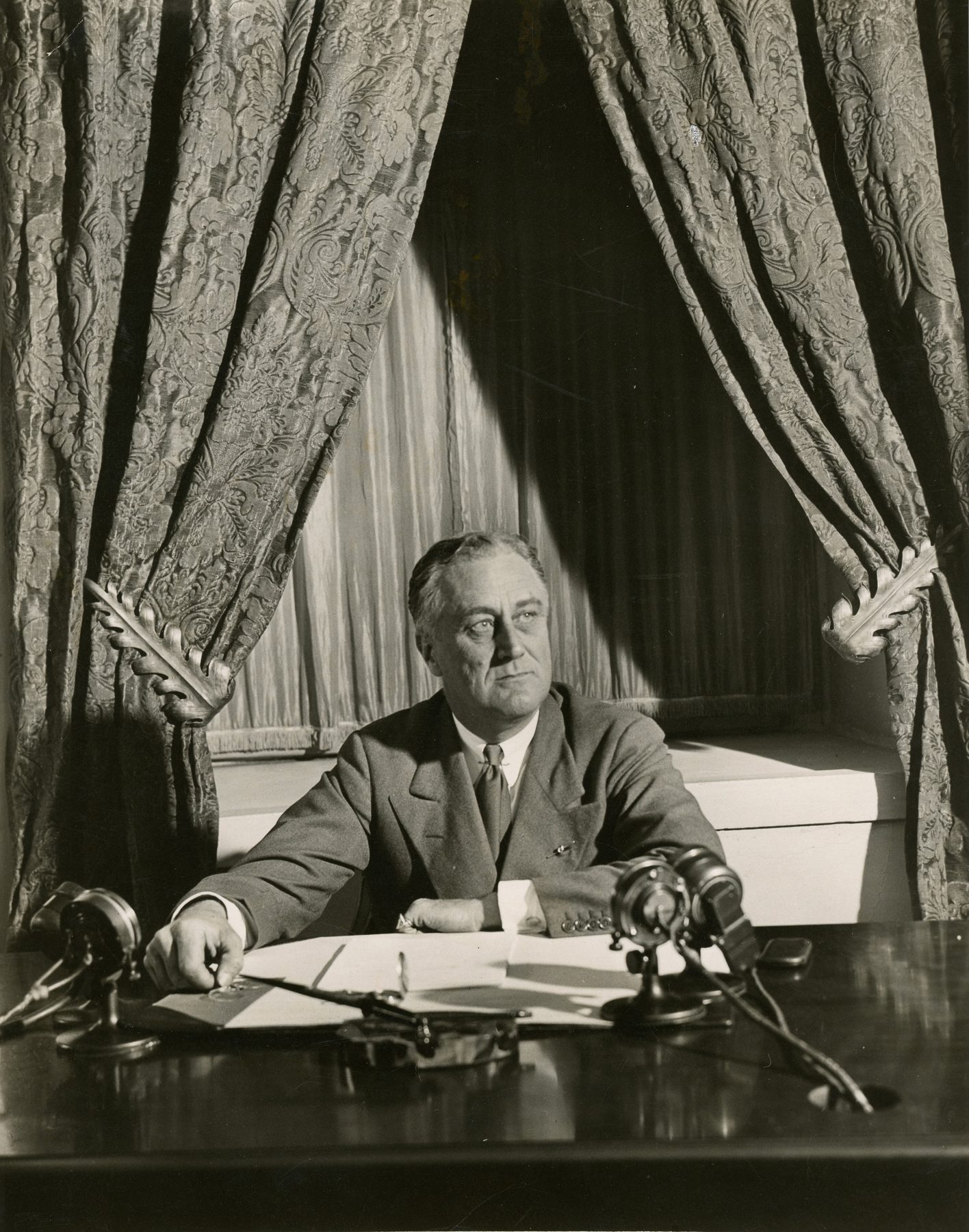
The coalition that elected him held two groups pulling in opposite directions. In Northern cities, Black voters began leaving the Republican Party because local Democratic organizations and New Deal relief programs reached them. In 1934 Arthur W. Mitchell of Chicago became the first Black Democrat elected to Congress history.house.gov. In the South, Democrats held enough power to shape or stop New Deal laws. The House Historian records that Southern Democrats narrowed the benefits of Social Security, worked in the House Rules Committee so that the Fair Labor Standards Act of 1938 excluded agricultural, domestic and service workers, and obstructed antilynching bills in the late 1930s and early 1940s history.house.gov. Senator Richard Russell of Georgia, leader of the Senate's Southern Caucus, used the filibuster to defeat bills banning lynching and abolishing the poll tax senate.gov.
War and the water's edge
On January 10, 1945, Senator Arthur Vandenberg of Michigan, the unofficial spokesman of Senate Republicans on foreign policy and a former isolationist, told the Senate he had changed his view senate.gov. The Senate approved the United Nations Charter on July 28, 1945, by 89 to 2 senate.gov. As chairman of the Foreign Relations Committee from 1947, Vandenberg called for stopping "partisan politics at the water's edge" and worked with the Truman administration on the Truman Doctrine, the Marshall Plan and NATO senate.gov.
"I believe that it must be the policy of the United States to support free peoples who are resisting attempted subjugation by armed minorities or by outside pressures." presidency.ucsb.edu
Harry S. Truman, Democratic president, message to Congress on Greece and Turkey, March 12, 1947
"But I do not believe that any nation hereafter can immunize itself by its own exclusive action." senate.gov
Arthur H. Vandenberg, Republican senator from Michigan, Senate floor, January 10, 1945
1948: the party splits over civil rights
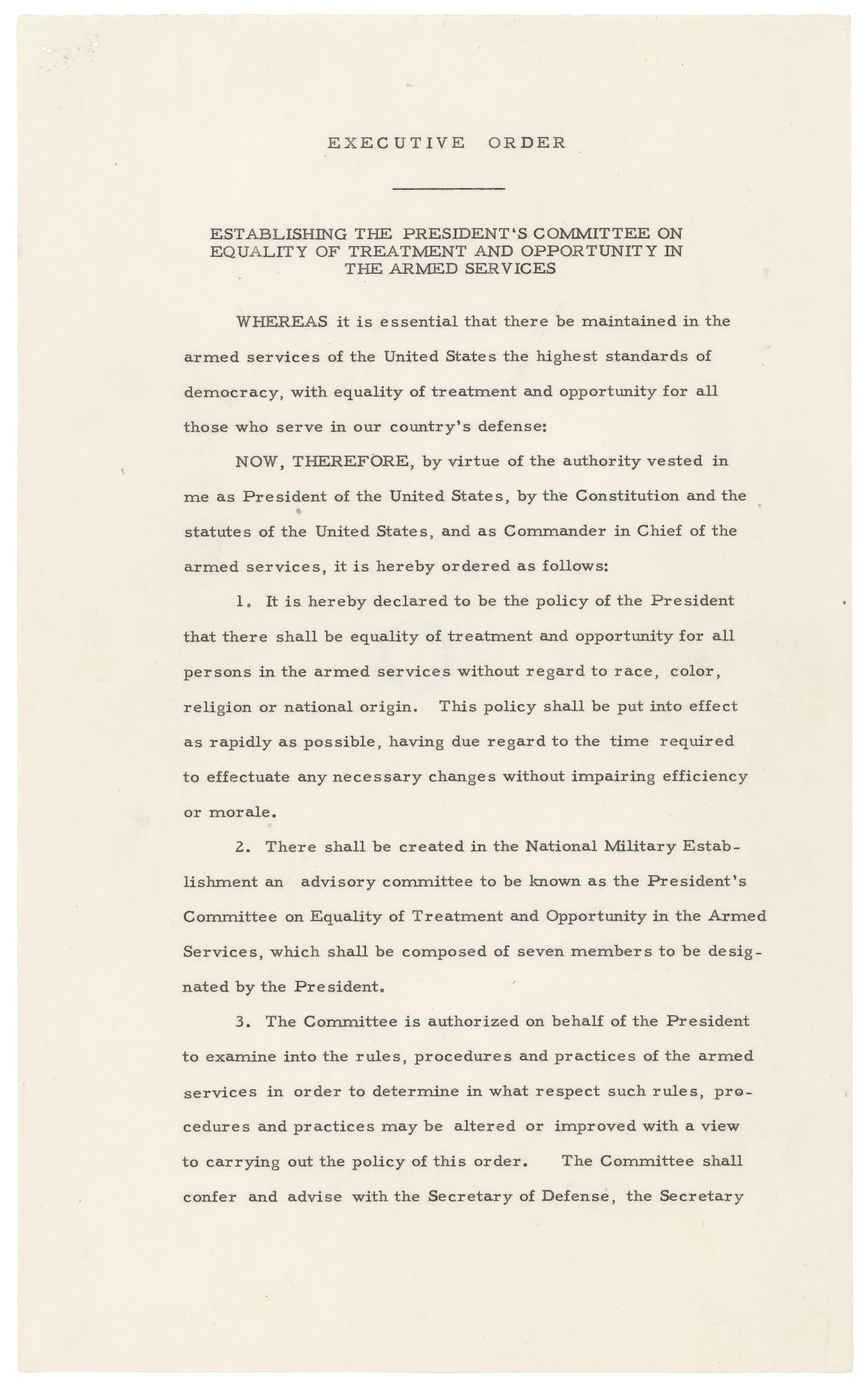
In February 1948 Truman asked Congress for civil rights legislation. When Southern senators threatened a filibuster, he used executive power. On July 26, 1948, he signed Executive Order 9981, which required "equality of treatment and opportunity for all persons in the armed forces without regard to race, color, religion, or national origin" archives.gov.
At the Democratic convention in Philadelphia that July, Hubert Humphrey, the mayor of Minneapolis, spoke for the civil rights program in the party platform www2.mnhs.org. The Republicans had adopted their platform a month earlier presidency.ucsb.edu.
"To those who say that this civil rights program is an infringement on States' Rights, I say this, that the time has arrived in America for the Democratic Party to get out of the shadows of States' Rights and to walk forthrightly into the bright sunshine of human rights." www2.mnhs.org
Hubert H. Humphrey, Democratic mayor of Minneapolis, Democratic National Convention, Philadelphia, July 14, 1948
"Lynching or any other form of mob violence anywhere is a disgrace to any civilized state, and we favor the prompt enactment of legislation to end this infamy." presidency.ucsb.edu
Republican Party Platform of 1948, adopted June 21, 1948
The final Democratic platform commended Truman "for his courageous stand on the issue of civil rights" presidency.ucsb.edu. The States' Rights Democratic Party, known as the Dixiecrats, nominated Governor Strom Thurmond of South Carolina senate.gov. Its platform, dated August 14, 1948, condemned "the action of the Democratic Convention in sponsoring a civil rights program" and said presidency.ucsb.edu:
"We stand for the segregation of the races and the racial integrity of each race." presidency.ucsb.edu
Platform of the States' Rights Democratic Party, August 14, 1948
Truman won with 303 electoral votes to 189 for Thomas Dewey. Thurmond won 39: Alabama, Louisiana, Mississippi, South Carolina and one elector in Tennessee archives.gov.
Brown and the Southern Manifesto
On May 17, 1954, Chief Justice Earl Warren delivered the Court's unanimous decision in Brown v. Board of Education tile.loc.govarchives.gov:
"We conclude that in the field of public education the doctrine of "separate but equal" has no place. Separate educational facilities are inherently unequal." tile.loc.gov
Chief Justice Earl Warren, opinion of the Court, Brown v. Board of Education, May 17, 1954
On March 12, 1956, Representative Howard Smith of Virginia, chairman of the House Rules Committee, introduced the "Declaration of Constitutional Principles," known as the Southern Manifesto. It was signed by 82 representatives and 19 senators, all from states of the former Confederacy, and urged Southerners to use all "lawful means" to resist school desegregation history.house.gov. Thurmond, by then a senator, signed it, and Russell co-authored it senate.govsenate.gov.
In September 1957 Governor Orval Faubus of Arkansas met President Dwight Eisenhower at Newport, Rhode Island, over the integration of Little Rock's Central High School. Ten days later Eisenhower sent federal troops to Little Rock and addressed the nation presidency.ucsb.edu.
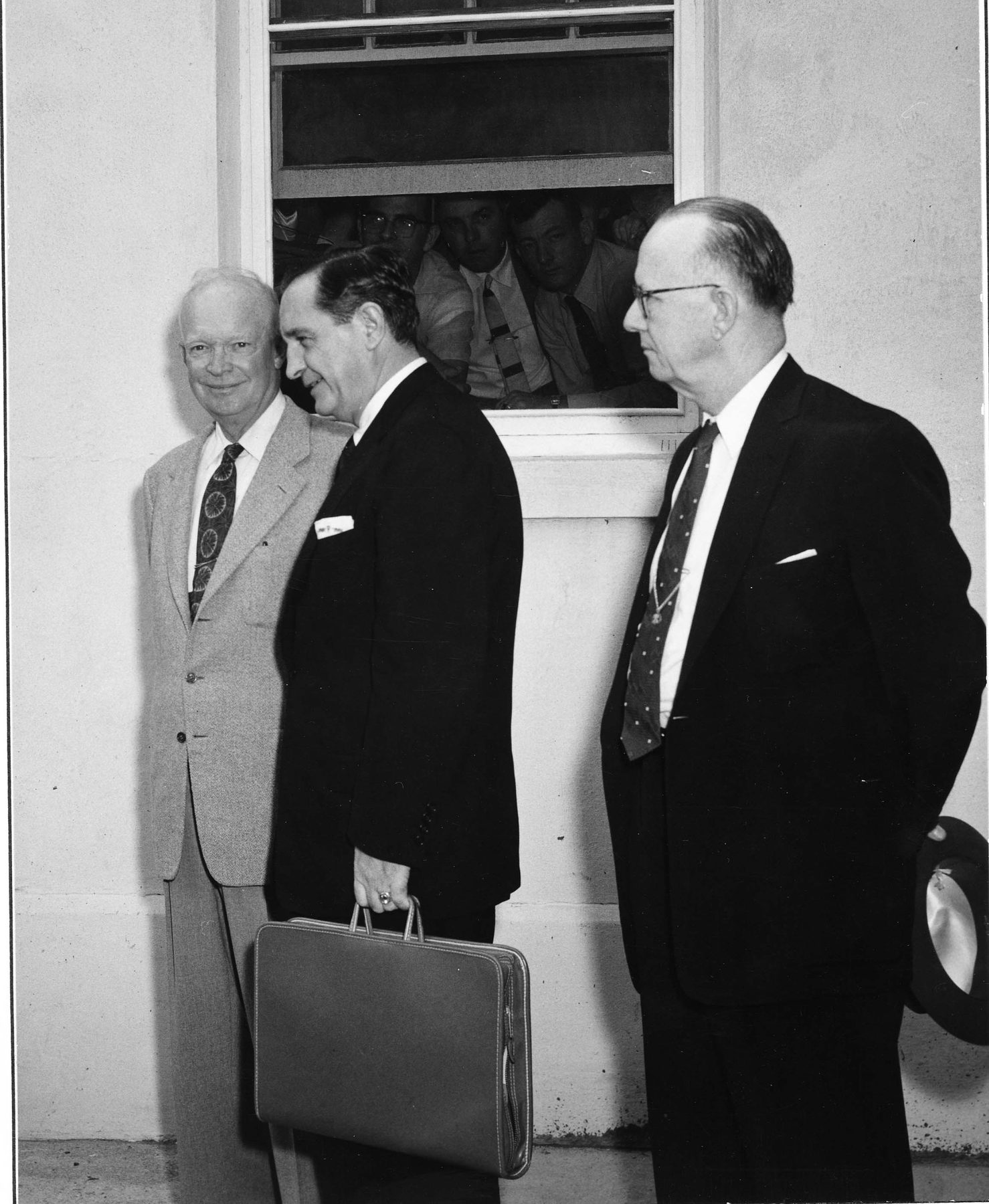
"Mob rule cannot be allowed to override the decisions of our courts," Eisenhower said on September 24, 1957 presidency.ucsb.edu. That year Thurmond spoke for 24 hours and 18 minutes against the Civil Rights Act of 1957, then a Senate record. The act passed the next day senate.gov.
1963 to 1965: the votes
On January 14, 1963, George Wallace was inaugurated governor of Alabama in Montgomery. The Alabama Department of Archives and History records his words: "and I say...segregation now...segregation tomorrow...segregation forever" archives.alabama.gov.
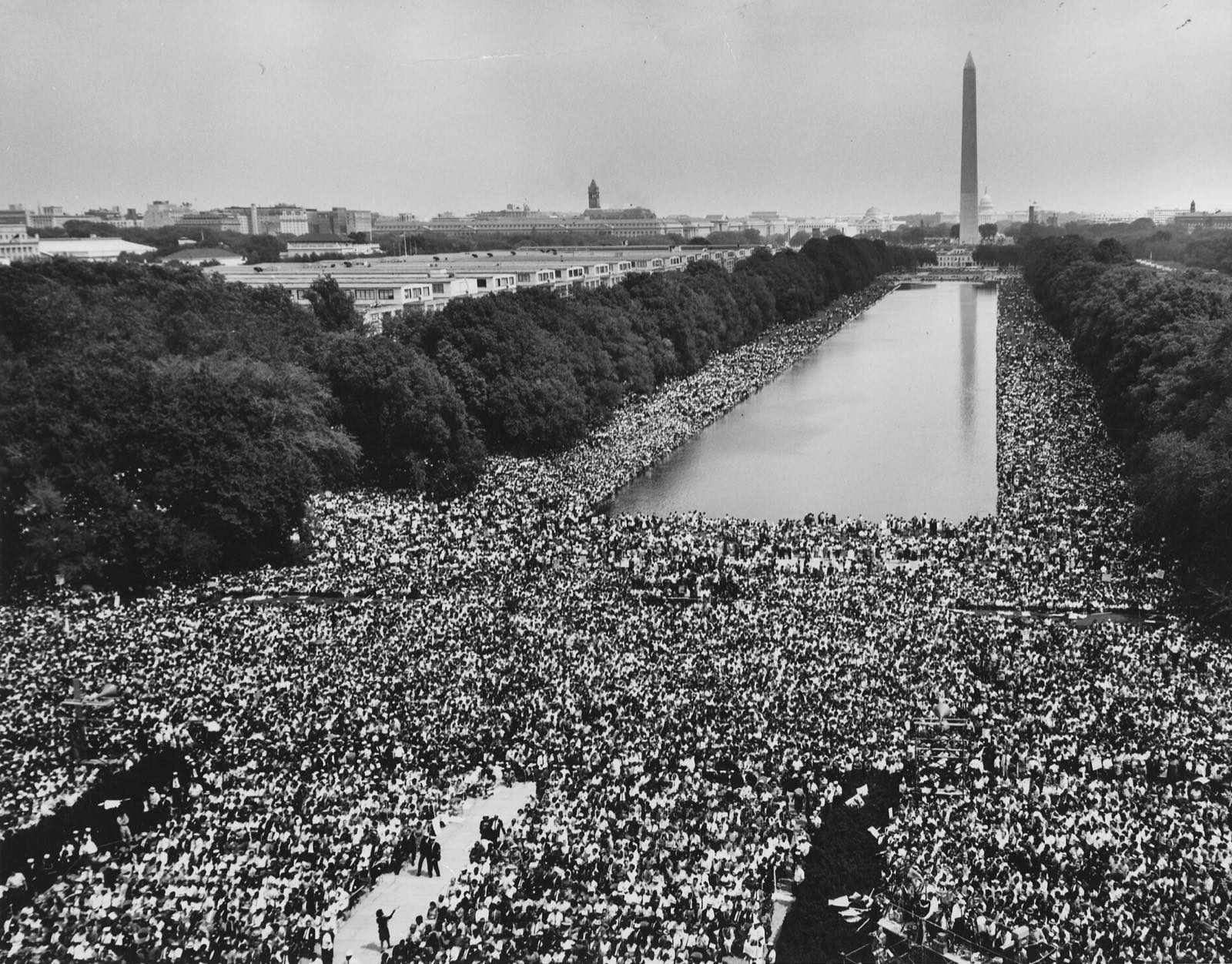
On June 11, 1963, President John F. Kennedy told the country on television: "We are confronted primarily with a moral issue. It is as old as the scriptures and is as clear as the American Constitution" presidency.ucsb.edu. On August 28, 1963, the March on Washington for jobs and civil rights took place in the capital catalog.archives.gov.
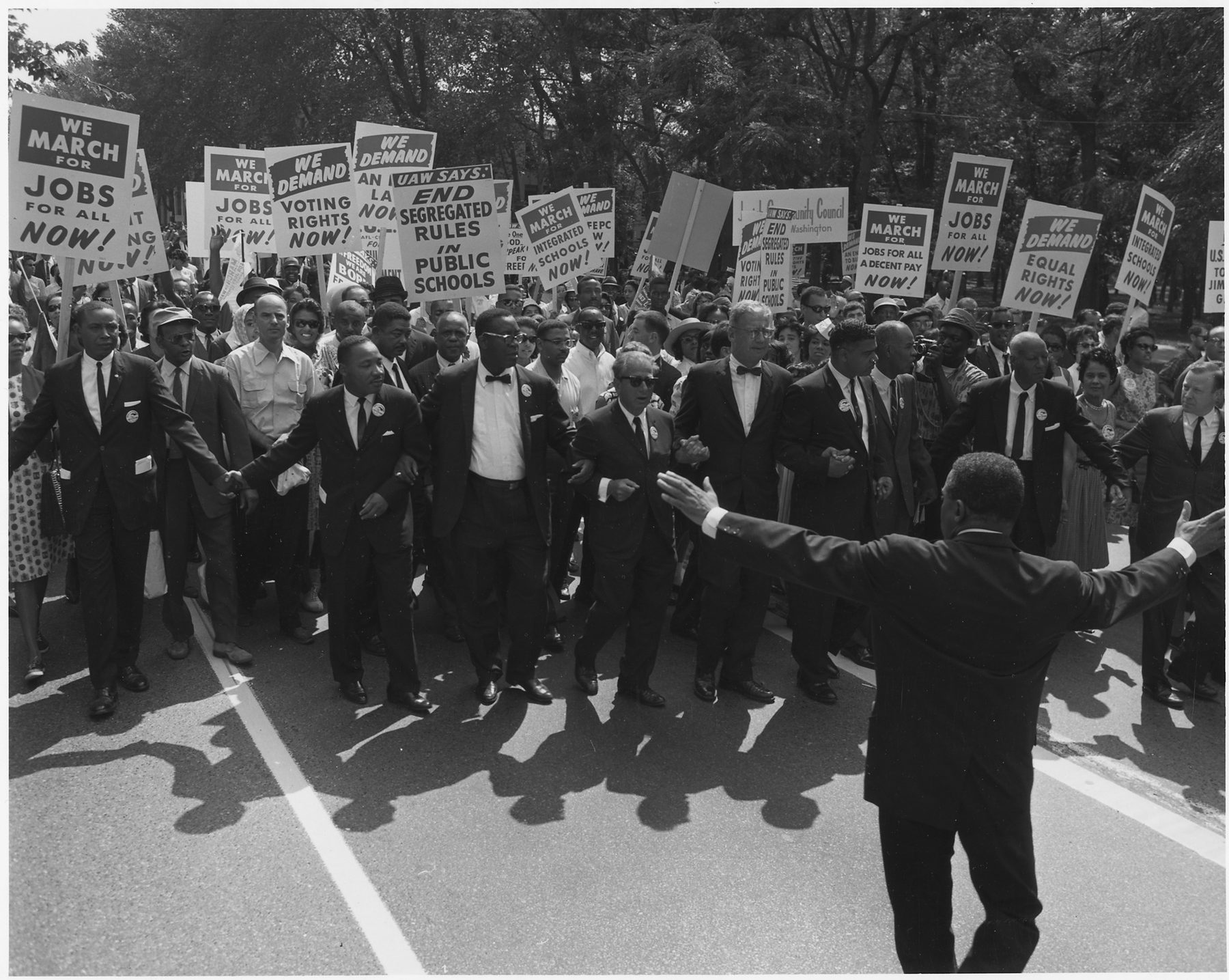
Kennedy was killed in November 1963, and his proposal became the Civil Rights Act of 1964 archives.gov. The House passed it on February 10, 1964, by 290 to 130 voteview.com. In the Senate the managers were the majority whip, Hubert Humphrey, and the Republican whip, Thomas Kuchel. Minority Leader Everett Dirksen of Illinois enlisted the Republican votes that made cloture possible senate.gov. On June 10, the last morning of the debate, both sides spoke.
For the bill:
"The question is whether we will have two types of citizenship in this Nation, or first-class citizenship for all." govinfo.gov
Hubert H. Humphrey, Democratic senator from Minnesota, Senate floor, June 10, 1964
"Stronger than all the armies is an idea whose time has come. ... The time has come for equality of opportunity in sharing in government, in education, and in employment. It will not be stayed or denied. It is here!" senate.gov
Everett Dirksen, Republican minority leader from Illinois, Senate floor, June 10, 1964
Against the bill:
"No, Mr. President, equal rights in this land of ours means that each citizen has an equal opportunity to acquire property through honest means, that once that property has been acquired he has a right to exercise dominion over it." govinfo.gov
Richard B. Russell, Democratic senator from Georgia, Senate floor, June 10, 1964
"I find no constitutional basis for the exercise of Federal regulatory authority in either of these areas; and I believe the attempted usurpation of such power to be a grave threat to the very essence of our basic system of government." govinfo.gov
Barry Goldwater, Republican senator from Arizona, Senate floor, June 18, 1964
Russell also told the Senate, "I know, and all other Members of the Senate know, that the bill has been drafted in such a way that its greatest impact will be on the States of the old Confederacy" govinfo.gov. Goldwater's two objections were Title II, public accommodations, and Title VII, employment. In the same speech he said, "I am unalterably opposed to discrimination or segregation on the basis of race, color, or creed," and that he had voted for the civil rights acts of 1957 and 1960 govinfo.gov.
The Senate passed the bill on June 19, 1964, by 73 to 27 voteview.com. On July 2 the House accepted the Senate version, 289 to 126, and Johnson signed it a few hours later history.house.gov.
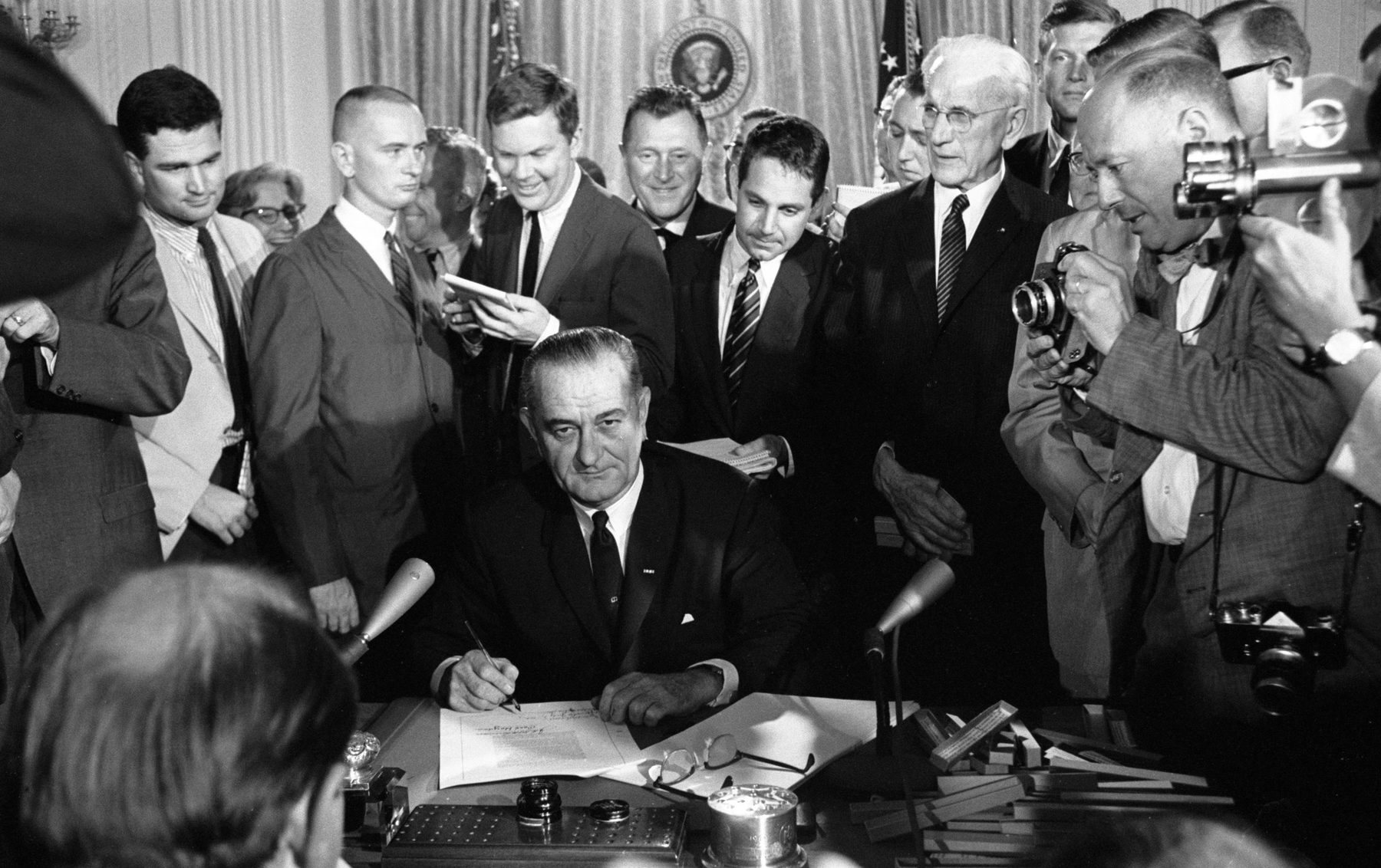
"We believe that all men are created equal. Yet many are denied equal treatment," Johnson said at the signing presidency.ucsb.edu.
The next year brought the vote itself. On March 15, 1965, after the violence against marchers in Selma, Alabama, Johnson spoke to a joint session of Congress presidency.ucsb.eduhistory.house.gov: "There is no constitutional issue here. The command of the Constitution is plain. ... There is no issue of States rights or national rights. There is only the struggle for human rights" presidency.ucsb.edu. The Senate passed the Voting Rights Act on May 26, 1965, by 77 to 19, the House on July 9 by 333 to 85, and the House approved the final version 328 to 74 on August 3 voteview.comhistory.house.gov. Johnson signed it on August 6, 1965. It outlawed literacy tests as a requirement for voting archives.gov.
1964: Goldwater, Reagan and the conservative movement
Goldwater won the Republican nomination and accepted it in San Francisco on July 16, 1964: "I would remind you that extremism in the defense of liberty is no vice. And let me remind you also that moderation in the pursuit of justice is no virtue" presidency.ucsb.edu. On October 27, Ronald Reagan gave a televised address for him, "A Time for Choosing" presidency.ucsb.edu. Reagan used a phrase Roosevelt had used in 1936.
"There is a mysterious cycle in human events. To some generations much is given. Of other generations much is expected. This generation of Americans has a rendezvous with destiny." presidency.ucsb.edu
Franklin D. Roosevelt, Democratic president, acceptance of renomination, Philadelphia, June 27, 1936
"You and I are told increasingly that we have to choose between a left or right, but I would like to suggest that there is no such thing as a left or right. ... You and I have a rendezvous with destiny." presidency.ucsb.edu
Ronald Reagan, Republican, televised address for Barry Goldwater, October 27, 1964
Johnson carried 44 states and the District of Columbia. Goldwater carried six states, five of them in the South archives.gov.
Riots and "law and order"
On July 28, 1967, Johnson created the National Advisory Commission on Civil Disorders, known as the Kerner Commission, to answer three questions: What happened? Why did it happen? What can be done to prevent it from happening again ojp.gov? It reported that of 164 disorders in the first nine months of 1967, 8 were major, 33 serious and 123 minor, and that in 75 disorders studied by a Senate subcommittee, 83 deaths were reported, 82 percent of them in Newark and Detroit ojp.gov. Its basic conclusion: "Our Nation is moving toward two societies, one black, one white," the report said, "separate and unequal" ojp.gov.
In 1968 both nominees spoke about order.
"We do not want a police state but we need a state of law and order, and neither mob violence nor police brutality have any place in America." presidency.ucsb.edu
Hubert H. Humphrey, Democratic nominee, acceptance speech, Chicago, August 29, 1968
"And to those who say that law and order is the code word for racism, there and here is a reply: Our goal is justice for every American. If we are to have respect for law in America, we must have laws that deserve respect." presidency.ucsb.edu
Richard M. Nixon, Republican nominee, acceptance speech, Miami Beach, August 8, 1968
Nixon also said that night that "the first civil right of every American is to be free from domestic violence" presidency.ucsb.edu. He won 301 electoral votes, Humphrey 191. George Wallace, running for the American Independent Party, received 9,906,473 popular votes and 46 electoral votes: Alabama, Arkansas, Georgia, Louisiana, Mississippi and one elector in North Carolina archives.gov.
Religion in this era
Catholics and the presidency. On September 12, 1960, Senator John F. Kennedy, a Catholic, spoke to the Greater Houston Ministerial Association, a group of Protestant ministers presidency.ucsb.edu. Six years earlier, President Eisenhower had signed the law adding "under God" to the Pledge of Allegiance presidency.ucsb.edu.
"I am not the Catholic candidate for President. I am the Democratic Party's candidate for President who happens also to be a Catholic." presidency.ucsb.edu
John F. Kennedy, Democratic nominee, Greater Houston Ministerial Association, September 12, 1960
"In this way we are reaffirming the transcendence of religious faith in America's heritage and future; in this way we shall constantly strengthen those spiritual weapons which forever will be our country's most powerful resource, in peace or in war." presidency.ucsb.edu
Dwight D. Eisenhower, Republican president, statement on signing the bill adding "under God" to the Pledge, June 14, 1954
Black churches. The Southern Christian Leadership Conference was founded in 1957, after the Montgomery bus boycott, when Martin Luther King Jr. invited Southern Black ministers to a meeting at Ebenezer Baptist Church in Atlanta. Under King it drew on the power and independence of Black churches kinginstitute.stanford.edu.
Clergy and the 1964 act. On June 10, 1964, Senator Russell objected on the floor that "cardinals, bishops, elders, stated clerks, common preachers, priests, and rabbis" had come to Washington to press for the bill and had sought to make its passage "a great moral issue" govinfo.gov.
Islam and the Nation of Islam. Malcolm X joined the Nation of Islam in prison and became a minister under Elijah Muhammad after his release in 1952; by the late 1950s he was its leading spokesman. He broke with the Nation of Islam in the spring of 1964, made a pilgrimage to Mecca, and met King for the only time in the Capitol during the Senate debate on the Civil Rights Act. He was assassinated on February 21, 1965 kinginstitute.stanford.edu.
School prayer. On June 25, 1962, in Engel v. Vitale, the Supreme Court struck down a prayer composed by New York's Board of Regents: "Almighty God, we acknowledge our dependence upon Thee, and we beg Thy blessings upon us, our parents, our teachers and our Country." Justice Black wrote that "it is no part of the business of government to compose official prayers for any group of the American people to recite as a part of a religious program carried on by government." Justice Stewart dissented: "I cannot see how an 'official religion' is established by letting those who want to say a prayer say it." Justices Frankfurter and White took no part tile.loc.gov. On June 17, 1963, in Abington School District v. Schempp, the Court held that no state law or school board may require Bible reading or recitation of the Lord's Prayer at the start of the school day tile.loc.gov.
Immigration. In 1965 Congress passed the Immigration and Nationality Act, which eliminated national quotas. In the years that followed, immigrants from China, India, Japan and the Philippines reshaped the country's demographics history.house.gov.
Evidence
Roll calls on the two acts, by party and region. "South" means the 11 states of the former Confederacy (Alabama, Arkansas, Florida, Georgia, Louisiana, Mississippi, North Carolina, South Carolina, Tennessee, Texas, Virginia). The counts include only members recorded yea or nay, and the totals match the official tallies voteview.com.
| Vote | Total | Southern Democrats | Other Democrats | Southern Republicans | Other Republicans |
|---|---|---|---|---|---|
| Civil Rights Act, House passage, Feb. 10, 1964 | 290 to 130 | 7 to 86 | 145 to 10 | 0 to 10 | 138 to 24 |
| Civil Rights Act, Senate cloture, June 10, 1964 | 71 to 29 | 1 to 20 | 43 to 3 | 0 to 1 | 27 to 5 |
| Civil Rights Act, Senate passage, June 19, 1964 | 73 to 27 | 1 to 20 | 45 to 1 | 0 to 1 | 27 to 5 |
| Civil Rights Act, House final, July 2, 1964 | 289 to 126 | 8 to 83 | 145 to 8 | 0 to 11 | 136 to 24 |
| Voting Rights Act, Senate passage, May 26, 1965 | 77 to 19 | 3 to 17 | 44 to 0 | 0 to 2 | 30 to 0 |
| Voting Rights Act, House passage, July 9, 1965 | 333 to 85 | 22 to 61 | 199 to 1 | 1 to 15 | 111 to 8 |
| Voting Rights Act, House final, Aug. 3, 1965 | 328 to 74 | 28 to 54 | 190 to 0 | 4 to 11 | 106 to 9 |
| Voting Rights Act, Senate final, Aug. 4, 1965 | 79 to 18 | 4 to 16 | 45 to 1 | 0 to 1 | 30 to 0 |
By party alone, House Democrats voted 152 to 96 for the 1964 act on February 10 and House Republicans 138 to 34 voteview.com. By region alone, members from the former Confederacy voted 7 to 96; everyone else voted 283 to 34 voteview.com.
Presidential results that bracket the era, from the National Archives archives.gov:
- 1932: Roosevelt 472, Hoover 59.
- 1936: Roosevelt 523, Landon 8.
- 1948: Truman 303, Dewey 189, Thurmond 39.
- 1964: Johnson 486, Goldwater 52.
- 1968: Nixon 301, Humphrey 191, Wallace 46.
What the evidence does not show
Roll calls record how members voted, not why. The speeches quoted here are the reasons members gave on the floor.
The regional totals do not show that every member from outside the South supported civil rights, or that every Southern member opposed it. The tables list the exceptions in both directions.
Party labels in this era did not line up with ideology the way they do now. In 1964 the Democratic Party included both Hubert Humphrey and Richard Russell, and the Republican Party included both Everett Dirksen and Barry Goldwater.
The House Historian's essay on the 1965 Immigration and Nationality Act names the countries immigrants came from. It does not give their religions, so this chapter does not state them.
Sources
- U.S. Senate, "Civil Rights Filibuster Ended," June 10, 1964. senate.gov (locator: full page). Accessed 2026-10-30.
- Jeffrey B. Lewis, Keith Poole, Howard Rosenthal, Adam Boche, Aaron Rudkin and Luke Sonnet, Voteview: Congressional Roll-Call Votes Database, UCLA, roll call and member files for the 88th and 89th Congresses. voteview.com and voteview.com (also S088, H089, S089) (locator: House 88th rolls 128 and 182; Senate 88th rolls 302 and 409; House 89th rolls 87 and 107; Senate 89th rolls 78 and 178; region counted by member state, yea and nay only). Accessed 2026-10-30.
- National Archives, "Civil Rights Act (1964)," Milestone Documents. archives.gov (locator: summary). Accessed 2026-10-30.
- Office of the Historian, U.S. House of Representatives, "The Civil Rights Act of 1964," Historical Highlights, July 2, 1964. history.house.gov (locator: full entry). Accessed 2026-10-30.
- U.S. Senate, "Senators Who Changed Parties During Senate Service (Since 1890)." senate.gov (locator: entry for J. Strom Thurmond). Accessed 2026-10-30.
- U.S. Senate, "Strom Thurmond: A Featured Biography." senate.gov (locator: full page). Accessed 2026-10-30.
- Congressional Record, Senate, June 18, 1964, vol. 110, pp. 14318 to 14319 (Goldwater statement). govinfo.gov (locator: p. 14319). Accessed 2026-10-30.
- National Archives, Electoral College results, 1932, 1936, 1948, 1964, 1968. archives.gov, archives.gov, archives.gov, archives.gov, archives.gov (locator: results and state tables). Accessed 2026-10-30.
- Franklin D. Roosevelt, "Address Accepting the Presidential Nomination at the Democratic National Convention in Chicago," July 2, 1932, The American Presidency Project. presidency.ucsb.edu (locator: full text). Accessed 2026-10-30.
- Herbert Hoover, "Address at Madison Square Garden in New York City," October 31, 1932, The American Presidency Project. presidency.ucsb.edu (locator: opening and section on liberalism). Accessed 2026-10-30.
- Office of the Historian, U.S. House of Representatives, "The 'Fulfillment of White's Prophecy,'" Black Americans in Congress. history.house.gov (locator: sections on De Priest, Mitchell and Southern Democrats). Accessed 2026-10-30.
- U.S. Senate, "Richard Russell: A Featured Biography." senate.gov (locator: full page). Accessed 2026-10-30.
- U.S. Senate, "Arthur H. Vandenberg, American Foreign Policy, January 10, 1945," Classic Senate Speeches. senate.gov (locator: introduction and final paragraph). Accessed 2026-10-30.
- U.S. Senate, "Arthur Vandenberg: A Featured Biography." senate.gov (locator: full page). Accessed 2026-10-30.
- Harry S. Truman, "Special Message to the Congress on Greece and Turkey: The Truman Doctrine," March 12, 1947, The American Presidency Project. presidency.ucsb.edu (locator: full text). Accessed 2026-10-30.
- Arthur H. Vandenberg, "American Foreign Policy," Senate speech, January 10, 1945, U.S. Senate. senate.gov (locator: section "Our Oceans Have Ceased to Be Moats"). Accessed 2026-10-30.
- National Archives, "Executive Order 9981: Desegregation of the Armed Forces (1948)," Milestone Documents. archives.gov (locator: summary). Accessed 2026-10-30.
- Hubert H. Humphrey, speech on civil rights, Democratic National Convention, July 14, 1948, Hubert H. Humphrey Papers, Minnesota Historical Society, including the text from the Official Proceedings of the Democratic National Convention, p. 192. www2.mnhs.org (locator: Official Proceedings p. 192). Accessed 2026-10-30.
- "Republican Party Platform of 1948," June 21, 1948, The American Presidency Project. presidency.ucsb.edu (locator: civil rights section). Accessed 2026-10-30.
- "1948 Democratic Party Platform," July 12, 1948, The American Presidency Project. presidency.ucsb.edu (locator: civil rights section). Accessed 2026-10-30.
- "Platform of the States Rights Democratic Party," August 14, 1948, The American Presidency Project. presidency.ucsb.edu (locator: full text). Accessed 2026-10-30.
- Brown v. Board of Education of Topeka, 347 U.S. 483 (1954), United States Reports, Library of Congress. tile.loc.gov (locator: syllabus and opinion of the Court). Accessed 2026-10-30.
- National Archives, "Brown v. Board of Education (1954)," Milestone Documents. archives.gov (locator: summary). Accessed 2026-10-30.
- Office of the Historian, U.S. House of Representatives, "The Southern Manifesto of 1956," Historical Highlights, March 12, 1956. history.house.gov (locator: full entry). Accessed 2026-10-30.
- Dwight D. Eisenhower, "Radio and Television Address to the American People on the Situation in Little Rock," September 24, 1957, The American Presidency Project. presidency.ucsb.edu (locator: full text); photograph, National Archives, NAID 7865613, catalog.archives.gov. Accessed 2026-10-30.
- Alabama Department of Archives and History, "Inaugural address of Governor George Wallace, which was delivered at the Capitol in Montgomery, Alabama," January 14, 1963. archives.alabama.gov (locator: item description). Accessed 2026-10-30.
- John F. Kennedy, "Radio and Television Report to the American People on Civil Rights," June 11, 1963, The American Presidency Project. presidency.ucsb.edu (locator: full text). Accessed 2026-10-30.
- Congressional Record, Senate, June 10, 1964, vol. 110, pp. 13308 to 13310 (Russell and Humphrey before the cloture vote). govinfo.gov (locator: pp. 13308 to 13310). Accessed 2026-10-30.
- Congressional Record, Senate, June 18, 1964, vol. 110, pp. 14318 to 14319 (Goldwater, "Civil Rights"). govinfo.gov (locator: pp. 14318 to 14319). Accessed 2026-10-30.
- Lyndon B. Johnson, "Radio and Television Remarks Upon Signing the Civil Rights Bill," July 2, 1964, The American Presidency Project. presidency.ucsb.edu (locator: full text). Accessed 2026-10-30.
- Lyndon B. Johnson, "Special Message to the Congress: The American Promise," March 15, 1965, The American Presidency Project. presidency.ucsb.edu (locator: full text). Accessed 2026-10-30.
- Office of the Historian, U.S. House of Representatives, "The Voting Rights Act of 1965," Historical Highlights, August 3, 1965. history.house.gov (locator: full entry). Accessed 2026-10-30.
- National Archives, "Voting Rights Act (1965)," Milestone Documents. archives.gov (locator: summary). Accessed 2026-10-30.
- Barry Goldwater, "Address Accepting the Presidential Nomination at the Republican National Convention in San Francisco," July 16, 1964, The American Presidency Project. presidency.ucsb.edu (locator: closing section). Accessed 2026-10-30.
- Ronald Reagan, "Address on Behalf of Senator Barry Goldwater: 'A Time for Choosing,'" October 27, 1964, The American Presidency Project. presidency.ucsb.edu (locator: full text). Accessed 2026-10-30.
- Franklin D. Roosevelt, "Acceptance Speech for the Renomination for the Presidency, Philadelphia, Pa.," June 27, 1936, The American Presidency Project. presidency.ucsb.edu (locator: closing section). Accessed 2026-10-30.
- National Advisory Commission on Civil Disorders, Report of the National Advisory Commission on Civil Disorders (U.S. Government Printing Office, 1968), catalog record NCJ 8073, Office of Justice Programs. ojp.gov and full text at belonging.berkeley.edu (locator: Summary, Introduction and "Patterns of Disorder"). Accessed 2026-10-30.
- Hubert H. Humphrey, "Address Accepting the Presidential Nomination at the Democratic National Convention in Chicago," August 29, 1968, The American Presidency Project. presidency.ucsb.edu (locator: section on peace and justice in our cities). Accessed 2026-10-30.
- Richard M. Nixon, "Address Accepting the Presidential Nomination at the Republican National Convention in Miami Beach, Florida," August 8, 1968, The American Presidency Project. presidency.ucsb.edu (locator: section on law and order). Accessed 2026-10-30.
- John F. Kennedy, "Speech of Senator John F. Kennedy, Greater Houston Ministerial Association, Rice Hotel, Houston, TX," September 12, 1960, The American Presidency Project. presidency.ucsb.edu (locator: full text). Accessed 2026-10-30.
- Dwight D. Eisenhower, "Statement by the President Upon Signing Bill To Include the Words 'Under God' in the Pledge to the Flag," June 14, 1954, The American Presidency Project. presidency.ucsb.edu (locator: full text). Accessed 2026-10-30.
- Martin Luther King, Jr. Research and Education Institute, Stanford University, "Southern Christian Leadership Conference (SCLC)." kinginstitute.stanford.edu (locator: opening paragraphs). Accessed 2026-10-30.
- Martin Luther King, Jr. Research and Education Institute, Stanford University, "Malcolm X." kinginstitute.stanford.edu (locator: full entry). Accessed 2026-10-30.
- Engel v. Vitale, 370 U.S. 421 (1962), United States Reports, Library of Congress. tile.loc.gov (locator: syllabus; opinion of the Court; dissent of Justice Stewart). Accessed 2026-10-30.
- School District of Abington Township v. Schempp, 374 U.S. 203 (1963), United States Reports, Library of Congress. tile.loc.gov (locator: syllabus). Accessed 2026-10-30.
- Office of the Historian, U.S. House of Representatives, "Overturning Exclusion, Limiting Immigration," Asian and Pacific Islander Americans in Congress. history.house.gov (locator: caption and section on the 1965 act). Accessed 2026-10-30.
- National Archives, "Photograph of Leaders at the Head of the Civil Rights March on Washington, D.C.," August 28, 1963, Records of the U.S. Information Agency, NAID 542002. catalog.archives.gov (locator: catalog record). Accessed 2026-10-30.
Last checked against its sources on October 30, 2026. Report a correction.